To support its objective of advancing forest management practices in Europe with a focus on climate and biodiversity, the EU-funded ForestPaths project has published a new feature examining the current landscape of policies in the sector.
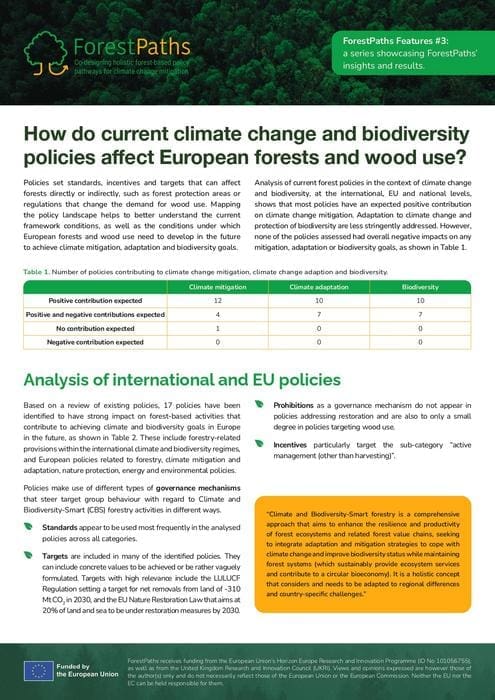
At a time when both environmental challenges and the measures addressing them are growing in scope and complexity, navigating the landscape of existing legislative initiatives is of key significance. Researchers involved in the ForestPaths project have come forward with a policy brief on how forests and wood use in Europe are affected by policies targeting climate change and biodiversity.
Co-funded under the European Commission’s Horizon Europe scheme, the project’s critical aim is to devise a balanced policy approach to forestry management that incorporates both climate mitigation and biodiversity. This effort is underpinned by a critical investigation into the governance of forest areas in Europe, which the aforementioned publication is an active contribution to.
Authored by the Oeko-Institute, this brief, within the context of the data reviewed by the authors, presents a substantial number of the investigated policies, which relate to climate change mitigation and forests. While boasting fewer measures tied to them, climate adaptation and biodiversity are also supported by several official acts at the international, EU and state levels. Notably, most of these policies are expected to have a positive contribution across the board and were found to be mostly synergetic or neutral and not opposing any of the three aspects.
As a next step, 17 core green initiatives have been singled out for their particularly prominent relation to the conditions of forests across the continent. Each of them is assigned to one of four critical climate mitigation aims – protection, management, restoration and wood use. This classification ultimately showcases a great variety in contemporary forestry policy-making with a particular emphasis on conservation, active management, afforestation and wood processing activities.
The policy brief’s findings were presented in the third publication in the ForestPaths Features series, which aims to present the initiative’s research outputs in an accessible manner.
***
ForestPaths (Co-designing Holistic Forest-based Policy Pathways for Climate Change Mitigation) receives funding from the European Union’s Horizon Europe Research and Innovation Programme (ID No 101056755), as well as from the United Kingdom Research and Innovation Council (UKRI). Views and opinions expressed are however those of the author(s) only and do not necessarily reflect those of the European Union or the European Commission. Neither the European Union nor the granting authority can be held responsible for them.
Article Source:
Press Release/Material by Pensoft Publishers
Featured image credit: wirestock | Freepik.com