A twin crisis faces the people of Myanmar, but while the war could end tomorrow, climate change will still shape the futures of millions.
Since the military seized power in a coup in February 2021, Myanmar has experienced a prolonged and intense conflict.
More than 5,000 civilians have been killed and 3.3 million displaced according to the latest report issued by the United Nations human rights office in September 2024.
Also, 27,400 people have been arrested, and numbers have been rising since the implementation of mandatory conscription (or enlistment for state service into the armed forces). The report was based on remote interviews with victims and witnesses because access was denied.
At the same time, with more than 5 million people living in low-lying and coastal regions, Myanmar is also one of the most vulnerable countries to climate change. Conflict and climate interact, further complicating both.
However, until now interactions between the two in this region are mainly under-studied.
Myanmar’s internally displaced communities are increasingly exposed to climate-related impacts. Growing resource extraction, often unregulated and facilitated by armed groups, have also degraded the environment and further increased communities’ vulnerability to climate change.
Due to the unstable electricity supply in Myanmar since the coup, the demand for charcoal for household cooking has increased, accelerating mangroves deforestation. Since mangroves provide a natural barrier against storm surges and cyclones, this deforestation increases Myanmar’s vulnerability to climate change.
Climate funding cut
The 2021 military coup and the subsequent conflict have also disrupted climate change adaptation and natural resource governance efforts. International funding for climate adaptation and resilience has also been cut off.
A recent study focused on reviewing the relationship between climate change and conflict shows that in addition to Myanmar, there are many overlooked regions where climate change has already intensified local conflicts but remains under-researched.
Instead, most research on this topic has focused on East and South-East Africa. This is justified by the significant vulnerabilities facing the Lake Chad Basin and the number of pastoral herder and other conflicts in the Horn of Africa.
However, different regions with significant vulnerabilities to climate change and prone to violent conflict, such as Myanmar, remain understudied.
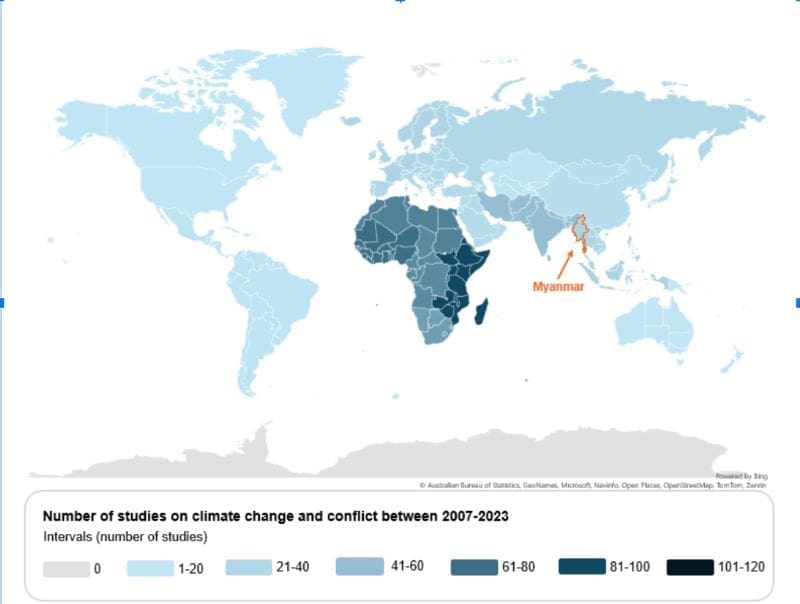
This phenomenon, sometimes referred to in the literature as the “streetlight effect“, may suggest that researchers tend to focus on areas for reasons of convenience. This can be problematic if case selection (and, therefore, knowledge production) is driven by convenience rather than practical relevance.
Climate change and violent conflict
The new study uncovers key insights into the critical and growing relationship between climate change and global conflict.
Climate change impacts – such as typhoons, floods, droughts, and coastal erosion – are increasing in frequency and intensity. These impacts have profound social, economic, and political consequences on coastal communities, particularly in Southeast Asia.
In Myanmar, Papua New Guinea and the Philippines, climate-induced stress is already exacerbating existing socio-political tensions, often leading to the outbreak or escalation of existing conflicts.
The study exposed significant knowledge gaps that directly shape Australia’s policy response.
Climate-driven instability in neighbouring countries could trigger regional security concerns, migration pressures and humanitarian crises. Key points from this review include how communities experience climate change and violent conflict and how climate impacts can exacerbate tensions and trigger violence.
The study also revealed that most of the reviewed climate change and conflict articles are in English. Many studies published in other languages are underrepresented in current databases, so we might be missing important perspectives and understanding of these situations.
Clearly, there is a significant gap regarding what’s happening in communities that are already affected by conflict and facing climate change impacts and how these double impacts could influence climate adaptation in the face of violent conflict.
There’s, in consequence, an urgent need to understand how to design better policies and projects that can help address these compounding crises in Myanmar and elsewhere in ways that work toward climate resilience and enduring peace.
***
Luisa F Bedoya Taborda is a lawyer and PhD student focused on climate change adaptation and peacebuilding in the School of Project Management, Faculty of Engineering at the University of Sydney, Australia.
Michele L Barnes is an Associate Professor and Research Leader focused on social dynamics and environmental change in the School of Project Management, Faculty of Engineering at the University of Sydney, Australia.
Luisa Fernanda Bedoya Taborda acknowledges funding support from the Australian Research Council Centre of Excellence for Coral Reef Studies and the College of Arts, Society, and Education at James Cook University.
Michele Barnes acknowledges funding support from the Australian Research Council through a Discovery Early Career Fellowship Grant (#DE190101583) and the Centre of Excellence Program (# CE140100020).
Originally published under Creative Commons by 360info™.
Journal Reference:
Bedoya Taborda, L.F., Barnes, M.L. and Morrison, T.H., ‘Adaptation and Peace: Extending the Agenda for Capacity-Building in Climate and Conflict-Affected Communities’, WIREs Climate Change 16, 1: e921 (2025). DOI: 10.1002/wcc.921
Article Source:
Press Release/Material by Luisa Bedoya Taborda and Michele Barnes | The University of Sydney
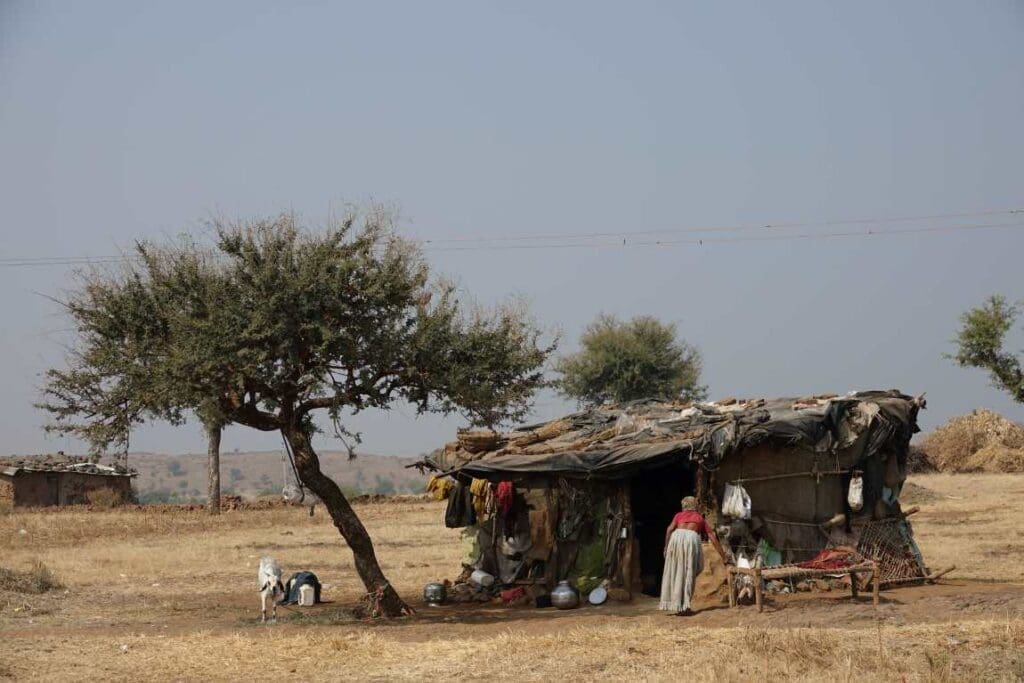
Featured image: A cow feeds near a river in Dawei, Myanmar. Myanmar is one of the most vulnerable countries to climate change. Credit: Isabel Retamales | Unsplash