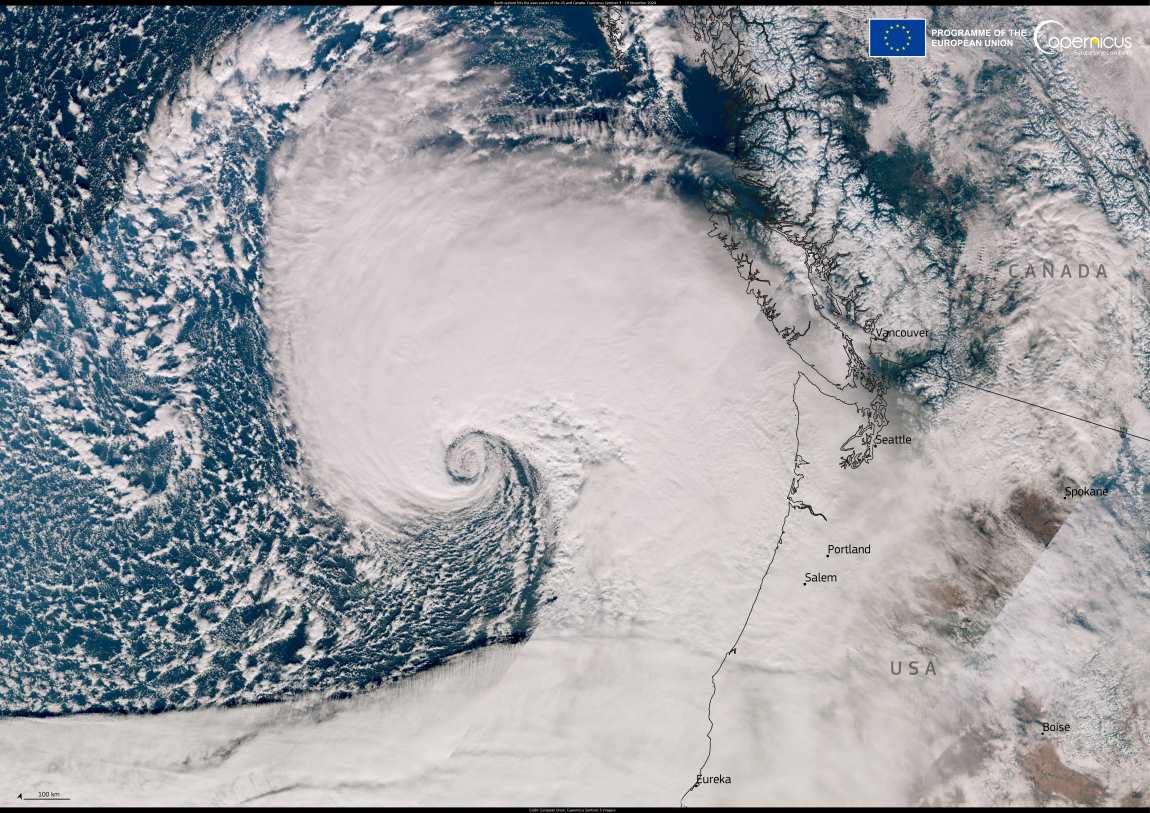
A powerful storm struck the Pacific Northwest region of the United States and British Columbia, Canada, on 19 November 2024, leaving 290,000 buildings without power and claiming at least two lives in Washington state. More than 70,000 people in British Columbia were also left without electricity.

The storm, called a “bomb cyclone” by weather enthusiasts, brought wind gusts of up to 124 km/h, followed by torrential rainfall that persisted for days, threatening the region with flooding, rockslides, and debris flows.

Bomb Cyclone USA res
US and Canada. Credit: European Union, Copernicus Sentinel-3 imagery

This Copernicus Sentinel-3 image shows the bomb cyclone as it approaches the west coasts of the US and Canada on 19 November.

Open data from the Copernicus Sentinel-3 satellites helps track the movement of cyclones and other tropical storms, providing key insights into extreme weather patterns.

Featured image credit: European Union, Copernicus Sentinel-3 imagery
European leaders meet to re-energise offshore wind powerNews

European leaders meet to re-energise offshore wind power

Odense, Denmark (AFP) - The countries bordering the North Sea meet in Denmark on Thursday to seal commitments to boost offshore wind power, a sector…
SourceSourceOctober 24, 2024 Full article
Tuvalu Coastal Adaptation Project
Can Australia repair its standing in the Pacific?News

Can Australia repair its standing in the Pacific?

By Wesley Morgan, UNSW in Sydney | 360info Long a regional laggard on climate action, Australia must convince Pacific leaders it's serious about moving away…
SourceSourceAugust 26, 2024 Full article
Image: Air quality patterns over parts of Europe
Image of the day: Air quality over Europe in early March 2025News

Image of the day: Air quality over Europe in early March 2025

A high-pressure system settled over Europe at the start of March 2025, influencing air quality across the continent. The weather conditions, which created stable atmospheric…
Muser NewsDeskMuser NewsDeskMarch 5, 2025 Full article