
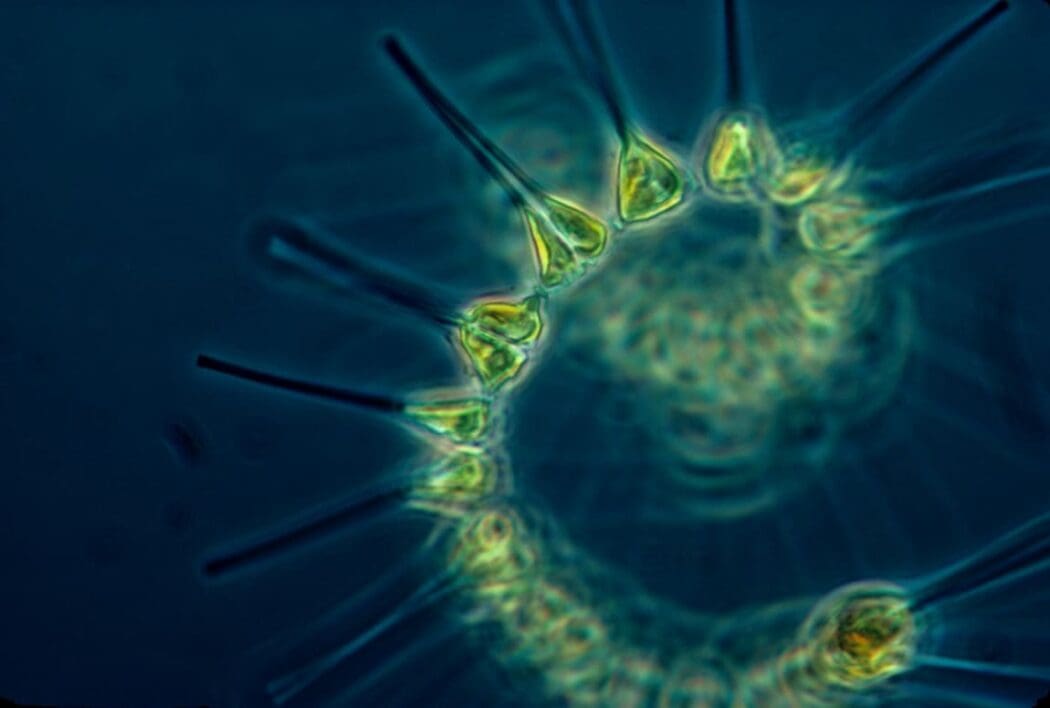
The eastern equatorial Atlantic Ocean is home to a vibrant marine ecosystem that thrives on the supply of nutrients from the deep ocean. At the heart of this productivity are intricate interactions between winds, currents, and daily solar heating, which bring life-sustaining nitrates to the surface.
Recent research, published in Nature Geoscience, has unveiled how these factors combine to fuel phytoplankton blooms, a critical foundation for the region’s rich biodiversity and marine food web.
In this article:

Complex drivers of phytoplankton bloom
GEOMAR – The eastern equatorial Atlantic supports a highly productive marine ecosystem dependent on the supply of nitrate-rich waters. Peak productivity occurs during the Northern Hemisphere summer, driven by intensified easterly winds.
These winds drive warm surface waters westward, allowing nutrient-rich deep waters to rise in the east. The Equatorial Undercurrent (EUC), a strong subsurface flow, transports cool, nutrient-laden waters eastward across the Atlantic. Seasonal wind patterns cause vertical oscillations of this current, while daily solar heating influences wind-driven mixing, further aiding nutrient transport.
“Our results highlight the complex interplay of wind forcing, currents and mixing in this ocean region,” says Professor Dr Peter Brandt, Professor of Experimental Oceanography at GEOMAR Helmholtz Centre for Ocean Research Kiel and lead author.
“Three distinct processes govern the nutrient supply at the equator: upwelling in the east driven by zonal winds, the vertical movement of the EUC, and wind-driven mixing modulated by the daily solar radiation cycle. These processes, each triggered by different aspects of the wind field, drive the upward transport of nutrients to the surface capable of triggering plankton blooms at the equator.”
Measurements and long-term data
To investigate these interactions, extensive measurements were taken during two research cruises with the German RV METEOR (M158 and M181). Data on temperature, salinity, nitrate concentration and current speeds were collected at various depths. Long-term observation data sets from equatorial moorings and Argo floats were also used.
“Turbulence measurements in the ocean are essential for understanding nutrient-supply processes,” explains Dr Mareike Körner, a former researcher at GEOMAR and now based at Oregon State University. “The turbulence data collected during our cruises, combined with similar data from moorings taken by our US collaborators, provided critical insight into the seasonal variations in nutrient mixing from the deeper ocean to the surface.”
Sensitive interactions between winds and currents
“The dynamics of the equatorial ocean are a finely tuned system of wind-driven processes,” says Peter Brandt. Even small changes, he warns, could disrupt this balance and have a significant impact: “Climate change could significantly alter this balance, impacting nutrient delivery to this crucial marine ecosystem and its productivity.”
Journal Reference:
Brandt, P., Körner, M., Moum, J. N., Roch, M., Subramaniam, A., Czeschel, R., Krahmann, G., Dengler, M., & Kiko, R., ‘Seasonal productivity of the equatorial Atlantic shaped by distinct wind-driven processes’, Nature Geoscience (2025). DOI: 10.1038/s41561-024-01609-9
Article Source:
Press Release/Material by Helmholtz Centre for Ocean Research Kiel (GEOMAR)
Featured image credit: NOAA | Unsplash