Summary:
Human-driven climate change is reshaping essential nutrient cycles in the ocean, according to a new study published in Proceedings of the National Academy of Sciences (PNAS).
Researchers from the University of California, Irvine, analyzed 50 years of global ocean data and found a significant decline in phosphorus levels in southern hemisphere waters. Phosphorus is vital for marine food webs, and its depletion could weaken plankton nutrition, potentially affecting fish growth. Surprisingly, nitrate levels, which were expected to decline, have remained stable.
The study provides the first field-based confirmation of how ocean warming alters nutrient distribution, challenging previous climate model predictions. The findings highlight the importance of long-term ocean monitoring programs like GO-SHIP, which provide critical empirical data to assess climate change’s impact on marine ecosystems.
The research is the first field-based confirmation of such climate impacts
Computer models reveal how human-driven climate change will dramatically overhaul critical nutrient cycles in the ocean. In the PNAS journal, University of California, Irvine researchers report evidence that marine nutrient cycles – essential for sustaining ocean ecosystems – are changing in unexpected ways as the planet continues to warm.
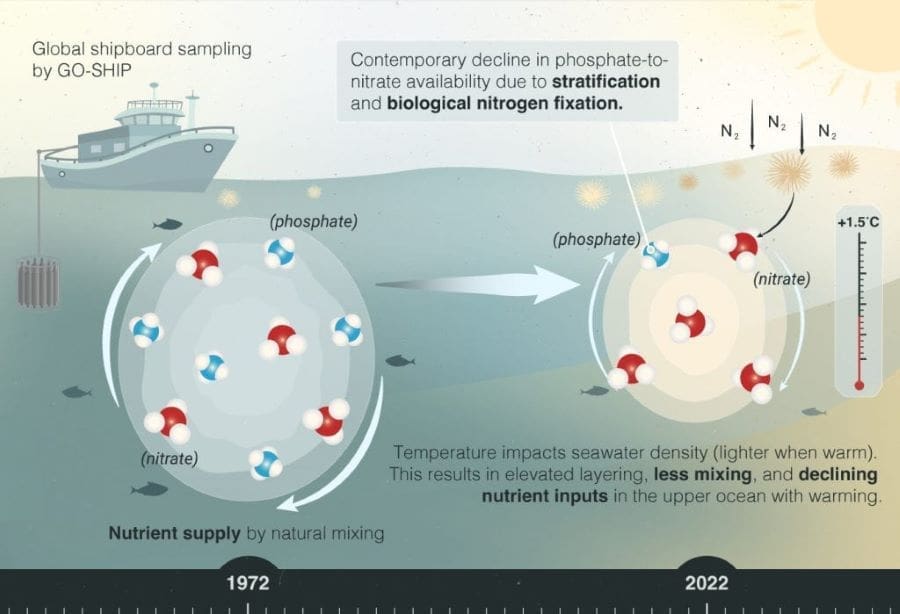
“Model studies have suggested that when the ocean warms it gets more stratified, which can drain certain parts of the surface ocean of nutrients,” said Adam Martiny, professor of Earth system science and ecology & evolutionary biology and one of the study’s lead authors. Although models suggest a connection between ocean temperatures and surface ocean nutrients, this is the first study to confirm climate change’s impacts on nutrient cycles.
The team, led by graduate student Skylar Gerace, analyzed 50 years of nutrient data from the ocean collected as part of the Global Ocean Ship-based Hydrographic Investigations Program (GO-SHIP). They discovered that over the last half-century, there’s been a major decline in phosphorus – a nutrient that plays a key role in the health of marine food webs – in southern hemisphere oceans.
“There can be cascading effects up the food web,” said Gerace, who explained how plankton – microorganisms that form the bases of many marine food webs – rely on phosphorous as a food source. “When phytoplankton have less phosphorus, they become less nutritious, which can impair zooplankton and fish growth rates.”
Surprisingly, concentrations of nitrate – a nutrient the team expected to decline – appear to remain steady. Nitrate is crucial for ecosystem functioning, so that it’s not in decline is a good sign, Martiny explained. Nevertheless, nitrate concentrations may still decline in the future as the climate continues to change. “But that we don’t know – that’s just speculation,” he said.
Martiny emphasized the importance of programs like GO-SHIP when it comes to doing science like this; without seafaring missions that collect empirical data on marine ecosystems, there would be no way to confirm if what the climate models are forecasting is actually happening. For instance, models have forecasted that there would by now be declining nitrate levels in ocean water, but direct observations reveal that this is not the case.
“It’s in general really hard to demonstrate long-term climate impacts on the ocean, because there’s so much variability, and ours is now part of a small collection of studies that demonstrates these long-term impacts,” said Martiny. “You can count on a hand the demonstrated long-term trends in ocean chemistry.”
Next, the team wants to quantify how changing nutrient cycles impact marine ecosystems in both hemispheres as climate change continues unfolding.
“We aim to investigate how this nutrient metric relates with broader ecosystem dynamics throughout the ocean, such as primary productivity,” said Gerace. “This could further establish measurements like ours as a holistic indicator for monitoring marine ecosystems as the ocean continues to warm and stratify.”
***
The research was supported by grants from the National Science Foundation, the National Oceanic and Atmospheric Administration, and NASA to Adam Martiny, and grants from the DOI Office of Biological and Environmental Research and NASA to Professor Keith Moore in the Department of Earth System Science.
Journal Reference:
S.D. Gerace, J. Yu, J.K. Moore, & A.C. Martiny, ‘Observed declines in upper ocean phosphate-to-nitrate availability’, Proceedings of the National Academy of Sciences 122 (6) e2411835122 (2025). DOI: 10.1073/pnas.2411835122
Article Source:
Press Release/Material by University of California, Irvine
Featured image: Phytoplankton bloom, Atlantic Ocean. Credit: European Union , Copernicus Sentinel-2 imagery