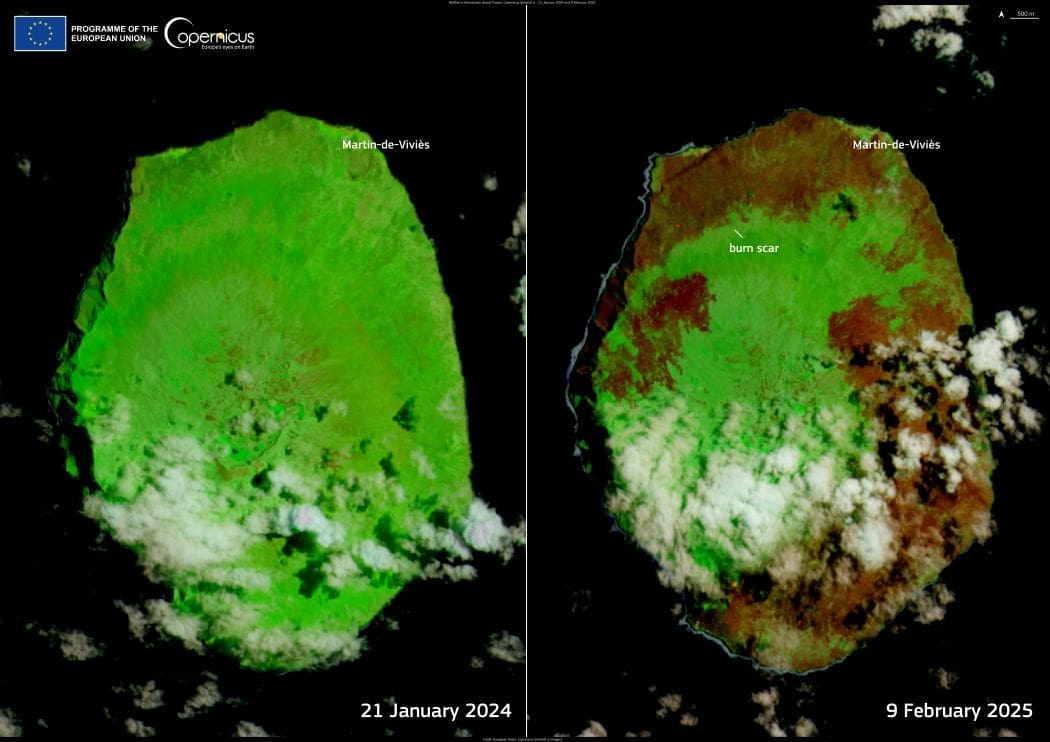
A wildfire that broke out on January 15, 2025, on Amsterdam Island, a remote French territory in the southern Indian Ocean, has left lasting devastation. By February 10, more than half of the island’s 58 km² was burned, according to satellite images. The fire has significantly impacted the island’s fragile ecosystem and disrupted vital atmospheric monitoring at the Martin-de-Viviès research station.
The French government was unable to intervene directly due to the island’s extreme isolation—nearly 2,800 km from Reunion Island — and had no choice but to wait for rain to help extinguish the flames. While the fire’s current status remains uncertain, its consequences are already profound, both for biodiversity and climate science.
An ecological disaster
Amsterdam Island, part of the UNESCO-listed French Southern and Antarctic Lands, is a crucial sanctuary for seabirds and marine mammals. It is home to the critically endangered Amsterdam albatross and supports 84% of the world’s Indian Yellow-nosed albatross population, according to the French Polar Institute. The island also hosts breeding colonies of elephant and fur seals, whose habitat has been severely affected by the fire.
The island’s distinctive vegetation, particularly the Phylica arborea shrub — the only tree-like species in the region — has also suffered extensive damage. Scientists remain concerned about the long-term ecological consequences, particularly for species now trapped by the fire’s destruction.
Loss of a vital climate monitoring station
Beyond the environmental damage, the wildfire has disrupted Amsterdam Island’s role as a key site for atmospheric monitoring. The Martin-de-Viviès research station, managed by France’s Laboratory for Climate and Environmental Sciences (LSCE), has been a critical facility for tracking carbon dioxide, methane, nitrous oxide, and ozone levels. The station’s remote location and minimal human interference made it one of only two observatories in the world capable of providing direct atmospheric background pollution measurements, alongside Hawaii’s Mauna Loa Observatory (MLO).
Since the fire broke out, data collection has been interrupted for the first time in over 40 years. “The island’s geographical location, its isolation, and the low level of human activity mean that measurements can be taken in a particularly ‘clean’ environment,” said Marc Delmotte, the head of the monitoring program. “An interruption in the readings is therefore a very unfortunate loss of data.”
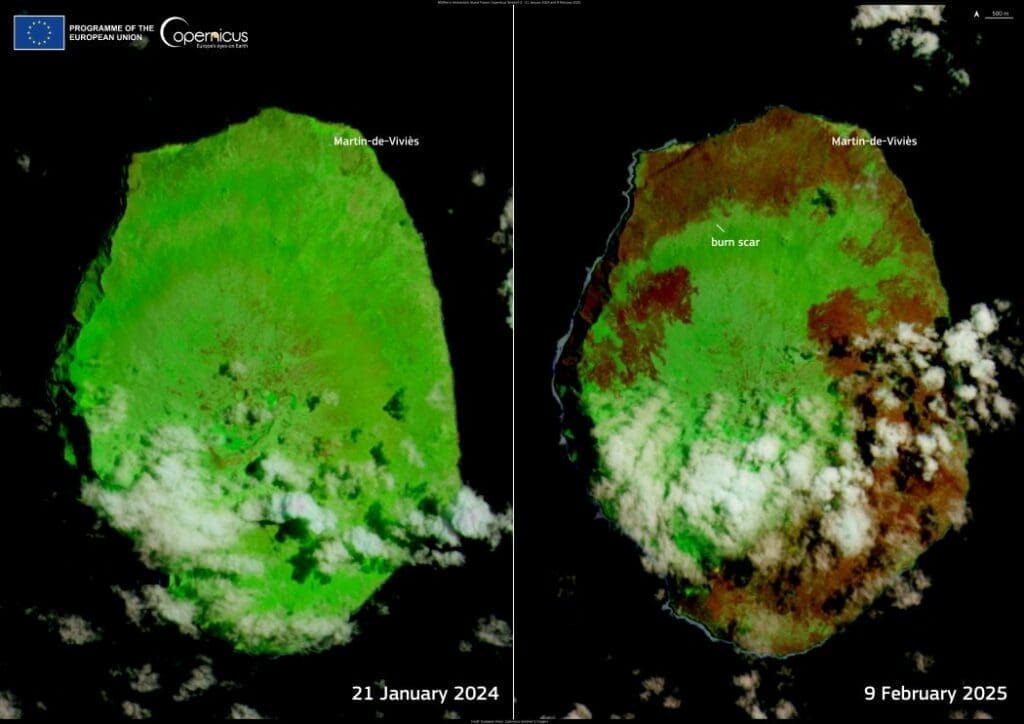
These Copernicus Sentinel-2 false-color images, captured on January 21, 2024, and February 9, 2025, reveal the vast extent of the damage.
Evacuation and damage assessment
When the fire broke out, 31 people — technical staff, military personnel, and scientists — were stationed at Martin-de-Viviès. They were evacuated on January 16, just one day after the fire began. A nearby French fishing vessel, the Austral, was able to take them on board, after which they were transferred to the TAAF supply ship Marion-Dufresne and transported to Reunion Island, arriving there on February 5.
A reconnaissance mission was launched in mid-February to assess the situation. Seven personnel, including a doctor and four firefighters, were deployed to measure the extent of the damage, identify potential remaining hotspots, and evaluate the status of the research station’s infrastructure. Preliminary reports suggest that while the station’s living quarters remain intact, critical infrastructure — including the island’s water access, telecommunications, and solar power systems — has been compromised.
Uncertain path to recovery
As of February 20, 2025, the full extent of the wildfire’s impact remains under assessment. The loss of critical scientific data, the destruction of key ecological habitats, and the damage to infrastructure make the road to recovery a long and challenging process. The financial and logistical barriers to restoring the island’s research operations are significant, given the remote location and the need for specialized equipment and personnel.
“This isn’t the first fire to hit the island, but it’s certainly the biggest in a long time,” Delmotte noted. “And depending on the damage highlighted by the mission, we’ll have a better idea of what work needs to be done.”
Scientists and environmentalists are urging the French government to prioritize the restoration of the monitoring station, emphasizing its irreplaceable role in global climate research. Meanwhile, conservationists warn that urgent action is needed to prevent further ecological losses on this unique and fragile island.
Article Sources: France24 | Copernicus | UNESCO World Heritage
Featured image credit: European Union, Copernicus Sentinel-2 imagery