Each year on 9 May, Europe marks a moment of reflection and celebration. Europe Day commemorates the Schuman Declaration of 1950 – a proposal that helped transform a divided continent into a cooperative union. The declaration, delivered by French Foreign Minister Robert Schuman, laid the foundation for what would become the European Union, reshaping Europe’s political landscape in the wake of two devastating world wars.
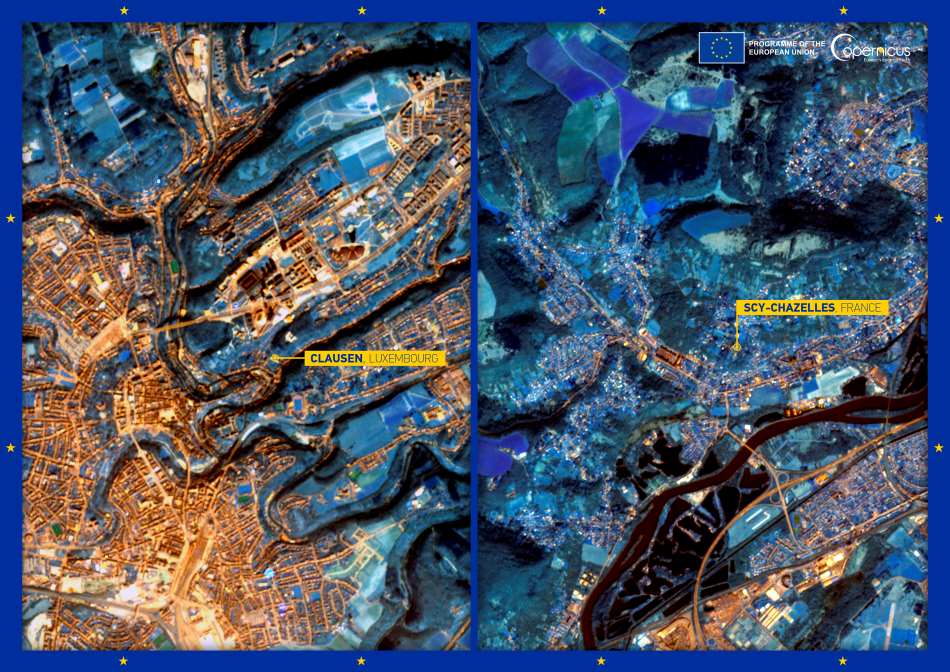
Born in 1886 in Clausen, Luxembourg, Schuman spent his life at the intersection of national identities, languages, and cultures. That experience shaped his belief in unity through cooperation. The image featured today, acquired by the Copernicus Sentinel-2 mission, captures two key locations that bookend Schuman’s life: Clausen, where he was born, and Scy-Chazelle, France, where he died in 1963. Both images were taken on 27 March 2025 and processed with a false-colour composite using blue and gold hues – a visual nod to the European Union’s official colours.
Clausen, a historic district of Luxembourg City, reflects Schuman’s early years in a country at the crossroads of European cultures. Scy-Chazelle, on the other hand, became a place of deep historical significance. It was here, in his modest home nestled in the hills of Moselle, that Schuman conceived the idea for the declaration that would later bear his name. Today, that home is preserved as the Robert Schuman House, a museum open to visitors who wish to explore the legacy of one of Europe’s foremost architects of unity. The house displays personal items, manuscripts, and exhibits that document the political vision that ultimately led to the formation of the European Coal and Steel Community – the EU’s earliest institutional predecessor.
According to the European Union, the 1950 declaration proposed placing Franco-German coal and steel production under a common High Authority, in a move designed to make future conflicts between the two nations “not merely unthinkable, but materially impossible.” This approach to shared governance and economic integration set the stage for a peaceful and interdependent Europe.
The choice of blue and gold in the Sentinel-2 imagery is more than aesthetic. These colours, long associated with the EU flag, symbolize solidarity and harmony. By rendering the satellite view in this palette, the image becomes a tribute to Schuman’s enduring vision: a Europe built on common values, collective responsibility, and mutual trust.
Europe Day is not just a commemoration of past achievements – it is also a reminder of the ideals that continue to shape Europe’s future. And in these satellite portraits of Schuman’s birthplace and final home, there is a fitting visual representation of a life dedicated to unity, peace, and cooperation across borders.
Featured image credit: European Union, Copernicus Sentinel-2 imagery