Summary:
A comprehensive study conducted across 179 sites in Bavaria has found that bees are especially vulnerable to the combined pressures of climate change and land-use intensification. While many insect populations are declining globally, the new research sheds light on how rising temperatures, especially at night, interact with habitat loss to further strain insect communities, particularly pollinators.
Scientists from Julius-Maximilians-Universität Würzburg, in collaboration with other German institutions, explored insect richness and abundance across various trophic levels, from flowering plants and cavity-nesting bees to hunting wasps and their parasites. Using trap nests and a space-for-time method, the team surveyed plots in forests, grasslands, arable fields, and urban areas.
They found that bee populations thrived under warmer daytime temperatures only in semi-natural areas like forests and grasslands, but declined sharply, by up to 65 percent, in more intensively used habitats such as cities and farmlands. Night-time warmth, in particular, had a consistent negative effect on bee diversity across all environments. The findings emphasize the complex interplay between land use and temperature changes, with implications for ecosystems and agricultural productivity.
The study has been published in Proceedings of the Royal Society B: Biological Sciences.
Heat and land use: Bees suffer in particular
The number and diversity of insects is declining worldwide. Some studies suggest that their biomass has almost halved since the 1970s. Among the main reasons for this are habitat loss – for example through agriculture or urbanization – and climate change.
These threats have long been known. What is less well-known is how these global change drivers interact and how their effects can become even more severe that way. For example, insects that have been deprived of their natural habitat could be even more affected by higher temperatures in a new environment.
Researchers at Julius-Maximilians-Universität Würzburg (JMU) have investigated precisely this serious interaction at 179 locations throughout Bavaria. The study is part of the LandKlif research cluster, coordinated by Professor Ingolf Steffan-Dewenter within the Bavarian Climate Research Network bayklif.
Bees are particularly affected
The study shows that insects from different trophic levels react differently to the combination of higher temperatures and more intensive land use. Bees were particularly affected. While populations in forests coped well with the heat, their urban relatives had their numbers reduced by 65 percent.
Like us humans, the animals were not only affected by hot daytime temperatures, but also by the warmer than average nights. Both the number and diversity of bees suffered considerably. “The fact that night-time temperatures have such an impact on diurnal insects is significant. Precisely because average night-time temperatures rise even faster than daytime temperatures,” explains biologist Dr. Cristina Ganuza.
Although insects higher up in the food chain coped better with the heat, they struggled in open agricultural habitats, for example. “This can have a negative impact on agricultural production because insects that contribute to natural pest control should be similarly affected,” Dr. Sarah Redlich continues.
The situation for these insects was better where agricultural land and natural areas were mixed.
Three key findings
The researchers summarize their findings in three key points:
- Warmer daytime temperatures lead to higher number and diversity of bees, but only in forests and grasslands, the most natural habitats. Therefore, the preservation and creation of interconnected natural habitats within agricultural and urban areas is of great importance.
- Higher night temperatures lead to lower bee richness across all studied habitat types. “This previously unknown negative effect of warmer nights on insects reveals a new threat that requires further research to uncover the underlying physiological mechanisms,” explains Steffan-Dewenter.
- Climate change and land use interact, but affect insects at lower or higher positions in the food chain in different ways. “Their different responses could disrupt food webs and important ecosystem functions such as pest control and pollination,” says Ganuza.
***
Cooperation partners and funding
The JMU-study was carried out in cooperation with the Technical University of Munich, the Weihenstephan-Triesdorf University of Applied Sciences and the University of Bayreuth. It was funded by the Bavarian State Ministry of Science and the Arts.
Journal Reference:
Ganuza Cristina, Redlich Sarah, Rojas-Botero Sandra, Tobisch Cynthia, Zhang Jie, Benjamin Caryl, Englmeier Jana, Ewald Jörg, Fricke Ute, Haensel Maria, Kollmann Johannes, Riebl Rebekka, Schiele Susanne, Uhler Johannes, Uphus Lars, Müller Jörg and Steffan-Dewenter Ingolf, ‘Warmer temperatures reinforce negative land-use impacts on bees, but not on higher insect trophic levels’, Proceedings of the Royal Society B: Biological Sciences 292, 2046: 20243053 (2025). DOI: 10.1098/rspb.2024.3053
Article Source:
Press Release/Material by Lutz Ziegler | Julius-Maximilians-Universität Würzburg (JMU)
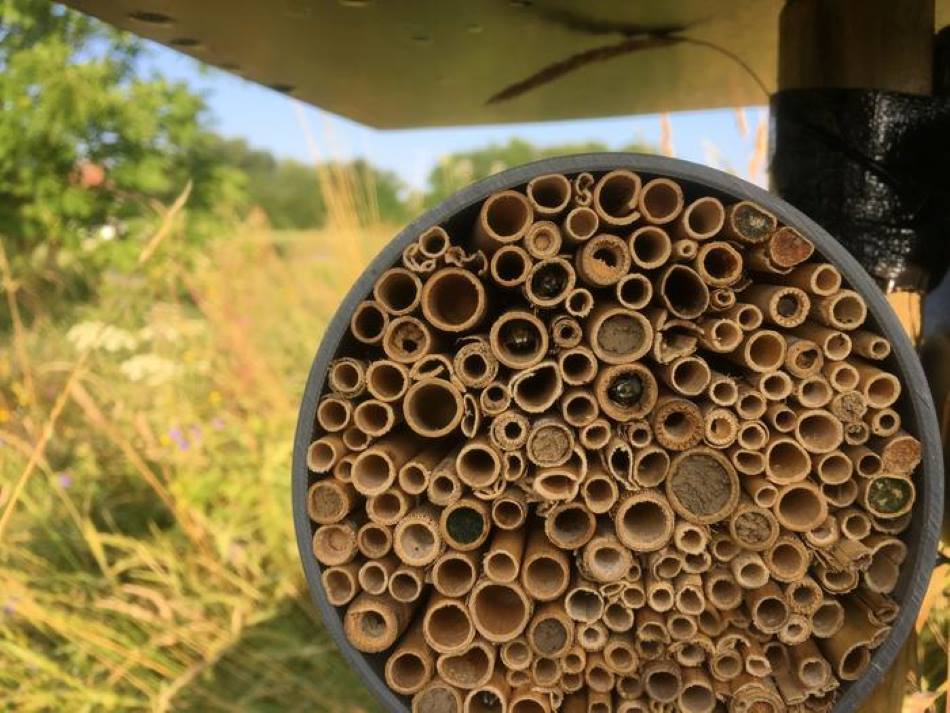
Featured image: Bees wait asleep in an artificial nest made of reed stems for favorable flight conditions. Different species close their nest entrances with clay or plant debris. Credit: Cristina Ganuza