
Summary:
Tiny microbes tasked with cleaning our wastewater are also releasing a powerful greenhouse gas — nitrous oxide (N2O), commonly known as laughing gas. Although these emissions vary seasonally and are known to arise from microbial processes, the specific mechanisms behind them have remained elusive. Now, a new study published in Nature Water sheds light on the complex interactions within wastewater treatment plants (WWTPs) that drive nitrous oxide emissions and points to a surprisingly simple solution.
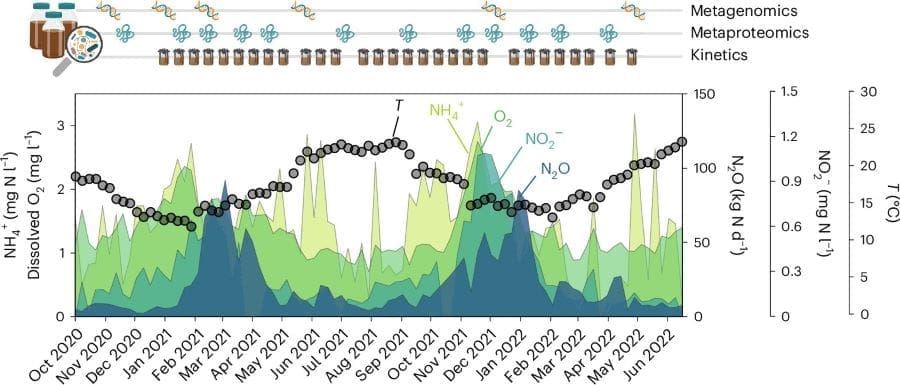
Led by Dr. Nina Roothans under the supervision of environmental engineers Michele Laureni and Mark van Loosdrecht, the research team conducted a two-year investigation at the Amsterdam West WWTP. Using advanced DNA and protein analysis techniques, they traced the emissions back to an imbalance between two groups of bacteria that manage nitrogen compounds. The key culprit: too much nitrite, a chemical intermediate linked to nitrous oxide production. Roothans discovered that the concentration of dissolved oxygen — a parameter that can be easily adjusted by plant operators — directly influences this microbial imbalance.
Gradually increasing oxygen levels instead of abrupt seasonal shifts could help mitigate emissions without requiring major infrastructural changes. The findings offer wastewater operators a low-cost, practical approach to cut emissions — and could inform strategies in agriculture as well.
Mitigating laughing gas emissions from wastewater
Laughing gas (nitrous oxide or N2O) is primarily released by the micro-organisms responsible for cleaning our wastewater. These microbes live in complex communities, with each group performing a specific role. Emissions vary throughout the day and across seasons, and the intricate microbial processes behind them remain largely unknown — making it difficult to design effective strategies to reduce emissions.
Understanding the balance between micro-organisms
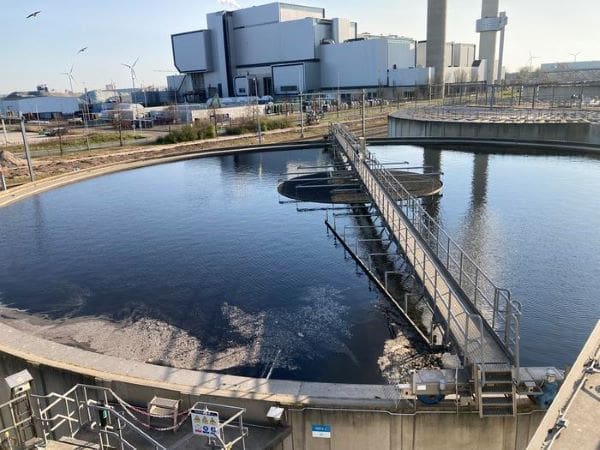
Motivated by the need to resolve this long-standing puzzle, Michele Laureni (assistant professor Bioprocess Engineering) and Mark van Loosdrecht (Professor Environmental Biotechnology) teamed up with the Dutch Water Authorities and STOWA. Under their supervision, the now Dr. Nina Roothans applied advanced techniques — including DNA and protein analyses — to study, in detail, how individual micro-organisms interact in WWTPs over a two-year period. The Amsterdam West WWTP from the Water Authority Amstel, Gooi and Vecht, operated by Waternet, was her model ecosystem. The research revealed how environmental and operational factors — such as temperature and oxygen levels — impact nitrous oxide emissions.
Oxygen impacts emissions
One of Roothans’ key discoveries was that the accumulation of nitrite — a central intermediate in the breakdown of nitrogen compounds — is linked to an imbalance between two groups of bacteria: those that convert ammonia into nitrite, and those that convert nitrite into nitrate. Because nitrite is a precursor to nitrous oxide, this imbalance was identified as the primary cause of nitrous oxide or laughing gas emissions. Crucially, Roothans also identified the oxygen concentration — something operators have direct control upon — as the main factor inducing this imbalance.
And this, Laureni notes, is precisely where the opportunity lies: “The nice thing is that, in principle, the solution may not require major infrastructural changes. The idea is that gradually increasing oxygen, rather than doing so abruptly when winter approaches, may already significantly reduce emissions. Moreover, this work is a great example of how very fundamental research can directly lead to actionable engineering insights.”
Simple and cost-effective
These findings are especially relevant for the Water Authorities, as they not only point to potential ways of reducing nitrous oxide emissions but also suggest that the required interventions may be both simple and cost-effective. Whether the identified strategy proves successful in practice will become clear in the coming years. Two new PhD candidates are now continuing the work to further develop and validate the approach, in collaboration with the Water Authorities and Royal HaskoningDHV. The fundamental insights from Roothans’ work are also expected to benefit the agricultural sector, where microbial nitrous oxide emissions pose an even greater challenge.
Journal Reference:
Roothans, N., Pabst, M., van Diemen, M. et al., ‘Long-term multi-meta-omics resolves the ecophysiological controls of seasonal N2O emissions during wastewater treatment’, Nature Water (2025). DOI: 10.1038/s44221-025-00430-x
Article Source:
Press Release/Material by Delft University of Technology
Featured image credit: Sime Basioli | Unsplash