Summary:
Deforestation in tropical regions could be driving a major health crisis by intensifying local heat exposure, according to new research published in Nature Climate Change. The study, led by Dr Carly Reddington and Professor Dominick Spracklen from the University of Leeds’ School of Earth and Environment, estimates that the loss of tropical forests is associated with around 28,000 heat-related deaths every year.
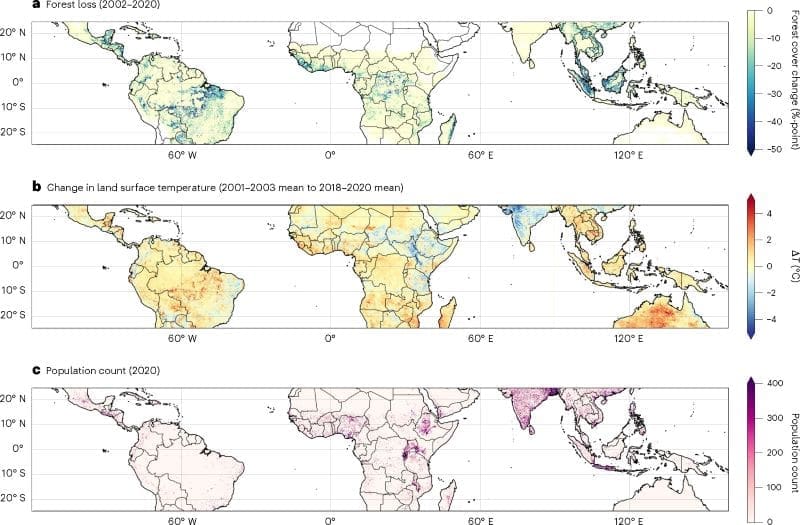
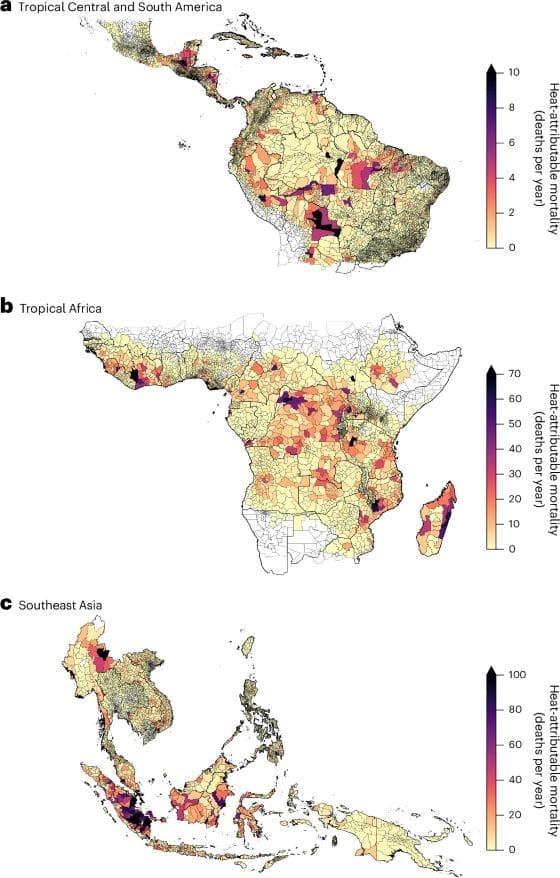
By analysing satellite data from 2001 to 2020 across Central and South America, Africa, and Southeast Asia, the researchers found that tropical deforestation has exposed 345 million people to higher temperatures. In affected areas, the population-weighted increase in daytime land surface temperature was 0.27°C. Mortality rates were highest in Southeast Asia, where 8–11 deaths per 100,000 people living near deforested regions could be attributed to heat exposure.
The loss of forests removes natural cooling mechanisms such as shade and evapotranspiration, while also reducing carbon storage, worsening both local and global warming. Vulnerable populations with limited access to healthcare or cooling infrastructure are especially at risk. In areas of tropical forest loss, local warming from deforestation could account for more than a third of total heat-related deaths, the study concludes, underscoring the health benefits of forest conservation.
Deforestation could account for over a third of heat deaths in areas of tropical forest loss, researchers find
The research was led by Dr Carly Reddington and Professor Dominick Spracklen, from the University of Leeds’ School of Earth and Environment.
The study, which analysed areas across Central and South America, Africa and South-East Asia, found that local climate heating caused by tropical deforestation has exposed over 300 million people to increased temperatures and is associated with 28,000 heat-related deaths each year.
Tropical deforestation contributes to rising temperatures by eliminating trees that naturally regulate the climate through shade, moisture release via evapotranspiration, and carbon dioxide absorption. Without these cooling mechanisms, heat accumulates more rapidly at the surface, atmospheric moisture declines, and greenhouse gas concentrations increase – amplifying both local and global warming.
Dr Reddington said: “Our work underscores tropical deforestation not only as an environmental issue but also as a major public health concern.
“Vulnerable populations – with limited access to healthcare, cooling infrastructure, or adaptive capacity – often live near deforested regions and may be disproportionately affected.
“Protecting tropical forests could save lives by maintaining cooler local temperatures and reducing the risk of deadly heat exposure.”
Vulnerable Populations
In recent decades, tropical forests have been heavily affected by deforestation and degradation, mainly due to farming and logging.
This loss of tree cover has serious consequences; threatening biodiversity, disrupting the climate, and altering water cycles.
Deforestation is associated with a range of problems detrimental to human health. Smoke pollution from fires in deforested areas degrades regional air quality. It has also been linked to an increased risk of malaria. This study demonstrates an additional health risk of deforestation through increased heat exposure and heat-related mortality.
The risks to human health are further exacerbated by social and economic factors. People living in rural areas of the tropics often have limited access to healthcare, making them more vulnerable to extreme heat.
Access to modern technologies that help people cope with heat – like air conditioning or cooling systems – is more limited in many tropical countries, and many people work outside during the day increasing exposure to heat.
The research found people living across the tropics were affected, with over 48 million people in Indonesia, 42 million people in the Democratic Republic of Congo and 21 million people in Brazil exposed to heating from tropical deforestation. The biggest impacts were found where lots of people live close to areas where forests have been cleared.
Methodology
Using satellite data from 2001 to 2020, the researchers mapped areas of tree cover change to identify forest loss across the tropics, and the subsequent change in land temperature in those areas.
They then compared human population distribution data to map exposure of populations to local warming from deforestation, before comparing against data on non-accidental mortalities (deaths which weren’t caused by accidents, suicides or homicides) to estimate the heat-attributable excess mortality associated with this warming.
In areas of tropical forest loss, more than one third of all heat-related deaths were associated with deforestation.
Implications
The research highlights the importance of conserving tropical forests for the benefit of local communities. Conserving these forests could mitigate the health effects of increasing temperatures on local populations, strengthening their ability to adapt to extreme weather conditions.
Professor Spracklen said: “Our findings underscore the urgent need to reduce tropical deforestation. Increased recognition of the benefits of tropical forests for nearby communities will help build stronger support for tropical forest protection.”
Journal Reference:
Reddington, C.L., Smith, C., Butt, E.W. et al., ‘Tropical deforestation is associated with considerable heat-related mortality’, Nature Climate Change (2025). DOI: 10.1038/s41558-025-02411-0
Article Source:
Press Release/Material by University of Leeds
Featured image credit: Mike van Schoonderwalt | Pexels