Summary:
Deforestation in the Brazilian Amazon is responsible for most of the rainfall decline and a significant share of rising temperatures during the dry season, according to new research published in Nature Communications. The study, led by scientists at the University of São Paulo, is the first to separate and quantify the influence of forest loss from that of global climate change on the region’s climate.
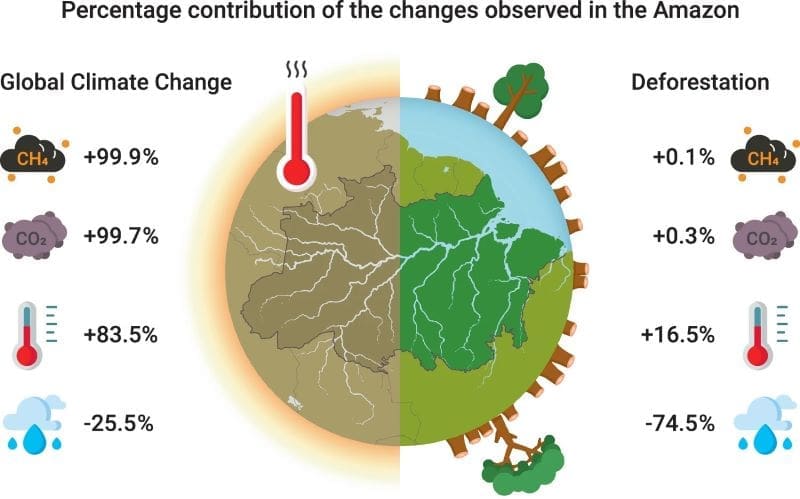
Analyzing data collected over 35 years across 2.6 million square kilometers of the Brazilian Legal Amazon, researchers found that deforestation accounted for about 74% of a 21-millimeter drop in rainfall per dry season and 16.5% of a 2°C rise in maximum surface air temperatures. While global emissions were the main driver of increasing carbon dioxide and methane levels, local forest loss emerged as the dominant factor altering seasonal rainfall patterns and amplifying heat.
The findings come as Brazil prepares to host COP30 in Belém, highlighting the Amazon’s role in global climate regulation. “We were able to separate and weigh each of these components, practically showing a kind of ‘account payable,’” said Professor Luiz Augusto Toledo Machado of the University of São Paulo. Researchers stressed that early stages of deforestation cause the most severe disruptions.
Deforestation accounts for 74% of rainfall reduction and 16% of temperature increase in the Amazon during the dry season, study says
Deforestation in the Brazilian Amazon is responsible for approximately 74.5% of the reduction in rainfall and 16.5% of the temperature increase in the biome during the dry season. For the first time, researchers have quantified the impact of vegetation loss and global climate change on the forest.
A study led by scientists from the University of São Paulo (USP) in Brazil provides fundamental results to guide effective mitigation and adaptation strategies. These are the target themes of the United Nations Climate Conference (COP30), which is scheduled for November in the Amazonian metropolis of Belém, in the state of Pará, Brazil.
The results of the study are published in the latest issue of Nature Communications and featured on its cover.
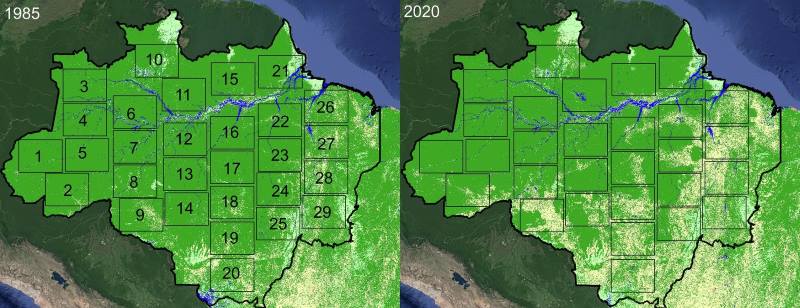
Researchers analyzed environmental, atmospherical change and land cover data collected over a 35-year period (1985-2020) from an area of approximately 2.6 million square kilometers in the so-called Legal Amazon, a zone created by the Brazilian government for regional development purposes covering all nine states where the Amazon biome occurs. Using parametric statistical models, they unraveled the effects of forest loss and changes in temperature, precipitation, and greenhouse gas mixing rates.
Rainfall decreased by approximately 21 mm per year during the dry season, with deforestation contributing to a 15.8 mm decrease. The maximum temperature increased by about 2.0 °C, of which 16.5% was attributed to forest loss and the remainder to global climate change.
“Several scientific articles on the Amazon have already shown that the temperature is higher, that rainfall has decreased, and that the dry season has increased, but there was still no separation between the effect of climate change, caused mainly by pollution from countries in the Northern Hemisphere, and deforestation caused by Brazil itself. Through this study, we were able to separate and weigh each of these components, practically showing a kind of ‘account payable,’” summarizes Professor Luiz Augusto Toledo Machado.
Machado, a researcher at the University of São Paulo’s Physics Institute (IF-USP) and a collaborator at the Max Planck Institute’s Department of Chemistry in Germany, tells Agência FAPESP that the results underscore the importance of preserving standing forests to maintain climate resilience.
Research has shown that the impact of deforestation is most intense in the early stages. The greatest changes in the local climate occur when 10% to 40% of the forest is lost.
“The effects of the changes, especially in temperature and precipitation, are much more significant in the first few percent of deforestation. In other words, we have to preserve the forest; that’s very clear. We can’t transform it into something else, such as pastureland. If there’s any type of exploitation, it needs to be sustainable,” adds Professor Marco Aurélio Franco, from the Institute of Astronomy, Geophysics, and Atmospheric Sciences (IAG) at USP.
Franco is the first author of the article and received a postdoctoral fellowship from FAPESP, which also supported the work through another grant (21/12954-5) from the Research Center for Greenhouse Gas Innovation (20/15230-5) and the Research Program on Global Climate Change – RPGCC (22/07974-0).
The project supported by the RPGCC is being developed in partnership with the Chinese Academy of Sciences. One of the overseas leaders and authors of the work is researcher Xiyan Xu.
Sensitive ecosystem balance
As the largest and most biodiverse tropical forest in the world, the Amazon plays an important role in regulating the global climate. For example, it is responsible for the so-called “flying rivers” – invisible waterways that circulate through the atmosphere and supply other biomes, such as the Brazilian savanna-like biome, known as the Cerrado. Trees draw water from the soil through their roots, transport it to their leaves, and release it into the atmosphere as vapor.
At the end of last year, an international group of researchers, including Machado and Professor Paulo Artaxo, also from the USP Physics Institute, published a study in Nature. The study showed the physical-chemical mechanism that explains the complex system of rain formation in the biome for the first time. This mechanism involves the production of aerosol nanoparticles, electrical discharges, and chemical reactions at high altitudes between night and day. The result is a kind of aerosol “machine” that produces clouds.
However, deforestation and forest degradation contribute to altering this rainfall cycle, intensifying the dry season locally and increasing forest fire periods.
According to data from MapBiomas, a collaborative network formed by non-governmental organizations, universities, and technology startups that maps land cover and land use in Brazil, the Brazilian Amazon lost 14% of its native vegetation between 1985 and 2023, reaching an area of 553,000 km² – equivalent to the territory of France. Pasture conversion was the main cause during this period. Despite deforestation reaching its second lowest level between August 2024 and July 2025 – an area of 4,495 km² – containing degradation, especially that caused by fire, remains challenging.
The dry season, which occurs between June and November, is when the effects of deforestation are most noticeable, particularly on rainfall. The cumulative effects further intensify seasonality.
Unraveling the data
To reach their conclusions, the scientists used parametric surface equations that considered both annual variations and deforestation. These equations enabled them to distinguish the unique contributions of global climate change and vegetation loss. They also used remote sensing data sets and long-term reanalyses, including land use classifications produced by MapBiomas.
In addition to analyzing data related to rainfall and temperature, the group examined greenhouse gas data. They concluded that the increase in carbon dioxide (CO₂) and methane (CH₄) levels over the 35-year period was driven almost entirely by global emissions (more than 99%). They observed an increase of approximately 87 parts per million (ppm) for CO₂ and about 167 parts per billion (ppb) for CH₄.
“At first, this result seemed to contradict other articles that show the impact of deforestation on reducing the forest’s ability to remove CO₂ from the atmosphere. But that’s not because CO₂ concentration is something on a large scale. Those were local measurements of CO₂ flux. When it comes to concentration, the increase is predominantly due to global emissions,” adds Machado.
The researchers warn in the article that if deforestation continues unchecked, then extrapolation of the results suggests a further decline in total precipitation during the dry season and an even greater rise in temperature.
Recent studies indicate that deforestation in the Amazon is altering South American monsoon patterns, which bring abundant rainfall to central and southeastern Brazil during the summer. These altered patterns result in drier conditions that could compromise the long-term resilience of the forest. Extreme events, such as the 2023 and 2024 droughts, only exacerbate the situation.
Journal Reference:
Franco, M.A., Rizzo, L.V., Teixeira, M.J. et al., ‘How climate change and deforestation interact in the transformation of the Amazon rainforest’, Nature Communications 16, 7944 (2025). DOI: 10.1038/s41467-025-63156-0
Article Source:
Press Release/Material by Luciana Constantino | FAPESP
Featured image: Deforestation area near Negro river, 2016; researchers warn in the article that if deforestation continues unchecked, then extrapolation of the results suggests a further decline in total precipitation during the dry season and an even greater rise in temperature. Credit: Léo Ramos Chaves | Pesquisa FAPESP | CC BY-NC-ND