
Summary:
Birds across Europe are steadily moving to higher elevations as global temperatures rise, according to a new study published in Global Ecology and Biogeography. Researchers examined 177 species in four major mountain regions – the Alps, the Pyrenees, the Scandinavian Mountains, and the British Highlands – using two decades of bird monitoring data from eight countries, spanning 2001 to 2021.
The study found that 63 per cent of species shifted uphill, averaging 0.5 metres per year. The most rapid changes occurred in Scandinavia and the Alps, where some species, such as the northern wheatear, have moved up as much as 33 metres since 2001. In contrast, birds in the UK and the Pyrenees showed no significant uphill movement.
Local factors like solar radiation influence where birds settle, with sunnier southern slopes hosting species at higher elevations than shadier northern slopes. “Sunny slopes attract birds to higher elevations because vegetation zones and food resources are located higher up. However, birds are also moving uphill at the same rate on shady slopes, which suggests that warming temperatures are affecting the entire mountain landscape,” explains PhD researcher Joséphine Couet from the Finnish Museum of Natural History.
These findings reveal how climate change is reshaping bird distributions across Europe’s mountain landscapes.
Birds move higher up mountains as the climate warms
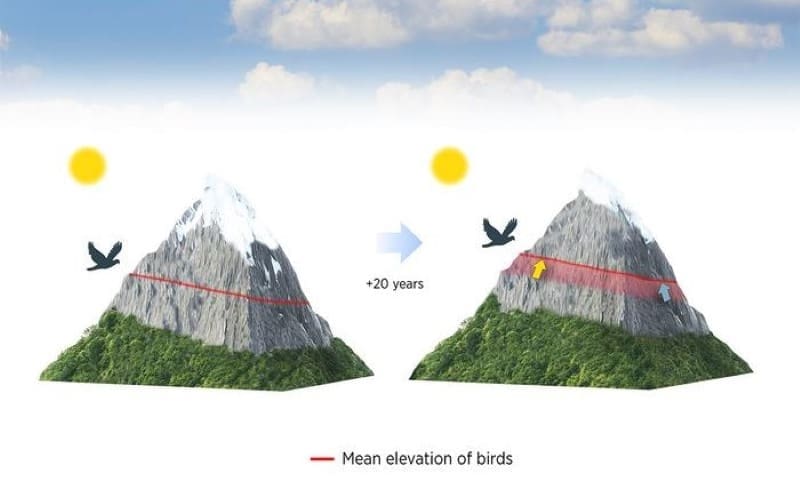
A new study published in the journal Global Ecology and Biogeography examined 177 bird species in four large mountain ranges: the Alps, the Pyrenees, the Scandinavian Mountains, and the British Highlands. Of these species, 63 per cent moved uphill. This uphill movement has averaged about half a metre per year in the 2000s.
The fastest change happened in Scandinavia and the Alps – for example, the northern wheatear has shifted an average of 33 metres uphill in the Scandinavian mountains since 2001. No significant uphill shift was observed in Great Britain or the Pyrenees. This indicates that the causes behind range shifts, such as the intensity of climate change and human land use, vary from region to region.
In mountainous areas, local climatic conditions, or microclimates, can vary considerably even over short distances. For example, the northern mountain sides receive less sunlight than the southern sides, resulting in cooler and wetter conditions. These differences affect the habitats of species.
“Sunny slopes attract birds to higher elevations because vegetation zones and food resources are located higher up. However, birds are also moving uphill at the same rate on shady slopes, which suggests that warming temperatures are affecting the entire mountain landscape,” explains PhD researcher Joséphine Couet from the Finnish Museum of Natural History, University of Helsinki.
The results show that broader climatic trends are driving birds to move uphill in the mountains across Europe. Slopes that are less exposed to solar radiation could serve as refuges, but these small-scale advantages are not enough to counteract large-scale uphill movements.
“Mountain areas are not only majestic landscapes, but also hotspots of biodiversity, home to many species that depend on specific climatic and habitat conditions. This information is crucial for conservation planning in complex terrains where local conditions vary greatly,” Couet emphasizes.
The study is based on bird monitoring data from eight European countries between 2001 and 2021.
Journal Reference:
Couet, J., E.-L. Marjakangas, A. Santangeli, et al., ‘Solar Radiation Affects Bird Distributions but Not Elevational Shifts in European Mountains’, Global Ecology and Biogeography 34, 11: e70143 (2025). DOI: 10.1111/geb.70143
Article Source:
Press Release/Material by University of Helsinki
Featured image: Northern wheatear (Oenanthe oenanthe oenanthe). Credit: Jani Närhi