
Summary:
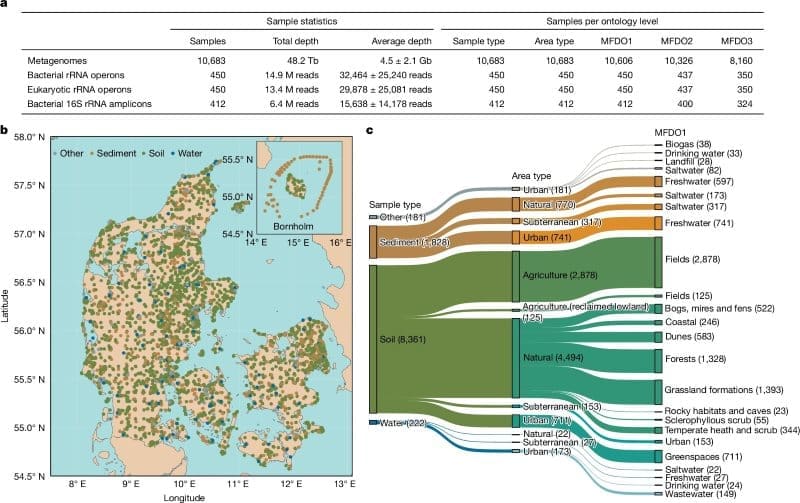
Denmark’s microbiome has now been charted at an unprecedented national scale, offering new insight into how microbial communities influence agriculture, nutrient flows, and climate. In a study published in Nature, researchers present Microflora Danica, an atlas built from 10,683 metagenomes and extensive rRNA datasets collected across the country at intervals of roughly four square kilometers. The project links microbial sequences to a detailed habitat classification system and reveals how land use shapes microbial diversity and function.
The atlas highlights the clear microbial signatures of intensively managed landscapes, where disturbed habitats exhibit high local diversity but show homogenized patterns nationwide. Natural habitats, in contrast, maintain a broader range of species and functions. Central to the study is the nationwide assessment of nitrifiers – microbes that govern how reactive nitrogen from fertilizers cycles through soils, water bodies, and the atmosphere. The team identified several dominant nitrifier lineages, including TA-21 within ammonia-oxidizing archaea and comammox-Nitrospira clade B, both lacking cultivated representatives despite their wide distribution.
These findings expose gaps in current understanding of nitrogen cycling and point to opportunities for more precise fertilizer strategies and improved assessments of nitrous oxide emissions. The atlas provides a foundation for monitoring microbial responses to land-use change and climate pressures.
The microbiome of an entire country mapped for the first time: New findings on Planetary Health
An international research team led by Aalborg University with contributions from the University of Vienna has systematically mapped the microbiome of an entire country for the first time. In the study Microflora Danica, over 10,000 environmental samples from across Denmark were analyzed – on average at intervals of only around 4 square kilometers. The result is an atlas of Danish environmental microbiomes with unprecedented spatial resolution and functional depth. Michael Wagner, Daan Speth, and Andrew Giguere from the Center for Microbiology and Environmental Systems Science at the University of Vienna played a key role in the evaluation of nitrifiers, a key group in the global nitrogen cycle.
Focus on nitrifiers: Major players still uncharacterized
The nitrifiers in microbial soil microbiomes determine how long reactive nitrogen from fertilizers remains available to plants and when it transforms into environmentally harmful forms that enter the atmosphere or waterways. The current study shows the nationwide abundance distribution of these organisms for the first time and reveals something surprising: two particularly widespread lines – TA-21 within the ammonia-oxidizing archaea (AOA) and comammox-Nitrospira Clade B – have no cultivated representative to date. Therefore these nitrifiers cannot yet be studied directly in the laboratory, even though they dominate large areas of agricultural and natural soils, respectively. In addition, the researchers found strong evidence of widespread, previously unknown, and also not yet cultivated groups of nitrite-oxidizing bacteria.
Why it matters: Fertilizers, water bodies, and nitrous oxide
Denmark is heavily agricultural (around two-thirds of its land is used for farming). The widespread use of nitrogen fertilizers means that large amounts of reactive nitrogen end up in the environment – with direct consequences for groundwater, coastal waters, and the climate. In agricultural soils, nitrifiers influence how much fertilizer nitrogen remains in the system – and how much enters water bodies as nitrate or escapes into the atmosphere as nitrous oxide (N₂O).
Overfertilization of water bodies leads to algal blooms and dead zones in the oceans, and nitrous oxide is a powerful greenhouse gas that also contributes to ozone depletion. Different nitrifiers produce varying amounts of N₂O and react differently to nitrification inhibitors, which are added to fertilizers in many countries to limit losses. “Understanding which nitrifiers are present and how abundant they are opens up major future potential for making agriculture more precise, efficient, and sustainable,” the Vienna researchers emphasize.
Anthropogenic influence detectable in the microbiome
The study also documents that the degree of habitat disturbance – such as intensive farming – is clearly reflected in microbial profiles. Disturbed habitats show high diversity locally, but are more homogenized nationwide. Natural habitats, on the other hand, preserve more overall diversity. These “microbial fingerprints” could be used in the future to evaluate the success of renaturation projects from a microbial perspective.
Relevance for Austria
“Our results show that microorganisms that are key drivers of biogeochemical processes are sensitive to land use and environmental changes”, emphasizes study author Michael Wagner from the University of Vienna, who is also head of the FWF Cluster of Excellence Microbiomes drive Planetary Health. “If we want to make agricultural systems more sustainable and take climate protection seriously, we must systematically consider the microbiome – both in research and in practice.”
Austria faces similar challenges to Denmark: in both countries, agriculture, nutrient inputs, and water protection shape environmental policy. The Danish results are therefore a model case for comparable analyses in Austria – from optimizing fertilizer use to estimating greenhouse gas emissions from soils. “A national microbiome atlas opens up new ways of combining agriculture and nature conservation on a data-based basis,” says the Viennese researcher.
About the study
‘Microflora Danica – the atlas of Danish environmental microbiomes’ is based on 10,683 metagenomes and supplementary rRNA data sets and links sequences to a five-level habitat ontology. In addition to a country-wide assessment of microbial biodiversity, the focus is particularly on nitrifiers, a group of microbes that is crucial for climate and water quality.
Journal Reference:
Singleton, C.M., Jensen, T.B.N., Delogu, F. et al., ‘The Microflora Danica atlas of Danish environmental microbiomes’, Nature (2025). DOI: 10.1038/s41586-025-09794-2
Article Source:
Press Release/Material by University of Vienna
Featured image credit: Freepik