Summary:
Pollinator diversity on smallholder farms remains relatively strong, even when those farms are located far from forests or other natural habitats, according to a new global analysis published in Ecology Letters. Smallholder farms account for up to 80% of farms worldwide and play a central role in food production across the tropics, where agriculture often unfolds within fragmented and complex landscapes.
The research draws on a systematic review and meta-analysis of 35 studies covering more than 500 farms in 13 tropical countries. Together, these studies examined how distance from natural habitat influences pollinator abundance, species richness, and crop fruit set. While proximity to forests is widely considered important for pollination in large-scale industrial farming, the analysis found no consistent relationship between distance to natural habitat and pollinator abundance or fruit production on smallholder farms. Patterns for pollinator species richness were more mixed and slightly negative overall, but varied widely between studies.
The findings suggest that the ecological complexity typical of smallholder farming systems may help sustain pollination services, even where natural habitats are fragmented or distant. Researchers caution, however, that results were uneven across regions and crops, and that some farms did experience pollination challenges. The authors also point to the need for more standardized methods and open data to strengthen future comparisons between farming systems.
Smallholder farms maintain strong pollinator diversity – even when far from forests
Industrial farming landscapes often have shortages of pollinators, which can cause production limitations for produce that needs them – and often lead to dire predictions (or at least online images of) supermarket produce sections empty of pollinator-dependent food.
This is largely due to unsustainable practices such as heavy pesticide use, the dependence on a handful of pollinator species, and long distances from natural areas where pollinators can live.
The story, however, on the globe’s smallholder farms, which account for 80% of all farms, appears different. Even though they are on often on fragmented landscapes that face similar sustainability challenges as industrial farms, new research suggests pollinator levels remain healthy – even if there are reasons for concern.
A new analysis of 35 studies demonstrated that, across 500 farms in 13 tropical countries, distance to forested or other natural habitats did not have a major negative impact on apparent pollinator populations or fruit production. The researchers, however, warned that the results were not consistent across studies and that more, systematic research is needed.
They also warned that environmental health still should be a critical concern in these landscapes.
“Globally, we need to improve biodiversity in agricultural landscapes to support wild pollinators,” said Ennia Bosshard, lead author of the study and Ph.D. researcher at the Exeter of University working with the Alliance of Bioversity International and CIAT. “Our findings help position tropical smallholder farmers as offering lessons because they are already more ecologically diverse.”
Inconsistent patterns
Bosshard, who is currently studying on-farm ecological diversity, distance to forest, and the relationship to pollinator population health in Kenya, said distance natural habits is likely to coarse a measurement for small tropical farms when compared to industrialized ones.
Also, results between studies – though generally aligned – showed that some smallholder farms do face pollination challenges. Researchers found individual studies where there were negative impacts on pollinator population health with large distances to natural habitats. The reason for this variability across studies remains unclear, but it may be due to the quality or size of natural habitat or the dependence of crops on specific pollinators, Bosshard said, noting that more research is needed on these scenarios.
One question the study could not address was whether pollinator baselines were different in the past, before the areas in the studies were altered by human activity. Still, the results point to higher ecological diversity as likely critical to maintaining (in most cases) healthy pollinator levels.
“Essentially, more diverse landscapes might buffer pollination services, even if they do not fully compensate for species that rely on forested or other specific habitat resources,” Bosshard said.
The study found some shortcomings that future research would need to address. One was a lack of standardized techniques to quantify pollinator populations in relation to habitat diversity. Researchers also called for a global meta-analysis to directly compare pollinators between smallholder farms and industrial ones.
“Our synthesis highlights the need for more methodological unification and standardization, as well as greater transparency in reporting methods for pollinator traits, natural habitat characteristics, farm management practices, and results management, including the open sharing of data and code,” Bosshard said. “Still, we believe this study makes an important contribution to better understanding and managing pollinators given the significant threats they face in many places.”
Journal Reference:
Bosshard, E., M. E. Harrison, F. van Veen et al., ‘Proximity to Natural Habitat Is Not Consistently Associated With Pollination Services in Tropical Smallholder Farms: A Systematic Review and Meta-Analysis’, Ecology Letters 28, 12: e70229 (2025). DOI: 10.1111/ele.70229
Article Source:
Press Release/Material by Sean Mattson | The Alliance of Bioversity International and the International Center for Tropical Agriculture (CIAT) | CGIAR
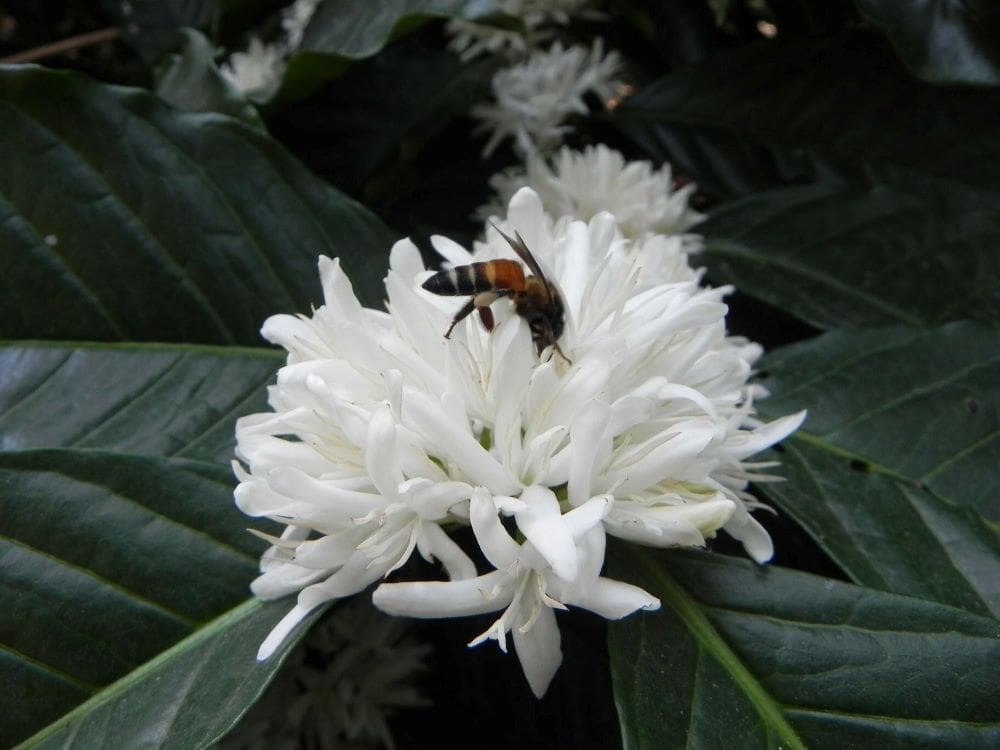
Featured image: During the coffee bloom, the coffee flowers attract a large number of pollinators, particularly bee species. In this image, Apis dorsata is seen visiting the coffee flowers. Credit: Courtesy of Deepthi Narasimhaiah