Breiðamerkurjökull, an outlet glacier of the Vatnajökull ice cap in south-eastern Iceland, has been steadily withdrawing from the lowlands for more than a century. Its changing front has reshaped the surrounding terrain, influencing river systems, sediment transport, and the growth of nearby glacial lakes. The glacier’s retreat is part of a broader pattern observed across Iceland, where sustained ice loss has been documented through ground measurements and satellite records.
At lower elevations, Breiðamerkurjökull once covered areas that are now exposed sandur plains. As the ice thinned and retreated, meltwater carved new channels and expanded Jökulsárlón, the glacial lagoon that has formed at the glacier’s terminus. These physical changes have altered how freshwater moves from the ice cap toward the coast, affecting both local landscapes and downstream environments.
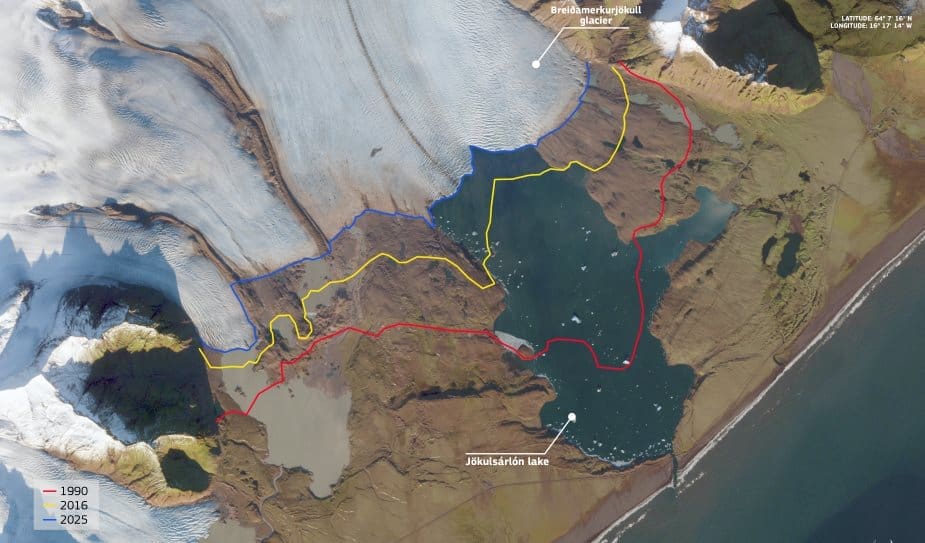
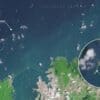
A Copernicus Sentinel-2 image acquired on 11 November 2025 illustrates how the glacier’s front has shifted over time. The scene shows Breiðamerkurjökull flowing from Vatnajökull into Jökulsárlón, with lines marking former and present terminus positions. The red line represents the glacier extent in 1990, the yellow line shows its position in 2016, and the blue line indicates the current ice margin. Together, these markers show a retreat of about 6 km over the past 25 years.
Historical analyses extend this record further back. Reconstructions based on elevation models, maps, aerial photographs, field observations, and written sources indicate that since its late nineteenth-century maximum, Breiðamerkurjökull has lost a large volume of ice. Over roughly 120 years, the glacier retreated several kilometres, exposing more than 100 km² of land and contributing meltwater equivalent to a measurable fraction of global sea-level rise. Much of this ice loss occurred after the mid-twentieth century, as thinning accelerated at lower elevations.
Ongoing satellite monitoring continues to document these changes with increasing precision, offering insight into how Breiðamerkurjökull responds to evolving climatic conditions and how its retreat may shape Iceland’s glaciated regions in the years ahead.
Featured image credit: European Union, Copernicus Sentinel-2 imagery