Southeastern Greenland is marked by rugged coastal mountains that rise sharply from the ice sheet, shaping both local climate and glacial dynamics. Steep slopes and deep valleys direct the flow of ice and meltwater, while shadowed terrain affects how the ice warms and melts through the seasons. These mountains form critical corridors for glaciers that channel ice toward fjords, influencing both ice movement and freshwater input to the surrounding environment.
Glaciers at the margins of the ice sheet respond dynamically to this terrain. Ice accelerates through narrow valleys while slower-moving sections linger along shadowed slopes, forming crevasse fields and stress fractures. Seasonal meltwater collects in depressions before descending through moulins to the glacier base, lubricating flow and affecting ice velocity. Even smaller outlet glaciers in this region play an important role in understanding how Greenland’s Ice Sheet responds to Arctic warming.
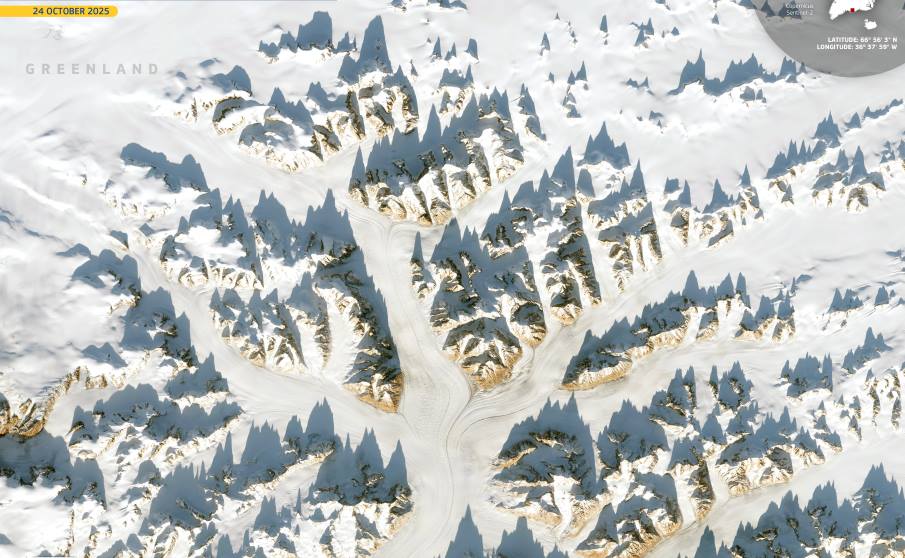
In the Copernicus Sentinel‑2 image, acquired on 24 October 2025, the interplay of light and shadow across the ice-sheet margin and surrounding peaks highlights subtle variations in elevation. Sunlit ridges contrast sharply with shaded valleys, revealing the rugged terrain that guides ice flow and meltwater drainage. This imagery allows scientists to monitor seasonal changes in ice velocity, surface melt patterns, and crevasse formation across otherwise inaccessible areas, providing crucial data for research on Greenland’s glacial and ecological systems.
Beyond ice dynamics, the mountains influence local climate. Their height and orientation affect wind patterns and snowfall distribution, which in turn impact surface melting and snow accumulation. The interaction of topography, ice, and weather underscores the complexity of these Arctic ecosystems, where mountains and glaciers are closely intertwined with environmental processes.
Observing these remote regions from space is essential for understanding the Greenland Ice Sheet’s margin. The combination of rugged mountains, valleys, and ice-sheet edges forms a dynamic system in which ice, rock, and climate interact, offering insight into how the Arctic landscape responds to warming temperatures.
Featured image credit: European Union, Copernicus Sentinel-2 imagery