Sharp limestone ridges, high plateaus, and glacier-carved valleys dominate the winter landscape of Triglav National Park, Slovenia’s only national park and the core of the Julian Alps UNESCO Biosphere Reserve. Located in the northwest of the country, the park is centred on Mount Triglav, which rises to 2,864 m and stands as Slovenia’s highest peak. Surrounding summits and exposed alpine terrain reflect a landscape shaped by ice, karst processes, and long, cold winters.
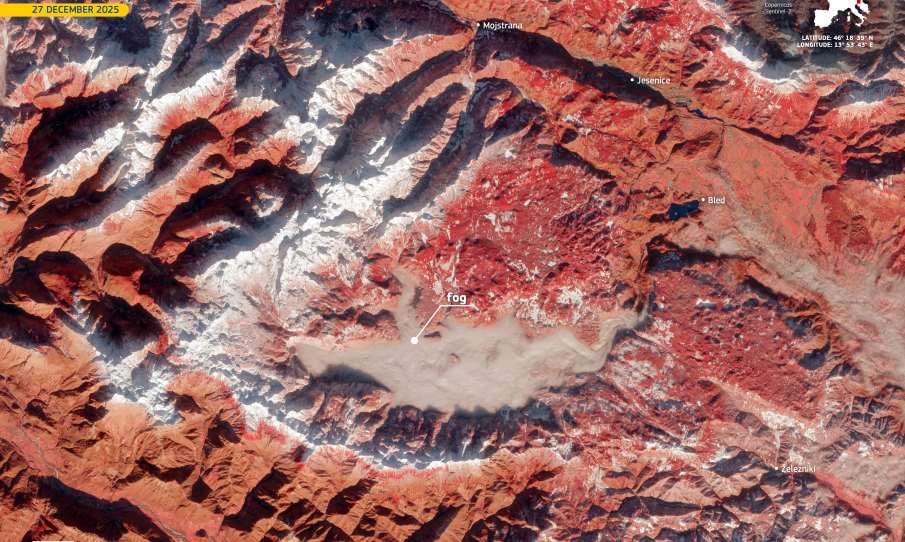
The Julian Alps form a continuous mountain system stretching into northeastern Italy and serve as an important Alpine corridor for wildlife. Deep valleys and high-altitude pastures create a mosaic of habitats where elevation strongly influences climate and species distribution. In winter, temperature inversions frequently trap cold air in valleys, producing persistent fog while higher slopes remain snow-covered and exposed to sunlight.
This false-colour image, acquired on 27 December 2025 by one of the Copernicus Sentinel-2 satellites, shows dense fog confined within a valley of Triglav National Park. Snow appears in bright white tones across higher elevations, while ice-free ground and sparse winter vegetation are visible in shades of brown and red, clearly outlining differences in altitude and surface conditions.
Above the tree line, alpine grasslands and rocky slopes support species adapted to steep terrain and snow. Chamois are the most characteristic inhabitants of the alpine zone, using open rocky areas in summer and retreating toward forests or valleys during harsh winters. Alpine ibex occupy high mountain grasslands and reduce movement in winter to conserve energy. Marmots, reintroduced to the area at the end of the 20th century after disappearing during the Ice Age, hibernate beneath snow-covered meadows. Birds such as black grouse rely on sheltered terrain and limited winter food sources.
Forests, less visible in this scene, cover roughly two thirds of the park at lower elevations and plateaus. Beech, spruce, and larch dominate, with spruce and larch becoming more common above 1,800 m further inland. These woodlands provide habitat for red deer, red foxes, and smaller mammals. Brown bears are not permanent residents of the high Alps, but individual animals are occasionally recorded in areas such as the Pokljuka plateau and nearby valleys, reflecting the park’s role within a wider regional ecosystem.
Open data from the Copernicus Sentinel-2 satellites supports monitoring of snow cover, fog persistence, and vegetation exposure across Triglav National Park and the Julian Alps. These observations help scientists and local authorities better understand how winter extremes influence alpine ecosystems, wildlife movement, and landscape dynamics in one of Europe’s most environmentally complex mountain regions.
Featured image credit: European Union, Copernicus Sentinel-2 imagery