
Summary:
Climate change played a measurable role in the decline of the Tang dynasty, according to a new interdisciplinary study examining how repeated droughts and floods strained food systems and political stability in northern China more than a millennium ago. The research, published in Communications Earth & Environment, focuses on the period between 800 and 907 CE, when the once-powerful dynasty began to unravel.
Using long-term tree-ring records from the Yellow River basin, the scientists reconstructed patterns of river runoff to understand how hydroclimatic extremes affected agriculture and supply networks. The analysis shows that recurrent flooding and prolonged droughts coincided with a shift away from drought-tolerant millet toward wheat and rice, crops that require more water and are less resilient during dry periods. As cooler and drier conditions set in during the late 9th century, harvest failures became more frequent, leading to food shortages that weakened both civilian populations and military garrisons along the empire’s northern frontier.
The study suggests that these environmental pressures, combined with raiding, disrupted grain supplies and encouraged migration away from border regions, contributing to political destabilization. While the authors stress that climate was only one factor among many, their findings illustrate how environmental stress can amplify existing vulnerabilities in complex societies.
— Press Release —
How climate change contributed to the demise of the Tang dynasty
Migration and mobility due to climate change are nothing new. This is suggested by an interdisciplinary study in which researchers from the University of Basel were also involved. They investigated how hydrological extremes such as droughts and floods between 800 and 907 CE in particular affected society and politics in China.
They report on their findings in Communications Earth and Environment.
Tree rings as contemporary witnesses
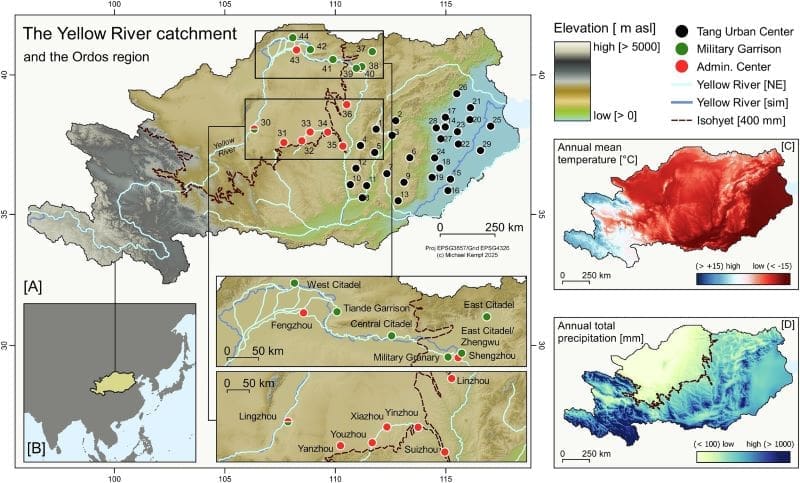
This period is interesting because it marked the decline of the Tang dynasty, which had existed since 618 CE and is considered a cultural high point in China’s history, with a sophisticated administrative system and a flourishing culture. The study focuses on the region around the Huanghe river (Yellow River) in northern China. Using climate proxy data, they determined trends in how the local climate changed in the 9th century CE.
Tree rings, for example, provide clues about the climate. Their condition indicates whether a year was dry or rainy: in years with high precipitation, trees grow faster and the tree rings are further apart than in dry years. The older a tree is, the further back this data archive goes.
The researchers used existing long-term tree-ring data records from the Yellow River basin. The reconstructed runoff behavior served as an indicator for hydroclimatic models, especially for the upper courses of the river. “The runoff eventually reaches further downstream and influences the amount of water available, for example for irrigating the fields,” says the study’s first author Michael Kempf, who has since moved from the University of Basel to the University of Cambridge.
Fatal changes in agriculture
Based on their analyses, the researchers conclude that climatic changes and an increase in extreme weather events were key factors in the collapse of the Tang dynasty in 907 CE. Increased droughts and floods took their toll on the soldiers tasked with protecting the empire’s outer borders and their families against invasive troops from across the borders.
“Hydroclimatic extremes have a very direct influence on crop failure and grain storage conditions,” says Kempf. Seed shortages and increased food demand quickly pushed supply systems to their limits. A bad year therefore also had consequences for the future.
The situation was further exacerbated by the choice of cereal crops: people increasingly favored the cultivation of wheat and rice over millet. Kempf can only speculate about the reasons for the agricultural change. Perhaps millet was considered a less prestigious food than wheat and rice. However, these are less climate-resistant than drought-resistant millet and require more water to grow. “As long as there is enough water, this is not a problem, but during prolonged dry periods, shortages occur.” Millet cultivation could perhaps have cushioned these negative effects. As it was, however, the risk of crop failures and famines increased.
These losses could not easily be compensated for by shipments from other parts of the country. This was also because droughts and floods affected supply routes and supply corridors collapsed.
Fleeing from hunger
The malnutrition of the population may ultimately have led to the collapse of border defenses in the north of the empire. “Of course, people were weakened and therefore more vulnerable. Due to the military pressure on the outer border regions, they migrated south, where they believed they would find better conditions,” says Kempf. “This led to political destabilization and is likely to have contributed to the demise of the Tang dynasty.”
However, Kempf emphasizes: “Our results are approximations. The actual conditions at that time cannot be reconstructed with certainty. It’s a complex interplay of many different factors.”
The study concluded that socio-cultural and climatic changes can lead to tipping points in the system because the balance is disrupted. This is a development that could occur more frequently in view of climate change today.
Journal Reference:
Kempf, M., Depaermentier, M.L.C., Spengler III, R.N. et al., ‘Hydroclimatic instability accelerated the socio-political decline of the Tang Dynasty in northern China’, Communications Earth & Environment 6, 1003 (2025). DOI: 10.1038/s43247-025-03038-x
Article Source:
Press Release/Material by Noëmi Kern | University of Basel
Featured image: Model of Mingzhou from the Tang Dynasty, exhibited at Ningbo Museum. Credit: Siyuwj | CC BY-SA