

Summary:
Feeding biochar to cattle could boost soil carbon storage and reduce agricultural emissions, according to a new study published in the journal Biochar. Researchers found that most of the biochar consumed by dairy cows survives digestion and remains chemically stable, allowing it to be returned to fields through manure and potentially store carbon in soils for long periods.
Biochar is a carbon-rich material produced by heating biomass such as wood or crop residues in low-oxygen conditions. It has been widely studied for improving soil quality and locking carbon into the ground. In feeding trials with dairy cows, scientists analysed dung samples using thermal analysis, elemental analysis and dichromate oxidation to measure how much biochar remained after digestion and whether its structure changed.
The results showed that 70 to 90 percent of the biochar passed through the animals largely intact. The recovered material retained stable aromatic carbon structures and met established criteria for highly durable biochar. The findings suggest that integrating biochar into livestock feed could offer a practical way to link animal production with long-term carbon sequestration in agricultural soils.
— Press Release —
Feeding biochar to cattle may help lock carbon in soil and cut agricultural emissions
Researchers have found that most biochar fed to dairy cows survives the digestive process and remains highly stable, meaning it could be applied to fields through manure and act as a long-term carbon storage solution. The findings provide new evidence that livestock systems could play a role in climate change mitigation.
The study, recently published in Biochar, investigated what happens to biochar after it passes through the digestive system of cattle. Biochar is a carbon-rich material produced when biomass such as wood or crop residues is heated under low-oxygen conditions. It has been widely studied for its ability to improve soil quality and store carbon in soils for extended periods.
Agriculture is responsible for a substantial share of global greenhouse gas emissions, and scientists are searching for innovative ways to reduce this impact while maintaining productivity. Feeding biochar to livestock has attracted increasing attention because it may simultaneously improve animal performance and enhance soil carbon storage.
“Our research shows that feeding biochar to cattle can create a cascading environmental benefit,” said the study authors. “The biochar not only passes through the animal largely intact but also remains chemically stable, making it well suited for long-term carbon sequestration when returned to soil through manure.”
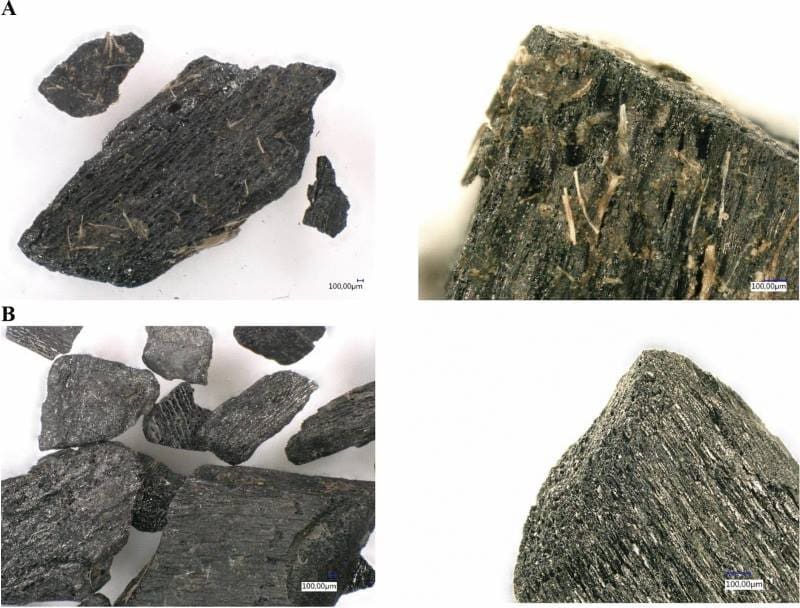
To examine biochar’s fate after digestion, the research team conducted feeding trials with dairy cows and analyzed dung samples using three advanced analytical methods. These techniques allowed scientists to measure how much biochar survived digestion and whether its chemical structure changed.
The results showed that approximately 70 to 90 percent of the biochar fed to cows was recovered in dung samples. Importantly, the surviving biochar retained key characteristics associated with long-term stability, including condensed aromatic carbon structures that resist microbial decomposition.
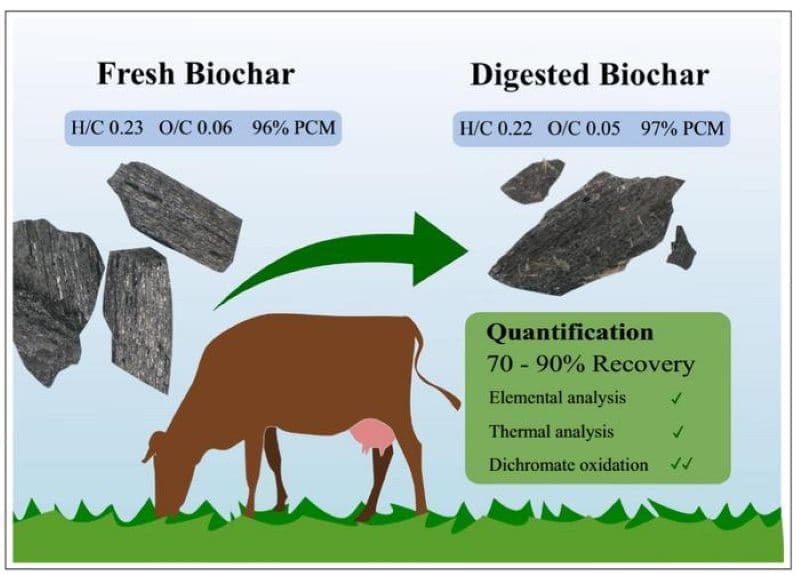
The researchers also discovered that digestion selectively preserved the most stable components of biochar. The digested material displayed chemical ratios consistent with highly durable biochar, indicating that it could persist in soils for extended periods after manure application. This stability is critical for carbon sequestration because it prevents carbon from rapidly returning to the atmosphere as carbon dioxide.
Beyond carbon storage, the findings suggest additional agricultural benefits. Biochar in manure may help stabilize nutrients and reduce emissions of methane and ammonia, both potent greenhouse gases linked to livestock production. The material may also support soil fertility by improving nutrient retention and water holding capacity when applied to agricultural land.
To ensure accuracy, the study compared multiple quantification methods and found that each reliably measured biochar content within a narrow margin of error. Among the tested approaches, chemical oxidation methods produced the most precise results, providing a valuable tool for future research on biochar cycling in agricultural systems.
While the findings are promising, the researchers emphasize that the effectiveness of feed-integrated biochar depends on the quality and composition of the original material. Additional studies are needed to evaluate long-term field performance and to assess how different biochar types influence animal health, manure properties, and soil carbon storage.
Overall, the study highlights a novel pathway for integrating climate solutions into livestock management. By combining animal feeding strategies with soil carbon sequestration, biochar could help agriculture reduce emissions while supporting sustainable food production.
Journal Reference:
Walz, I.L., Dittmann, M. & Leifeld, J., ‘Recovery and composition of biochar after feeding to cattle’, Biochar 8, 13 (2026). DOI: 10.1007/s42773-025-00507-6
Article Source:
Press Release/Material by Biochar Editorial Office | Shenyang Agricultural University (SYAU)
Featured image credit: Lomig | Unsplash