On Malta’s north-eastern coast, Valletta stands as a fortified Renaissance capital, shaped by military engineering and enclosed by the sea. The city occupies a narrow peninsula between the Grand Harbour and Marsamxett Harbour, its bastions and curtain walls tracing the rocky shoreline. Founded in 1566 by the Order of the Knights of St John after the Great Siege, Valletta was conceived as a planned stronghold and administrative centre, built according to a strict grid that still structures the urban landscape.
Recognised as a UNESCO World Heritage Site, Valletta is regarded as one of the most concentrated historic areas in the world. Within just 55 hectares lie 320 monuments reflecting the civil, religious and military functions of the Order. St John’s Co-Cathedral, the Grand Master’s Palace and the auberges constructed for the different langues form part of a unified architectural ensemble dating largely from the 16th and 18th centuries. Despite wartime damage and later reconstruction, the original street layout, scale and skyline remain largely preserved, maintaining the relationship between the fortified city and its maritime setting.
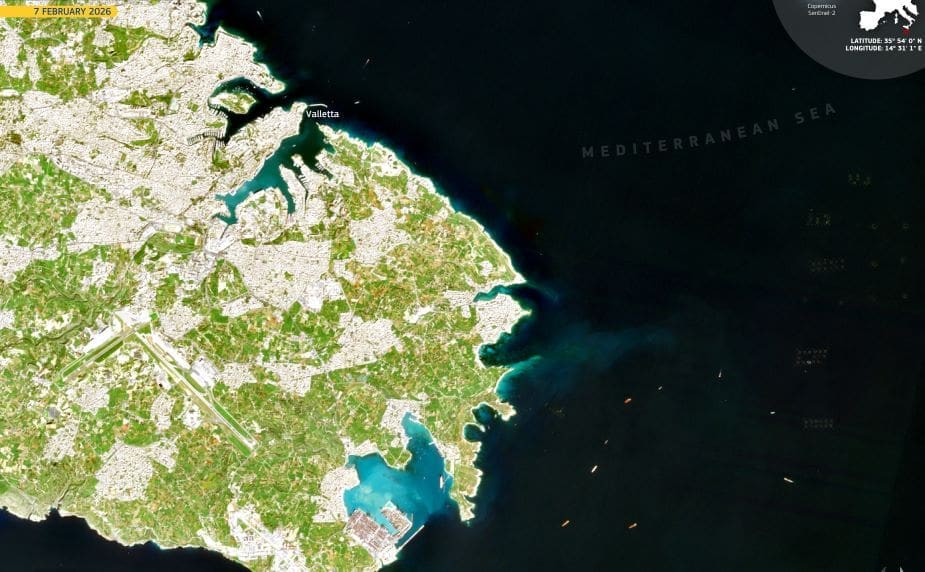
In this Copernicus Sentinel-2 image acquired on 7 February 2026, Valletta appears as a compact, pale-toned peninsula projecting into deep blue waters. Dense built-up areas show in light grey and beige, while the harbours on either side frame the city in darker shades of blue. Lighter turquoise bands indicate shallow coastal zones and port infrastructure. Beyond the walled core, bright green patches of cultivated land interrupt the continuous urban fabric of eastern Malta.
The satellite perspective also situates the capital within a country of limited space and high demographic pressure. Malta has around 560,000 residents and a population density of 1,816 people per square kilometre, placing it among the most densely populated states globally. Development, transport corridors and port facilities surround the peninsula, increasing demands on infrastructure and public space. In such a context, heritage protection must operate alongside modern planning controls to safeguard views, building heights and the historic profile of the skyline.
Earth observation data support these efforts by enabling long-term monitoring of land-use change, coastal development and environmental impacts. From orbit, Valletta’s Renaissance plan remains clearly legible – a 16th-century city embedded within a 21st-century urban landscape.
Featured image credit: European Union, Copernicus Sentinel-2 imagery