Wellington, New Zealand | AFP | Muser NewsDesk
Scientists say they have drilled deeper than ever beneath the West Antarctic Ice Sheet, peering back millions of years to reveal signs it was once, at least in part, open ocean.
The vast expanse is estimated to hold enough ice to raise global sea levels by four to five metres (13 to 16 feet), said the international team of 29 researchers.
By drilling through the ice and the sediment below, they retrieved samples showing what it was like up to 23 million years ago.
The hope is that by studying how it melted in Earth’s past, they can determine the factors that drove its retreat, including the ocean temperature at the time.
This may help determine how fast the ice sheet will melt in the future in Earth’s warming climate.
“Satellite observations over recent decades show the ice sheet is losing mass at an accelerating rate, but there is uncertainty around the temperature increase that could trigger rapid loss of ice,” they said in a report released Wednesday of their initial observations.
“Up until now, ice sheet modellers have relied on geological records from further afield.”
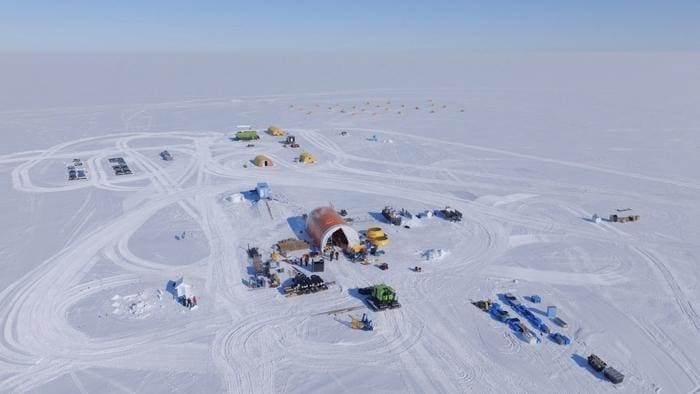
They drilled through 523 metres of ice and 228 metres of ancient rock and mud at Crary Ice Rise on the Ross Ice Shelf, said the team led by Earth Sciences New Zealand, Wellington’s Victoria University, and Antarctica New Zealand.
‘Marine organisms’
“Some of the sediment was typical of deposits that occur under an ice sheet like we have at Crary Ice Rise today,” said co-chief scientist Molly Patterson of the United States’ Binghamton University.
But they also found shell fragments and the remains of marine organisms that need light — material more typical of an open ocean, an ice shelf floating over ocean, or an ice-shelf margin with icebergs calving off, Patterson said.
Scientists already thought the region was once open ocean, indicating a retreat of the Ross Ice Shelf, and potential collapse of the West Antarctic Ice Sheet.
But there was uncertainty about when this happened.
The new record provided sequences of environmental conditions through time, and direct evidence of the presence of open ocean in this region, Patterson said.
Huw Horgan, a fellow co-chief of the project from Victoria University of Wellington, said initial indications were that the samples spanned the past 23 million years.
This included periods when Earth’s global average temperatures were significantly higher than two degrees Celsius above pre-industrial times, Horgan said.
Drilling ended in January and core samples have been transported from Crary Ice Rise more than 1,100 kilometres (680 miles) across the Ross Ice Shelf to Scott Base, from where they will be sent to New Zealand for further analysis.
bes/djw/ceg
© Agence France-Presse
Article Source:
Press Release/Material by AFP
Featured image: An aerial view of the Antarctic drilling site in the 2023-2024 season. Credit: Anthony Powell | Antarctica New Zealand