
Summary:
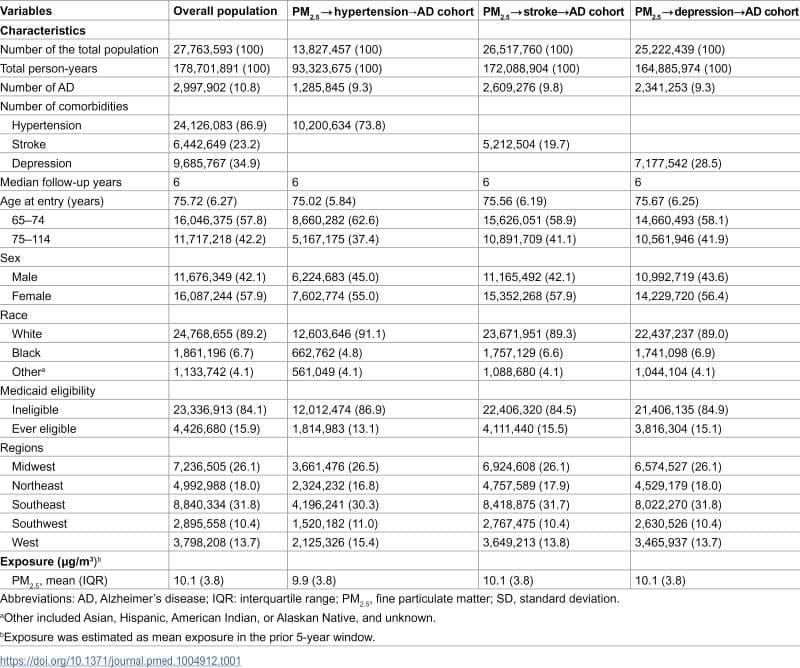
Air pollution may play a direct role in the development of Alzheimer’s disease, according to a large U.S. study published in PLOS Medicine. Researchers led by Yanling Deng at Emory University analyzed data from 27.8 million Medicare beneficiaries aged 65 and older between 2000 and 2018. Over the study period, about 3 million participants were diagnosed with Alzheimer’s disease.
The team examined long-term exposure to fine particulate matter, known as PM₂.₅, using five-year average pollution levels prior to diagnosis. Higher exposure was associated with an increased risk of developing Alzheimer’s. The link was slightly stronger among individuals with a history of stroke, suggesting this group may be more susceptible to the neurological effects of air pollution. Hypertension and depression were also associated with both pollution exposure and Alzheimer’s risk, but they did not substantially explain the relationship.
The findings indicate that air pollution may contribute to Alzheimer’s largely through direct biological pathways rather than indirectly through common chronic conditions. The results add to evidence that reducing air pollution could form part of broader strategies to lower dementia risk in aging populations.

— Press Release —
Air pollution may directly contribute to Alzheimer’s disease
People with greater exposure to air pollution face a higher risk of developing Alzheimer’s disease, according to a new study by Yanling Deng of Emory University, U.S.A., and colleagues, published in the open-access journal PLOS Medicine.
Alzheimer’s disease is the most common form of dementia, affecting about 57 million people worldwide. Exposure to air pollution is a known risk factor for Alzheimer’s disease, and for several common chronic health conditions, such as hypertension, stroke and depression. These chronic conditions are also linked to Alzheimer’s disease, but previously it was unclear whether air pollution causes these chronic conditions, which then lead to dementia, or if these conditions might amplify the effects of air pollution on brain health.
A team at Emory University studied more than 27.8 million U.S. Medicare recipients aged 65 years and older from 2000 to 2018. The researchers looked at individuals’ air pollution exposure level and whether they developed Alzheimer’s disease, while emphasizing the role of other chronic conditions. They found that greater exposure to air pollution was associated with an increased risk of Alzheimer’s disease, and that association was slightly stronger in individuals who had experienced a stroke. Hypertension and depression, however, had little additional impact.
Overall, the findings suggest that air pollution contributes to Alzheimer’s disease mostly through direct pathways rather than through other chronic health conditions. However, people with a history of stroke may be especially susceptible to the harmful effects of air pollution on brain health. The study indicates that improving air quality could be an important way to prevent dementia and protect older adults.
The authors add, “In this large national study of older adults, we found that long-term exposure to fine particulate air pollution was associated with a higher risk of Alzheimer’s disease, largely through direct effects on the brain rather than through common chronic conditions such as hypertension, stroke, or depression.”
“Our findings suggest that individuals with a history of stroke may be particularly vulnerable to the harmful effects of air pollution on brain health, highlighting an important intersection between environmental and vascular risk factors.”
Journal Reference:
Deng Y, Liu Y, Hao H, Xu K, Zhu Q, Li H, et al., ‘The role of comorbidities in the associations between air pollution and Alzheimer’s disease: A national cohort study in the American Medicare population’, PLOS Medicine 23 (2): e1004912 (2026). DOI: 10.1371/journal.pmed.1004912
Article Source:
Press Release/Material by PLOS
Featured image credit: Freepik (AI Gen.)