Summary:
Waste wood biochar could help turn buildings into thermal batteries, according to a new study published in the journal Biochar. Researchers at Yonsei University in South Korea report that a composite made from spruce-derived biochar, modified montmorillonite clay and paraffin can store and release heat efficiently, reducing cooling demand in buildings.
The team engineered a porous “biomineral” scaffold by doping treated clay into lignocellulose-based biochar, then infused it with hexadecane, a phase change material that absorbs heat as it melts and releases it as it solidifies. The resulting composite reached latent heat values of 121.3 joules per gram – a 223 percent increase compared with a clay-only system – and improved thermal conductivity by 78 percent relative to pure paraffin. In laboratory cycling tests between 23 and 50 °C, the material retained more than 95.9 percent of its heat storage capacity after 1,000 cycles.
Building energy simulations suggest that walls incorporating the composite could cut annual cooling energy use by about 54 percent compared with bulk paraffin and by roughly 24.3 percent compared with buildings without phase change materials, pointing to a lower-carbon approach to indoor temperature control.

— Press Release —
Turning waste wood into a thermal battery
Researchers at Yonsei University in South Korea have developed a new composite material that stores and releases heat by melting and solidifying a common wax-like substance called paraffin. The team combined spruce wood biochar with a naturally occurring clay mineral called montmorillonite and then infused the porous hybrid with liquid hexadecane, a type of paraffin that serves as a phase change material. Phase change materials absorb large amounts of heat as they melt and then release it as they solidify, acting like compact thermal “batteries” for managing temperature swings.
“By engineering a greener support framework for paraffin, we can capture more heat, move it more efficiently and do it with materials that come from biomass and earth minerals,” said lead author Dimberu G. Atinafu of Yonsei University.
A greener scaffold for storing heat
Conventional phase change composites often rely on costly or fossil-based carbon materials such as graphene and carbon nanotubes to hold molten paraffin in place and boost heat transfer. In the new study, the team instead used lignocellulose-based biochar derived from spruce waste and modified montmorillonite clay, creating what they describe as an engineered “biomineral” support. The clay was treated with an organic surfactant to open up its layered structure, then doped into the biochar to form a three dimensional porous network. This engineered mineral-doped biochar showed a more than fivefold increase in surface area over the raw clay, giving paraffin more space to infiltrate and crystallize.
Read also: Modern buildings risk not being ready for climate change warns academic
More energy stored, faster heat flow
When the researchers infused the hybrid with hexadecane under vacuum, the resulting composite – dubbed EMBC16 – stored substantially more thermal energy than a similar paraffin–clay material without biochar. The engineered composite reached latent heat values up to 121.3 joules per gram, representing about a 223 percent increase in energy storage capacity compared with the montmorillonite-only composite.
At the same time, the material’s thermal conductivity improved by 78 percent relative to pure paraffin, allowing heat to move in and out more quickly during melting and solidification. In repeated heating and cooling tests between about 23 and 50 degrees Celsius, EMBC16 maintained over 95.9 percent of its original latent heat after 1000 cycles and showed less than 2.2 percent leakage of molten paraffin, indicating robust long term stability.
Simulated energy savings in buildings
To explore real world impact, the team used building energy simulation software to test how the new composite would perform as an interior finishing material in a model historic building in Seoul. Compared with using bulk paraffin alone, walls incorporating EMBC16 cut annual cooling energy consumption by about 54 percent in the model, and reduced cooling demand by roughly 24.3 percent relative to a baseline building without any phase change material.
Read also: Biochar’s overlooked potential: A game-changer for carbon storage and climate strategies
Thermal imaging experiments on lab samples also showed that EMBC16 surfaces warmed more slowly than clay-based composites and cooled in a controlled way, demonstrating both thermal insulation and buffering effects. The material’s porous architecture and tailored surface chemistry help balance heat storage and heat flow, which is critical for smoothing daily temperature fluctuations.
Toward circular and scalable thermal materials
Because the composite uses biochar from waste biomass and abundant clay minerals, the researchers say it aligns with circular economy goals while avoiding some environmental concerns associated with high cost nanocarbons. However, they note that the current process relies on a synthetic surfactant and intensive washing steps, which could generate wastewater at scale. As a next step, the team proposes replacing the surfactant with low cost bio-based molecules, such as plant-derived saponins, and adopting closed-loop water recycling and more efficient activation methods to make production more sustainable.
“Biochar–mineral hybrids open a path to thermal materials that are not only high performing but also rooted in waste to resource thinking,” said corresponding author Sumin Kim. “These composites could help future buildings store daytime heat or coolth and release it when needed, reducing our reliance on active air conditioning systems.”
Journal Reference:
Atinafu, D.G., Nam, J. & Kim, S., ‘Engineered mineral-doped biochar-infused paraffin for synergistic enthalpy storage and enhanced thermal management’, Biochar 8, 6 (2026). DOI: 10.1007/s42773-025-00517-4
Article Source:
Press Release/Material by Biochar Editorial Office | Shenyang Agricultural University (SYAU)
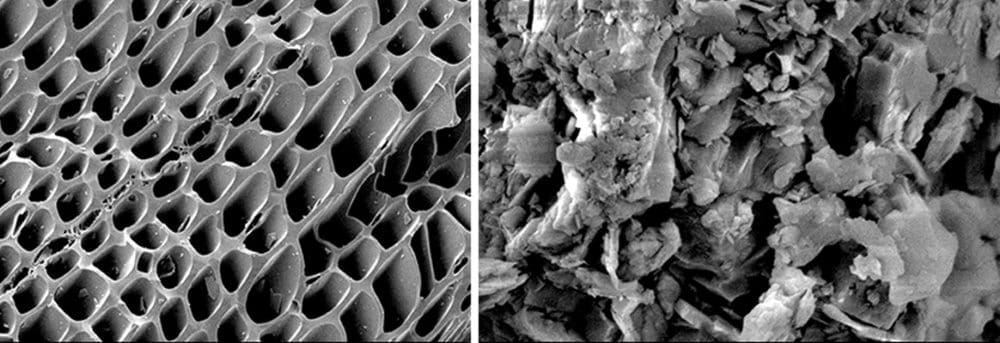
Featured image: Scanning electron microscopy (SEM) images of (left) spruce tree-derived carboxy biochar (SB) and (right) organically intercalated montmorillonite (MT) (cropped image of Fig. 2). Credit: Atinafu, Nam & Kim (2026) | DOI: 10.1007/s42773-025-00517-4 | Biochar | CC BY