Tromsø, European Youth Capital 2026, lies about 350 km north of the Arctic Circle in northern Norway and is home to nearly 80,000 residents, making it the largest urban centre in Northern Norway. Built largely on the island of Tromsøya and connected to the mainland by bridge and tunnel, the city is often described as a gateway to the North Pole. It hosts the University of Tromsø – The Arctic University of Norway (UiT) – and serves as a regional hub for research, fisheries, culture and Arctic policy. With roughly half its population under 35 and residents from more than 140 nationalities, Tromsø combines Arctic geography with a distinctly young demographic profile.
Each winter, the city enters a period of polar night, when the sun remains below the horizon and only faint daylight appears for a short time around midday. For weeks, daily life unfolds in twilight conditions shaped by snow, artificial light and the surrounding mountains and fjords. The seasonal darkness is a defining feature of Tromsø’s climate and identity, as much as the midnight sun that follows in summer.
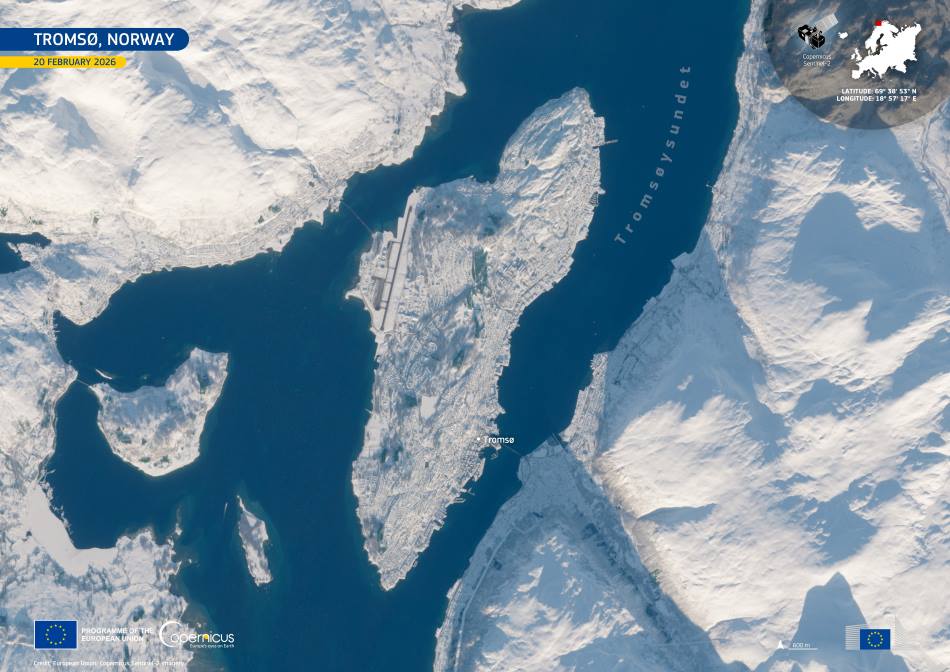
This Copernicus Sentinel-2 image from 20 February 2026 is among the first images acquired after the end of the polar night. It shows Tromsø and the surrounding landscape covered in snow, with the island city set against white mountain ridges and dark Arctic waters. Roads, residential areas and port facilities are visible beneath a uniform winter cover, while the fjords cut through the terrain in sharp contrast. The low angle of the returning sunlight accentuates relief and shadow across the terrain.
The joint use of Copernicus Sentinel-1 and Sentinel-2 satellites enables regular monitoring of Arctic conditions throughout the year. Sentinel-1’s radar instruments can collect data regardless of cloud cover or darkness, which is particularly important during the polar night. Sentinel-2 provides high-resolution optical imagery when daylight allows. Together, these missions support scientists and public authorities in tracking snow extent, sea ice, land use and other environmental indicators.
The Arctic is warming faster than many other regions of the world, and sustained Earth observation is essential for understanding how these changes affect northern communities and ecosystems. Satellite data from the Copernicus programme contribute to long-term records that inform climate research, local planning and environmental protection strategies.
Captured as daylight returns to Tromsø in February 2026, the image documents both a seasonal transition and the broader environmental context of a city that stands at the centre of Arctic research and youth engagement in Europe this year.
Featured image credit: European Union, Copernicus Sentinel-2 imagery