Estonia faced one of its coldest winters in around 25 years in early 2026, with January and the first half of February marked by persistent sub-zero temperatures and widespread ice formation. The Estonian Environment Agency reported that average temperatures remained well below the long-term norm, as a stable high-pressure system brought clear skies and prolonged frost across the country.
Night-time temperatures in inland areas frequently fell to around −20 °C, while daytime values often remained between −10 °C and −3 °C. The extended freeze contributed to the rapid formation and thickening of sea ice along the western coast and around the archipelago.
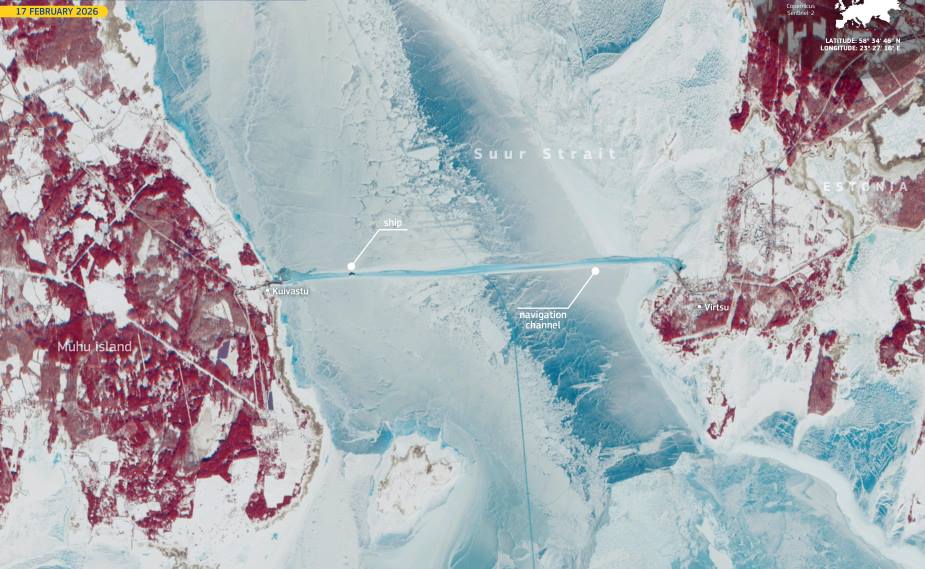
The Copernicus Sentinel image, acquired on 17 February 2026, focuses on the Suur Strait (Suur väin) in western Estonia, the stretch of water separating Muhu Island from the mainland. In the scene, the strait appears largely frozen, with sea ice spanning wide sections between the coastlines. Snow covers both shores, while the pale, textured surface of the ice contrasts with darker patches of open water and fractured ice further offshore. The surrounding low-lying landscape, fields and forested areas are blanketed in snow, reflecting the prolonged cold spell that dominated the region.
Ice conditions in the Suur Strait and nearby waters were strong enough in February to support the opening of seasonal ice roads linking islands and the mainland, including connections serving Saaremaa and Hiiumaa. These temporary routes operate only when ice thickness meets strict safety thresholds and are closely monitored by authorities.
Such sustained freezing conditions affect maritime traffic, local transport and daily routines, particularly in western Estonia where communities depend on reliable connections across narrow straits. By mid-February, the country remained under the influence of cold Arctic air.
Copernicus Sentinel satellites provide regular observations of sea ice extent, snow cover and surface conditions across the Baltic region, enabling authorities and researchers to monitor the evolution of winter events such as the February 2026 freeze in detail from space.
Featured image credit: European Union, Copernicus Sentinel-2 imagery