Each year, the European Commission hosts European Ocean Days, a week-long series of events dedicated to ocean policy, science and maritime industries. The gathering brings together policymakers, researchers, businesses, investors, coastal communities and civil society to exchange ideas and discuss priorities for Europe’s seas.
Inspired by the European Ocean Pact, the third edition of the event – held in Brussels from 2 to 6 March 2026 – features consultations, panel discussions, workshops and community sessions. Participants from sectors including fisheries, aquaculture, maritime transport, marine technology and coastal development explore ways to support economic activity at sea while protecting marine ecosystems.
At the opening of the event, European Commission President Ursula von der Leyen announced the launch of OceanEye, a new initiative aimed at strengthening Europe’s capacity to observe and monitor the ocean and to improve international cooperation in ocean data.
The initiative is intended to reinforce Europe’s leadership in ocean science and observation while supporting marine industries and improving the protection of ocean ecosystems. The European Union also announced €50 million from the Horizon Europe programme for 2026–2027 to support an International Alliance dedicated to expanding global ocean monitoring systems.
The role of the EU blue economy
Ocean-related economic activities are commonly referred to as the blue economy. In the European Union, this includes sectors such as maritime transport, fisheries, aquaculture, coastal tourism, offshore renewable energy, port services and marine technology.
These sectors represent a significant part of Europe’s coastal economies. According to the European Commission’s EU Blue Economy Report 2025, ocean-related industries provide around five million jobs across the EU and generate roughly €250 billion in gross value added.
The blue economy is closely linked to the condition of marine ecosystems. Fisheries rely on healthy fish stocks, maritime transport depends on safe navigation and stable ocean conditions, and tourism depends on clean and attractive coastal environments.
Mediterranean Sea and its blue economy
The Mediterranean Sea is one of the world’s most intensively used marine regions and a central area for blue-economy activity. The basin connects Europe, Africa and Asia through major maritime routes, making it a key corridor for international shipping.
Coastal tourism is the largest economic sector in many Mediterranean countries, attracting hundreds of millions of visitors each year. Fisheries and aquaculture also remain important sources of employment and food production for coastal communities around the basin.
Economic estimates frequently place the value of Mediterranean ocean-related activities at around US$450 billion annually, reflecting the scale of tourism, shipping, fisheries and coastal industries operating in the region.
At the same time, the Mediterranean is a relatively small and semi-enclosed sea with intense human activity. Scientific monitoring is therefore essential to understand how marine ecosystems evolve and how environmental changes may affect economic activities that depend on the sea.
Why chlorophyll matters in the ocean
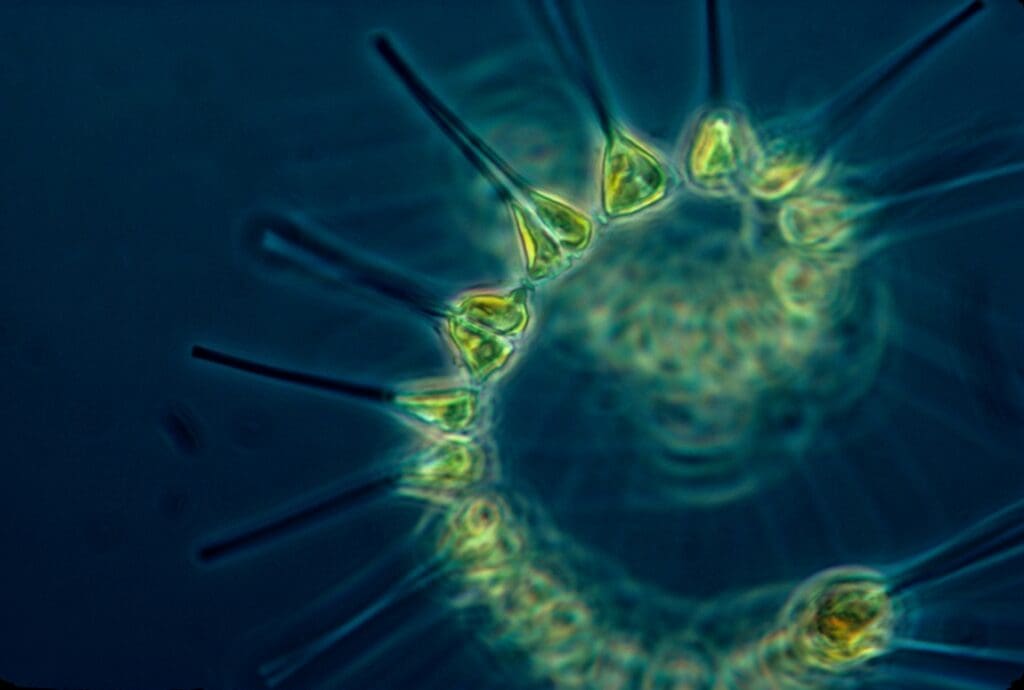
One of the key indicators scientists use to monitor marine ecosystems is chlorophyll-a (Chl-a), a pigment found in phytoplankton – microscopic algae that perform photosynthesis in the upper layers of the ocean.
Phytoplankton form the base of the marine food web. Their abundance influences the productivity of marine ecosystems and ultimately supports fisheries and other ocean-based resources.
Measuring chlorophyll concentrations helps scientists understand how marine ecosystems function, how productivity varies across regions and seasons, and how environmental changes influence ocean life.

This image shows the distribution of chlorophyll-a in the Mediterranean Sea on 3 March 2026, based on data from the Copernicus Marine Service.
Chlorophyll is one of the ocean variables monitored by the Copernicus programme. Satellite observations combined with modelling systems allow scientists to map phytoplankton activity across large ocean regions, providing insights into marine productivity and environmental variability.
These data help researchers analyse ecosystem changes and support applications linked to fisheries management, aquaculture planning and marine environmental monitoring.
Copernicus Marine Service and the OceanEye initiative
The Copernicus Marine Service is part of the European Union’s Earth observation programme and provides open access to information about ocean conditions, including temperature, currents, sea level and marine ecosystems.
The newly announced OceanEye initiative will build on existing European programmes such as Copernicus and the European Digital Twin Ocean (EDITO), with the goal of strengthening Europe’s ocean observation capabilities.
OceanEye aims to expand ocean monitoring systems, improve prediction tools and reinforce international cooperation on ocean data. According to the European Commission, the initiative is expected to contribute to a fully operational European ocean observation system by 2030.
Improved observation and data systems are increasingly important for understanding marine ecosystems and supporting sustainable ocean-based economic activity. Satellite measurements of variables such as chlorophyll provide one of the many tools used to monitor the state of the ocean and track environmental changes over time.
Featured image credit: European Union, Copernicus Marine Service Data