Heavy rainfall during Ecuador’s 2026 rainy season pushed rivers beyond their banks across parts of the country’s coastal region, where low-lying plains are particularly exposed to flooding. In early March 2026, authorities warned that continued storms and saturated ground could worsen conditions in the Guayas River basin, one of the most densely populated and economically important regions of western Ecuador.
The National Institute of Meteorology and Hydrology of Ecuador (INAMHI) issued alerts on 2 March 2026 for intense rainfall and thunderstorms across the coastal provinces, including Guayas and Los Ríos. Rivers in this basin respond quickly to prolonged precipitation. When water levels rise in upstream tributaries, floodwater spreads across agricultural land and settlements before flowing toward the Gulf of Guayaquil.
The situation followed earlier storms in the region. On 20 February 2026, more than 12 hours of rain caused flooding in Guayaquil and the neighbouring city of Durán, with streets submerged and drainage systems overwhelmed. Local authorities reported water entering homes and disrupting traffic in several districts as emergency crews worked to clear blocked drains.
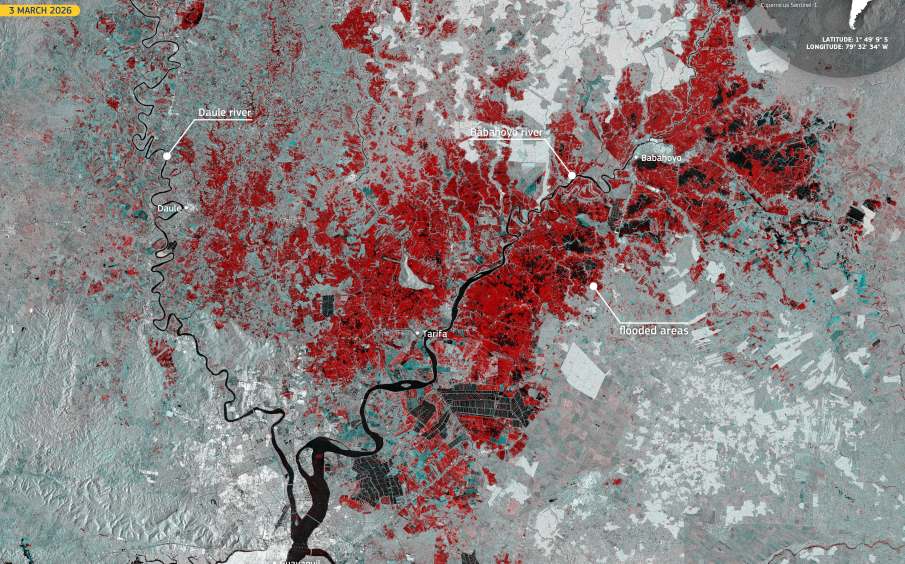
This image, acquired on 3 March 2026 by one of the Copernicus Sentinel-1 satellites, shows flooded areas in red tones along both banks of the Babahoyo River.
The Babahoyo River flows through Los Ríos Province before joining the Daule River to form the Guayas River near the city of Guayaquil. Its broad floodplain is used extensively for agriculture, meaning seasonal floods can affect both farmland and nearby communities.
The Sentinel-1 satellites, part of the European Union’s Copernicus Earth observation programme, carry radar instruments that can observe the Earth’s surface through clouds and heavy rain. This capability allows analysts to map flooded areas even during severe weather, when optical satellites cannot see the ground.
Copernicus satellite data enable authorities to detect and map the extent of flooding, supporting emergency services in assessing impacts, coordinating response actions, and informing long-term urban resilience planning in vulnerable coastal cities.
Featured image credit: European Union, Copernicus Sentinel-1 imagery