Across the southwest Pacific, a chain of volcanoes marks the boundary where the Pacific Plate descends beneath the Australian Plate. This tectonic boundary forms the Tonga–Kermadec volcanic arc, a system extending more than 3,000 km from New Zealand to Tonga. The region hosts dozens of submarine volcanoes generated by the continuous subduction of oceanic crust, making it one of the most active volcanic belts on Earth.
Home Reef is one of these volcanoes. Located in the central Tonga islands between Late Island and Metis Shoal, the volcano rises from the seafloor to just below the ocean surface. Because its summit lies only a few metres beneath sea level, eruptions can rapidly build volcanic material above the water, temporarily creating new land.
Historical observations compiled by the Smithsonian Institution’s Global Volcanism Program (GVP) show that Home Reef has produced several short-lived islands since the mid-19th century. Island-forming eruptions were recorded in 1852, 1857, 1984 and 2006, each creating a small volcanic island composed largely of ash, pumice and fragmented lava. These islands rarely persist for long. Once eruptive activity declines, waves and storms gradually erode the loose deposits until the island disappears beneath the sea again.
One of the most powerful eruptions occurred in 1984. During that event, an ash plume rose to about 12 km above the ocean and a new island roughly 1,500 m long and 500 m wide formed above the vent. Cliffs reaching 30–50 m surrounded a central crater lake. The eruption also released large pumice rafts that drifted across wide areas of the Pacific Ocean.
Rapid island growth observed from space
Home Reef entered another active phase in September 2022, when volcanic material quickly accumulated above the vent and a new island appeared above sea level. Satellite observations detected gas and steam plumes rising from the volcano and discoloured water spreading around the eruption site, indicating volcanic ash and minerals entering the surrounding sea.
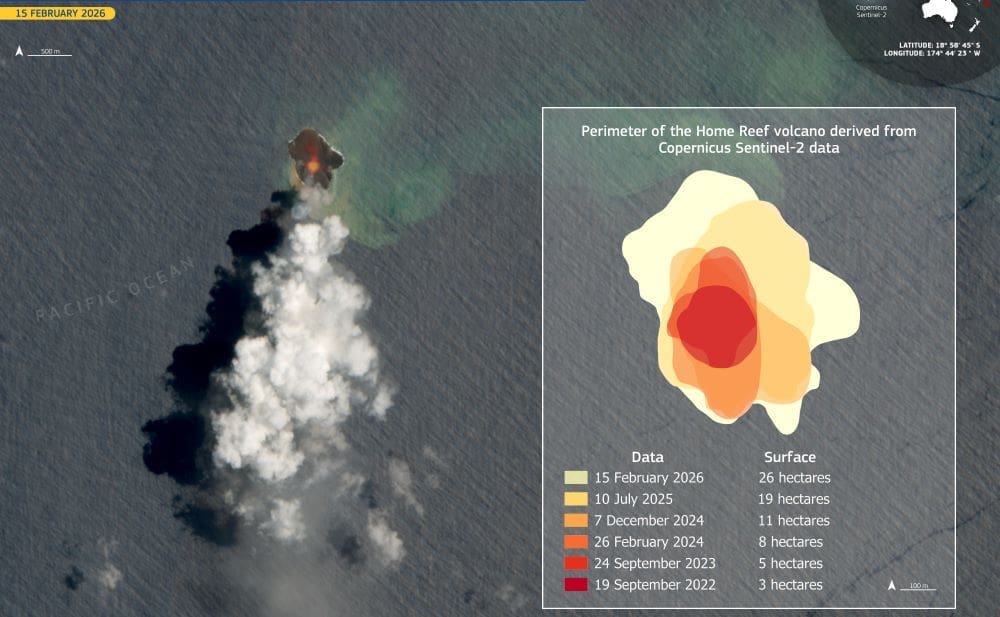
The data visualisation in the image traces the progressive expansion of this island using outlines derived from Copernicus Sentinel-2 observations taken between 19 September 2022 and 15 February 2026. Each mapped perimeter represents the coastline measured from satellite data at a specific date, allowing scientists to compare how the island’s shape and size changed during the eruption.
The backdrop image, acquired by a Sentinel-2 satellite on 15 February 2026, shows the volcano during its current eruptive phase. A plume rises above the volcanic vent while thermal signals associated with hot lava are visible in the satellite data. Discoloured waters surrounding the island reveal volcanic material released into the ocean.
The measurements shown in the visualisation indicate that the island’s surface area expanded from about 3 hectares in September 2022 to roughly 26 hectares by February 2026, making it nearly nine times larger than when it first emerged during the eruption.
Submarine eruptions like those at Home Reef provide rare opportunities to observe the formation of new land almost in real time. As volcanic material accumulates above the seafloor, temporary islands can appear where only ocean existed before. These eruptions also release gases, ash and pumice into the surrounding environment and may produce floating pumice rafts capable of drifting thousands of kilometres across the Pacific.
Earth observation satellites now play a crucial role in documenting these rapidly changing volcanic landscapes. The Copernicus Sentinel missions enable scientists to monitor eruptions in remote regions, map newly formed islands and measure how coastlines evolve over time. Continuous satellite observations help researchers understand volcanic processes while supporting hazard assessment and environmental monitoring across the world’s oceans.
Featured image credit: European Union, Copernicus Sentinel-2 imagery