An asset map shows where economic value is concentrated across a landscape. Instead of displaying only buildings or land cover, it estimates the value of different types of assets – such as housing, infrastructure, industry, and agriculture – expressed per unit area. This approach helps authorities understand what could be at risk when disasters occur and supports planning for hazards such as floods, storms, wildfires, or landslides.
Munich illustrates why such information is important. As one of Germany’s largest economic centres, the city contains dense clusters of residential neighbourhoods, commercial districts, industrial areas, and major transport infrastructure. When disasters affect highly urbanised regions like this, the concentration of assets means that potential economic losses can be significant.
To support disaster risk assessment across Europe, the European Commission’s Joint Research Centre (JRC) developed the Basic European Asset Map (BEAM). The system provides a consistent framework for mapping economic assets across European territories and estimating their value. By using harmonised datasets, BEAM allows authorities to compare exposure to risk between regions and integrate asset information into broader disaster risk analyses.
In 2025, Germany’s Federal Office of Civil Protection and Disaster Assistance (BBK) requested the Copernicus Emergency Management Service (CEMS) to produce an updated BEAM dataset for Germany through activation EMSN223. The project generated detailed asset maps expressing economic value in euros per square metre, including both cumulative asset values and individual components such as private households, industry, commerce, vehicles, and agriculture.
Economic assets across Munich’s landscape
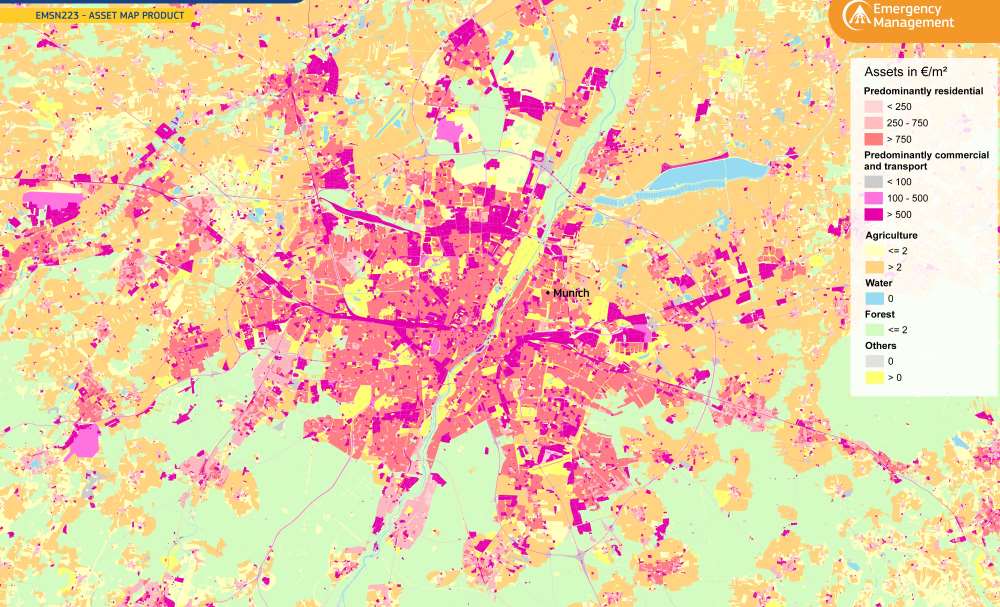
The visualisation above shows the distribution of assets across Munich and its surrounding region. The highest concentrations appear in the central urban area, where predominantly residential assets shown in orange dominate large sections of the city. Clusters of predominantly commercial and transport assets, mapped in magenta, highlight major economic corridors, industrial zones, and infrastructure hubs.
Beyond the dense urban core, the landscape changes rapidly. Agricultural land covers much of the surrounding countryside, represented by pale yellow areas that indicate much lower value per square metre. Large forested areas, shown in green, appear particularly south and west of the city, while lakes and rivers form blue patches within the regional landscape. These contrasts illustrate how exposure varies between urban districts, rural farmland, and natural environments.
Such differences matter for climate and disaster risk planning. Floods, storms, heatwaves, or wildfires do not produce the same economic consequences everywhere. By mapping residential, commercial, agricultural, and forest assets together, authorities can identify where exposure is highest and where different parts of the landscape may face distinct types of hazard risk.
Through its Risk and Recovery Mapping activations, the Copernicus Emergency Management Service supplies geospatial information used to analyse disaster impacts, estimate economic losses, and support recovery planning. The Munich asset map illustrates how such spatial data can help decision-makers understand where assets are concentrated and where future disasters could have the greatest financial impact.
More information about the Country-wide economic asset mapping for Germany, 2025 (EMSN223) is available here.
Featured image credit: European Union, Copernicus Emergency Management Service