Summary:
Daily temperature variation may pose a greater challenge for ectotherms than previously understood, according to a study published in Philosophical Transactions of the Royal Society B: Biological Sciences. Cold-blooded animals – including fish, reptiles and many invertebrates – do not appear to adjust their physiological responses to these regular fluctuations.
Ectotherms depend on external heat sources, meaning their body temperature closely reflects environmental conditions. Existing frameworks suggested that repeated exposure to fluctuating temperatures would reduce the sensitivity of physiological processes, allowing more stable functioning.
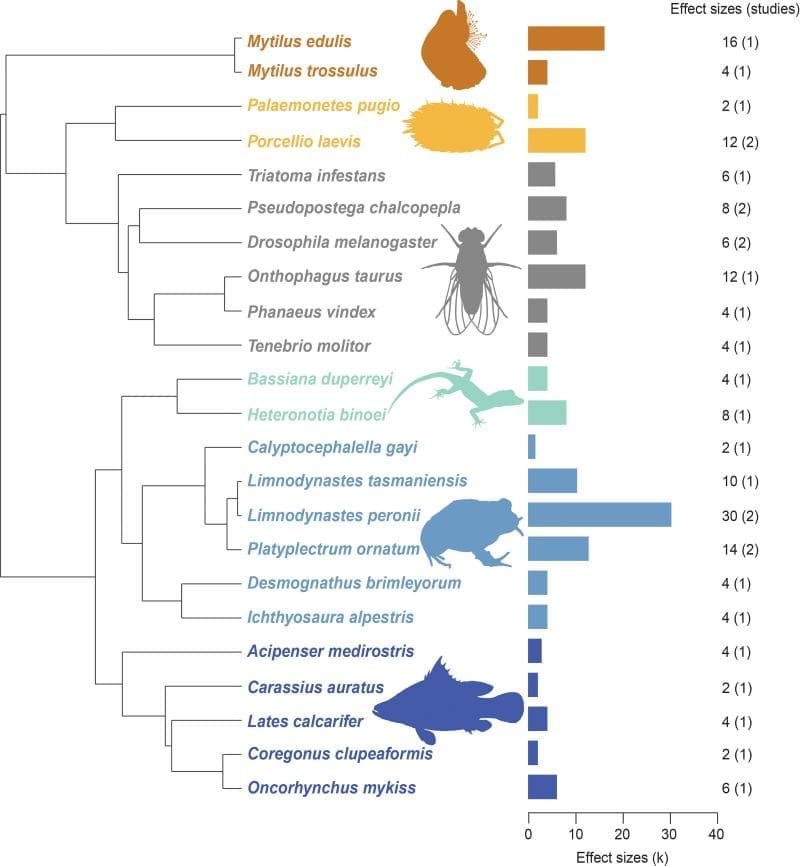
To test this, researchers led by Murdoch University conducted a meta-analysis of 26 studies, examining metabolic, locomotor, cardiovascular and enzyme activity across a wide range of species. The analysis found no consistent evidence that ectotherms modify their physiological sensitivity under daily temperature variation.
Reptiles and fish showed greater sensitivity to temperature changes, which may increase their exposure to risk as climate variability intensifies. The results indicate that ectotherms rely more on behavioural responses or longer-term adaptation rather than short-term physiological adjustment.
— Press Release —
Climate variability poses a threat to cold blooded animals
A new Murdoch University study has found that cold blooded animals (ectotherms) are unable to adjust physiologically to daily temperature fluctuations, a limitation that could leave them increasingly vulnerable as climate change drives even greater temperature variability.
Daily temperature variations are a common feature in natural environments, ranging from subtle to extreme depending on the geographic location, season, and local climate patterns.
Ectotherms, which includes almost all fish, reptiles, and invertebrates, rely on external sources to regulate their body heat. Their internal temperature closely mirrors the temperature of their environment, making daily temperature variations highly consequential.
Based on existing scientific framework, it was previously assumed that ectotherms adjusted physiological factors like their metabolism, movement, heart function, and enzyme activity to become less sensitive to temperature changes – to essentially become more stable in fluctuating conditions.
However, a study led by Dr Daniel Gomez Isaza from the Harry Butler Institute, revealed this was not the case.
To understand how cold‑blooded animals responded to everyday temperature swings, the research team combined data from 26 separate studies and compared how different species performed under constant versus fluctuating temperatures.
“By analysing metabolic, locomotor, cardiovascular and enzyme activity across a wide range of ectotherms, we expected to see signs that these animals adjust their physiology to become less sensitive to daily temperature change,” Dr Gomez Isaza said.
“Instead, we found the opposite. There was no consistent evidence that ectotherms fine‑tune their physiology in response to these predictable fluctuations.
“This suggests that ectotherms have limited capacity (or need) for regulating their internal physiology to cope with to short-term environmental fluctuations.”
Dr Essie Rodgers, a co-author and Lecturer at Murdoch University’s School of Environmental and Conservation Sciences, believes this vulnerability could pose a threat to ectotherms in the long-term.
“This inability could expose the vulnerability of ectotherms to unpredictable daily temperature fluctuations, which are becoming increasingly common with the progression of climate change,” she said.
“Because ectotherms aren’t adjusting their physiology to daily temperature swings, it’s likely they’ll have to depend more on behavioural strategies – like seeking shade, sun, or cooler microhabitats – or on rapid, short‑term stress responses to cope with these changes.
“Over the longer term, their resilience may hinge on genetic adaptation rather than day‑to‑day physiological flexibility, which raises real concerns as temperature variability continues to increase.”
Journal Reference:
Daniel Gomez Isaza, Essie Rodgers, ‘Unresponsive to change: Ectotherms fail to adjust physiology to daily temperature variation’, Philosophical Transactions of the Royal Society B: Biological Sciences 381 (1946): 20250055 (2026). DOI: 10.1098/rstb.2025.0055
Article Source:
Press Release/Material by Murdoch University
Featured image credit: Pavan Prasad | Pixabay