In the Kattegat Strait between northern Denmark and Sweden, the small island of Læsø is shaped by ongoing geological processes rather than fixed boundaries. Part of a Natura 2000 protected area, the low-lying island is defined by coastal systems that continue to evolve through post-glacial land uplift of around 5–6 mm per year. Over roughly 4,900 years, Læsø has developed through successive barrier ridges and sediment accumulation, forming a coastline that continues to expand.
Situated in Region Nordjylland, Læsø and its surrounding waters are designated as a Ramsar site covering 66,548 hectares. The area includes one of Denmark’s largest tidal salt marsh systems outside the Wadden Sea, alongside mudflats, sandbanks, heathlands and shallow marine zones. These habitats support large populations of staging and wintering waterbirds, while the surrounding marine areas provide breeding grounds for species such as the harbour seal (Phoca vitulina). Salt-tolerant vegetation characterises the marsh landscape.
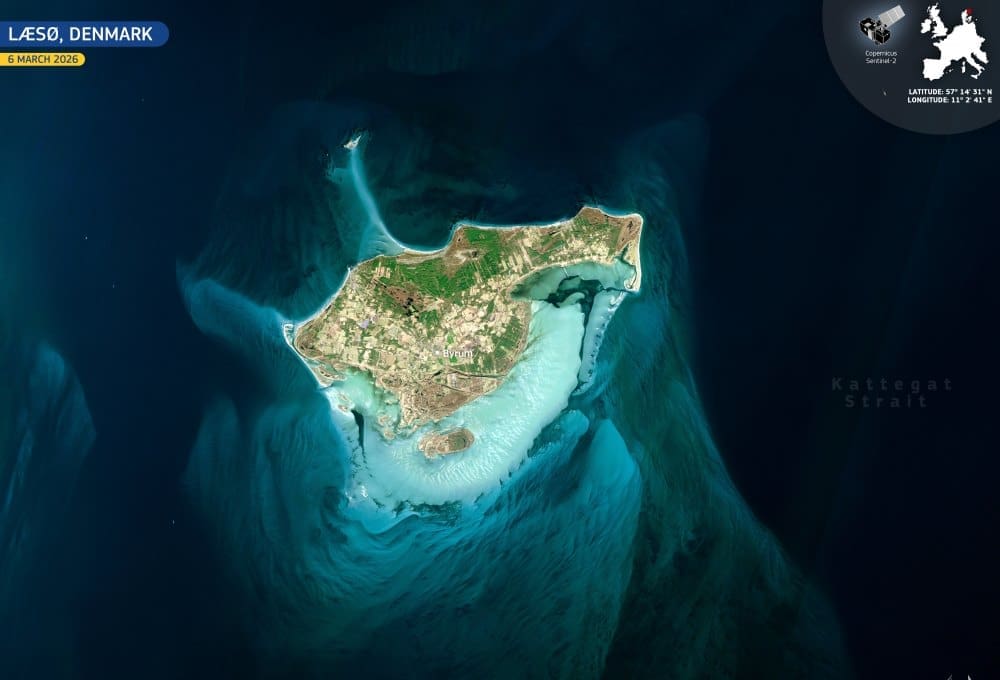
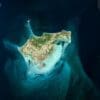
This image, acquired on 6 March 2026 by a Copernicus Sentinel-2 satellite, shows Læsø surrounded by turquoise waters. Light blue tones trace shallow sandbanks and submerged ridges, revealing the island’s sedimentary structure, while darker waters indicate deeper channels. On land, forest appears in green and cultivated areas in pale tones, contrasting with open coastal systems shaped by marine processes.
Læsø’s physical conditions have also shaped human activity. Between 1150 and 1652, the island supported an extensive salt industry, with up to 135 salt production huts operating simultaneously and around 1,700 archaeological remains identified today. Limited timber resources led residents to develop a building method using eelgrass washed ashore. The material, naturally impregnated with salt, was woven into dense roofing that could last for centuries. At its peak, around 250 houses used this technique, forming a distinct architectural landscape.
Today, Copernicus satellite data support continuous monitoring of Læsø’s coastal dynamics. These observations provide measurable insight into shoreline change, habitat development and the long-term impacts of climate pressure on fragile coastal ecosystems.
Featured image credit: European Union, Copernicus Sentinel-2 imagery