Northern Europe’s landscapes frame a new step in Europe’s space and connectivity strategy, as Norway and Iceland join the European Union’s secure satellite communications programmes. The agreement linking both countries to GOVSATCOM and the IRIS² programme connects geography with infrastructure, integrating remote and strategic regions into a broader secure communications network.
The Nordic region plays an important role in Europe’s digital and security landscape. Its vast distances, harsh winters and sparse populations make reliable connectivity a persistent challenge, particularly in high-latitude areas where terrestrial infrastructure is limited. Norway’s Arctic-facing coastline and Iceland’s isolated position in the North Atlantic give both countries strategic importance for maritime routes, environmental monitoring and North Atlantic connectivity and monitoring.
At a local scale, Oslo sits at the northern end of the Oslofjord, where dense urban development meets forested terrain. Iceland, by contrast, is shaped by tectonic activity, with volcanos, lava fields and large ice masses defining its surface. These differences are clearly visible in the satellite view, which juxtaposes an urban Nordic capital with a sparsely populated volcanic island.
Satellite view of Oslo, Norway and Iceland
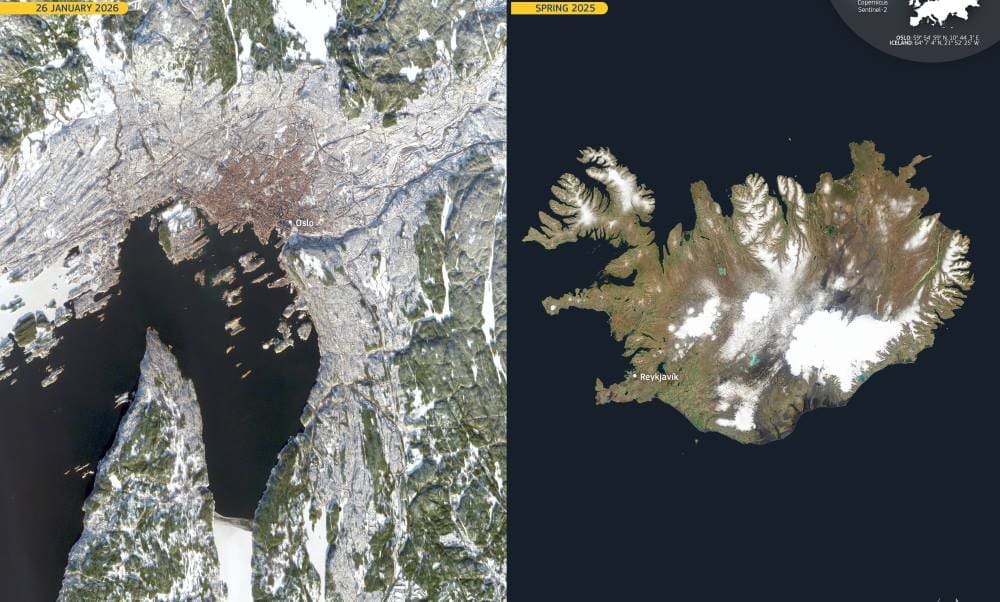
The left-hand Sentinel-2 scene, captured on 26 January 2026, shows Oslo under a winter blanket, with snow covering much of the urban area while the fjord remains a dark, defining feature around the city and port. The image on the right combines multiple Sentinel-2 acquisitions from spring 2025 to depict Iceland’s varied surface, where exposed ground, patches of vegetation and lingering snow and ice create a mosaic across the island, including the extensive Vatnajökull ice cap in the southeast.
Beyond the visual contrast, the timing of the agreement is significant. GOVSATCOM provides access to secure satellite communication services by pooling existing national and commercial capacities for government users across Europe. IRIS², now under development, will expand that capability into a dedicated multi-orbit system designed to deliver secure communications and broadband connectivity across Europe and beyond.
For Norway and Iceland, participation strengthens access to secure communications for civil protection, maritime operations and crisis response, while also supporting connectivity in remote regions. For the European Union, their inclusion extends the geographic reach of the system into the North Atlantic and Arctic-adjacent areas, regions that are becoming increasingly relevant for climate monitoring, shipping and security.
The image therefore reflects more than seasonal conditions across Nordic landscapes. It captures territories that are now being integrated into a wider European effort to build a more secure and autonomous communications infrastructure, linking remote environments with a growing network in orbit. Through missions such as Copernicus, Earth observation continues to support monitoring of these regions, providing data on environmental change, infrastructure and activity across Europe and its neighbouring areas.
Featured image credit: European Union, Copernicus Sentinel-2 imagery