Mount Elgon rises along the Uganda–Kenya border as one of East Africa’s largest and oldest volcanic formations, with a base covering 4,000 km² and a diameter of 80 km. Formed about 24 million years ago, the mountain once exceeded the height of Kilimanjaro before millions of years of erosion reduced its summit to 4,321 m at Wagagai, the highest of its five main peaks. The massif also includes Sudek (4,302 m) on the Uganda–Kenya border, Koitobos (4,222 m) in Kenya, and Mubiyi (4,211 m) and Masaba (4,161 m) in Uganda. Today, it still rises more than 3,000 m above the surrounding plains, a vertical range that gives the massif a dominant influence on local climate and ecosystems.
Its scale supports a continuous sequence of environments, from savannah at lower elevations to dense montane forest and, higher up, moorland and Afro-alpine vegetation. These transitions create a compact but highly varied ecological system, allowing species to occupy distinct altitude zones within the same massif. Mount Elgon National Park, extending across Uganda and Kenya, protects much of this high-altitude environment within a transboundary conservation area designated under UNESCO’s Man and the Biosphere Programme (MAB).
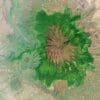
In the Copernicus Sentinel-2 image acquired on 15 January 2026, Mount Elgon appears as a broad, near-circular massif defined by deep green vegetation. At its centre, the 40 km² caldera is clearly visible in brown and ochre tones, marking the collapsed core of the ancient volcano. Surrounding it, forested slopes form a continuous ring that contrasts sharply with the lighter, fragmented agricultural land beyond the park boundaries. This boundary is not only visual but functional, showing where protected forest ecosystems give way to intensively used land, particularly along the lower slopes where cultivation is most extensive.
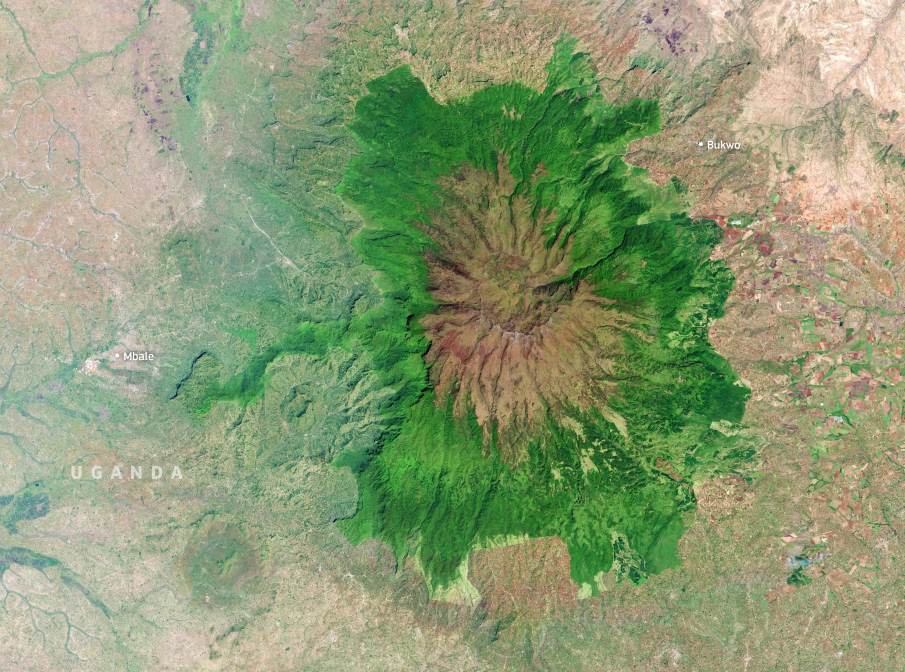
Biodiversity and altitudinal ecosystems of Mount Elgon
Mount Elgon National Park supports more than 300 bird species, including Jackson’s francolin, Tacazze sunbird and the endangered lammergeyer (bearded vulture), while its forests and higher zones provide habitat for elephants, buffaloes, leopards, hyenas and primates such as blue monkeys and black-and-white colobus monkeys. The mountain also hosts endemic fauna including river frogs, side-striped chameleons, marine vipers, king mole rats and mole shrews, alongside larger mammals such as giant forest hogs, eland and duiker.
The mountain forms part of the Eastern Afromontane biodiversity hotspot, where vegetation changes sharply with altitude. Lower zones are characterised by species such as Juniperus procera and Cassipourea malosana, while higher elevations are dominated by bamboo (Arundinaria alpina) and mixed stands of Podocarpus milanjianus. With increasing altitude and rainfall, Hagenia abyssinica and Hypericum revolutum become more prominent, giving way to grasslands and moorland, while wetter windward slopes support hardwood species including Elgon teak and giant camphor, alongside distinctive plants such as giant groundsel and giant lobelia.
Beyond biodiversity, Mount Elgon functions as one of Kenya’s five main water towers, feeding river systems that drain into Lake Victoria, Lake Turkana and Lake Kyoga. The forested slopes regulate water flow and sustain ecosystems and agriculture far beyond the mountain itself, linking local land cover directly to regional water security.
The mountain is also a lived landscape shaped by long-standing cultural ties and demographic change. The Bagisu and the Sabiny communities inhabit its slopes, while the Ndorobos have historically lived within the forested areas of Benet. For the Bagisu, the mountain is known as Masaba and is regarded as an ancestral figure, reflected in cultural practices such as the Imbalu circumcision ritual held every even-numbered year. Population within the biosphere reserve has increased rapidly, driven in part by immigration and the return of previously displaced communities to districts including Bukwo, Kapchorwa and Kween, adding pressure to land at the margins of the protected area.
Copernicus Sentinel data enable continuous monitoring of Mount Elgon’s forest cover, land-use change and ecosystem pressures, including along park boundaries, providing a consistent view of how this transboundary landscape is evolving and supporting conservation and land management across the Uganda–Kenya border.
Featured image credit: European Union, Copernicus Sentinel-2 imagery