Summary:
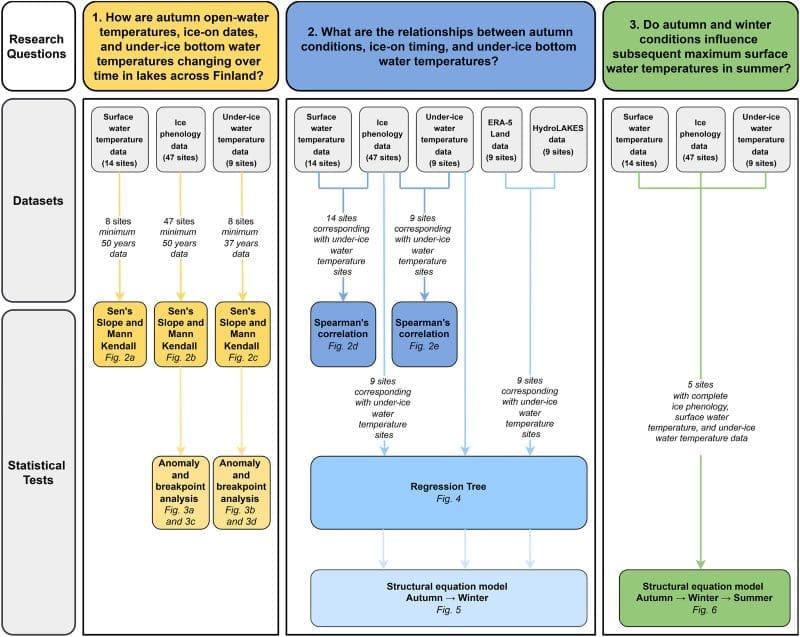
Warmer autumn conditions are altering how lakes cool and freeze, with effects that carry into winter and summer, according to a long-term study published in Water Resources Research. An international team including York University, the Finnish Environment Institute and the University of Eastern Finland analysed 37–50 years of data from 47 lake sites across Finland to assess how autumn conditions influence ice formation and under-ice temperatures in dimictic lakes.
Autumn surface waters warmed by about 0.37 °C per decade, delaying lake freezing by just over four days per decade over the past 50 years. Despite this warming, later ice formation was linked to colder bottom water during winter. The effect is explained by extended periods of open water, which allow continued heat loss and mixing before ice cover forms.
Stronger autumn winds, higher solar radiation and larger lake size were also associated with colder under-ice conditions. In addition, later freeze-up combined with earlier ice melt was linked to higher peak surface temperatures in summer. The results indicate a seasonal chain of processes, where autumn conditions influence winter thermal structure and summer extremes, with implications for oxygen dynamics, nutrient cycling and aquatic ecosystems.
— Press Release —
Climate warms, but under‐ice water temperatures in lakes can become cooler
Climate change undoubtedly affects lakes and the functioning of their ecosystems, but seasonal impacts are not always straightforward. An international team of researchers from York University in Canada, the Finnish Environment Institute and the University of Eastern Finland in Joensuu investigated how lake autumn surface warming is associated with winter under‐ice temperatures and ice phenology. The results were published in Water Resources Research. The study synthesised 37–50 years of data since 1971 from dozens of Finnish lake sites that are located across the country.
Warm autumns delay lake freezing, but overall water temperatures in winter can become lower
There was a negative relationship between the timing of ice-on and under-ice bottom water temperatures. In warmer autumns, when lakes freeze later, bottom water temperatures are colder in winter compared to years with cooler autumns and earlier freeze-up. This is one of the main results of the study, and though it may sound counterintuitive, there is a logical explanation.
When lakes remain ice-free longer in autumn, they continue to lose heat to the atmosphere. Without the insulating layer of ice cover, mixing continues and more heat escapes before winter begins. As a result, winter water temperatures are colder by the time ice eventually forms. Interestingly, a late ice-on date and an early ice-off date were associated with the subsequent maximum surface water temperatures in summer, however, under-ice bottom water temperatures had no correlation.
Autumn surface waters have become warmer due to climate change
The lake areas included in the study had become warmer during the monitoring period. The researchers found that autumn surface water temperatures had risen by an average of 1.85 °C, and lake freezing had been delayed by 20 days. Strong winds and the amount of shortwave radiation from the sun in autumn, as well as large lake size, were linked to colder under-ice bottom water temperatures.
Until now, the role of autumn in the limnology of dimictic lakes, i.e., lakes that undergo a complete cycle twice a year, has not been properly investigated. Dimictic lakes are typical in many areas of the boreal climate zone, and almost all Finnish lakes are dimictic. The present study is the first large-scale, multi-lake analysis using long-term time series to demonstrate the influence of autumn on lake thermal structure.
“We are only now beginning to understand the significant importance of autumn conditions for northern temperate lakes. Our recent findings should be taken into account in limnological research and climate change impact projections,” say Faith Ferrato, MSc, Dr Joshua Culpepper and Professor Sapna Sharma from York University.
“Water temperature is a key factor that determines the biology of ectothermic aquatic organisms. In very cold water, many organisms, from plankton to fish, often behave more passively. At the same time, temperature has significant effects on, for example, the physiology of organisms,” says Raine Kortet, Professor of Aquatic Ecology at the University of Eastern Finland.
“This study also highlights the importance of long-term hydrological monitoring data when assessing the impacts of climate change on lake hydrology and biology,” adds Merja Pulkkanen, Team Manager at the Finnish Environment Institute.
Journal Reference:
Ferrato, F. R., Culpepper, J. A., Pulkkanen, M., Kortet, R., & Sharma, S., ‘Phenological shifts in autumn drive changes in ice-on timing and under-ice water temperature in dimictic Finnish lakes’, Water Resources Research 62, e2025WR042047 (2026). DOI: 10.1029/2025WR042047
Article Source:
Press Release/Material by Maj Vuorre | University of Eastern Finland (UEF)
Featured image credit: Polina Kuzovkova | Unsplash