Paris, France | AFP | Muser NewsDesk
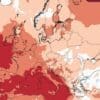
Europe’s deadly heatwave pushed east Sunday with hundreds of millions still sweltering across the continent despite fleeting relief from overnight storms, notably in France and Belgium.
The heat remained intense across central and eastern Europe, with the Czech Republic, Hungary and Poland hit hard as temperatures soared and records fell. At least 191 million Europeans were expected to face temperatures above 35 °C during the day, according to AFP estimates.
The World Health Organization said it had recorded more than 1,300 excess deaths in Europe since June 21. Overall, some 381 million Europeans were set to see temperatures exceed 30 °C, according to analysis based on forecasts from the German Meteorological Service and population data.
This heatwave is the most severe ever recorded in Europe, and would have been “virtually impossible” in June without climate change, the World Weather Attribution group of scientists said.
All-time temperature records have been broken in Germany, Poland and the Czech Republic, as well as for the month of June in the UK and in Switzerland.
‘Not a fiasco’
“Right now 150 million people are living under extreme heat, hundreds have died, schools are shut, grids are buckling,” WHO chief Tedros Adhanom Ghebreyesus said on X.
Storms brought some respite overnight, particularly in France after several days of temperatures close to 40 °C. But they also caused damage, as a man died near Brussels when a tree fell on his car, local media reported.
In France, the highest-level heat alerts were expected to ease on Sunday evening, although millions continued to endure sweltering conditions.

Still marked by the 2003 heatwave — Europe’s worst in centuries, which killed around 15,000 people — French authorities feared a rising death toll.
The country’s national health agency said Sunday it had tallied around 1,000 more deaths than expected from June 24, and warned the figure was likely to increase further.
Many of those fatalities are among those aged 65 and over, it said.
But Health Minister Stephanie Rist said France would “probably” avoid a repeat of the devastating death toll during the 2003 heatwave, citing better preparation in care homes for the elderly.
Interior Minister Laurent Nunez rejected criticism over the response, insisting: “This is not a fiasco — we were prepared.”
Records tumble
Temperatures soared above 40 °C in several countries on Sunday as the heatwave shattered records across central and eastern Europe.
Poland recorded a new all-time high of 40.5 °C in the western town of Slubice, according to the national meteorological institute.
Germany set a new national high of 41.7 °C at Coschen, near the Polish border, surpassing a high set just a day earlier, while the Czech Republic also broke records for a second consecutive day, with 41.1 °C recorded in Doksany, north of Prague.
France’s National Centre for Scientific Research (CNRS) said rising temperatures were clearly affecting marine life and biodiversity.
Speaking from a beach at Wimereux in northern France, CNRS research director Gregory Beaugrand told AFP the warming of the Channel was disrupting the food chain, as “fish that like cold waters are disappearing”.
French paleoclimatologist Jean Jouzel told the Tribune newspaper he feared political attention would quickly shift once the heatwave ends.
Urging people to heed scientific warnings, he said: “People are closing their eyes — but it is extremely serious.”
bur/cw/rh/gv
© Agence France-Presse
Article Source:
Press Release/Material by AFP
Featured image credit: freepik | Magnific