Scientists from across academic disciplines are extremely concerned about climate change. Many of them have already changed their own lifestyles or engaged in advocacy and protest, with even more being willing to do so in future. This is evident from a large-scale survey of scientists from all over the world, conducted by an international research team led by the University of Amsterdam. The researchers not only looked at the views of scientists and the extent to which they are engaged in climate action, but also at how the involvement of scientists with climate change can be increased.
The research was published in the journal Nature Climate Change.

“Climate change is an existential threat to humanity,” says postdoctoral researcher Fabian Dablander of the UvA’s Institute for Biodiversity and Ecosystem Dynamics and one of the lead authors of the study. “To secure a liveable future, each of us needs to ask ourselves: how can I best contribute at this crucial moment in human history? Scientists are well placed to help tackle climate change beyond conducting academic research. However, little is known about their wider engagement with the issue. Hence our study, in which we conducted quantitative and qualitative analyses of a survey of over 9,000 researchers from all scientific disciplines, not just climate science.”
Fundamental and personal
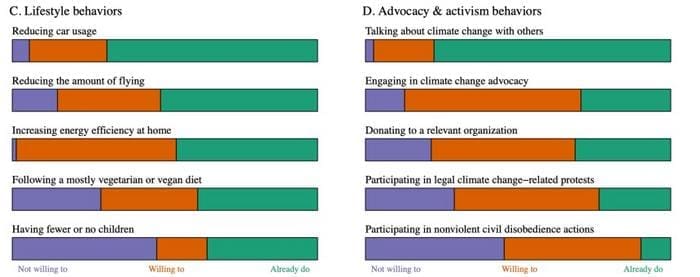
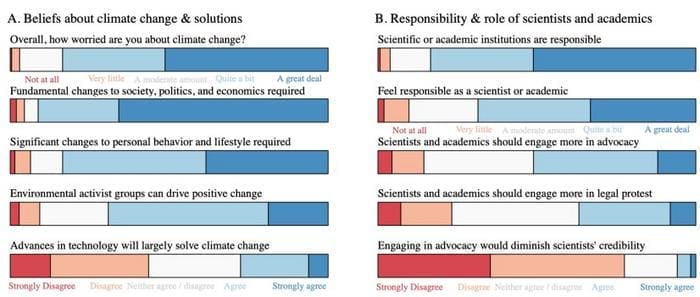
Most respondents (83%) in the survey say they are ‘quite a bit’ or ‘a great deal’ worried about climate change. The vast majority (91%) of them believe that fundamental changes in social, political and economic systems are needed to truly tackle climate change. Most respondents (84%) also think that significant changes in personal behaviour and lifestyle are needed. Many of them say they have already made significant changes to their lifestyle, by driving less (69%), flying less (51%) and switching to a more plant-based diet (39%).
Willingness to engage
A majority of scientists in the survey believe that climate activist groups can bring about positive change and that scientists should be more engaged in climate advocacy and even protest. A significant proportion of respondents are already engaged in climate advocacy (29%), have participated in legal protest (23%) and/or have even engaged in civil disobedience (10%), and about half say they would be willing to engage in some of these in the future.
Breaking down barriers
Based on the data, Dablander and colleagues then looked at which factors predict scientists’ engagement in advocacy and protest. They propose a two-step model of engagement. First, in order for scientists to be willing to engage, they need to overcome mostly intellectual barriers such as a lack of belief in the effectiveness of the actions, lack of identification with activists, lack of knowledge, fear of losing credibility, and fear of repercussions. Second, to actually engage they need to overcome mostly practical barriers such as a perceived lack of skills, lack of time, lack of opportunities, and not knowing any groups involved in climate action.
Based on their two-step model, the researchers propose ways to increase scientists’ engagement, such as facilitating interactions between scientists who are already engaged and those who are not, and making institutional reforms, for example by offering more time and money for climate-related actions or rewarding public engagement.
Wake-up call
“Governments and corporations continue to make empty promises that downplay the level of transformation that is required to prevent climate breakdown,” says Adam Aron, professor of psychology at the University of California, San Diego, and a co-author of the study: “This study makes clear that scientists from all disciplines are very worried and are calling for this fundamental transformation. I hope it helps wake people up and get engaged—more and more scientists are.”
About the survey
In their study, the researchers sampled the scientific community by sending targeted emails to more than 250,000 academics. The more than 9,000 scientists who ultimately responded to the survey came from 115 countries, all academics disciplines, and all career stages. The researchers acknowledge the possibility that scientists who were already involved in climate change may have been more likely to participate in the survey, which could affect the extent to which the reported percentages are representative of the scientific community as a whole.
Journal Reference:
Dablander, F., Sachisthal, M.S.M., Cologna, V. et al. ‘Climate change engagement of scientists’. Nature Climate Change (2024). DOI: 10.1038/s41558-024-02091-2
Article Source:
Press Release/Material by UvA
Featured image credit: Freepik