About a million years ago, Earth’s ice age cycles underwent a dramatic shift, marking what scientists call the Mid-Pleistocene Transition (MPT). This period has long intrigued researchers, who have proposed various explanations, often focused on shifts in ocean currents, for the Earth’s prolonged ice age cycles.
Now, a new study published in Science offers a fresh perspective, exploring how the complex flow of deep ocean currents, especially around Antarctica, might have played a pivotal role in these climate changes.
The Mid-Pleistocene Transition has puzzled scientists for decades, with many theories exploring the processes behind this dramatic shift in climate patterns.
Traditionally, a slowdown in the Atlantic Meridional Overturning Circulation (AMOC) – a major component of Earth’s climate system responsible for redistributing heat across the planet – has been considered a leading factor.
The new study, led by an international team of researchers from the Woods Hole Oceanographic Institution (WHOI), the Lamont-Doherty Earth Observatory, the Scripps Institution of Oceanography, and Cardiff University, offers a different view, pointing to the complex interplay of deep ocean currents as a major driver in shaping the prolonged ice age cycles.
By analyzing a climate record spanning 1.2 million years, the researchers reconstructed the properties of the deep ocean to better understand its impact on global climate.
“The deep ocean is enormous, especially when considering its capacity to store carbon dioxide (CO₂) compared to the atmosphere,” explained Dr. Sophie Hines, an Assistant Scientist at Woods Hole Oceanographic Institution (WHOI) and lead author of the study. “Even a modest change in ocean circulation could significantly impact global climate.”
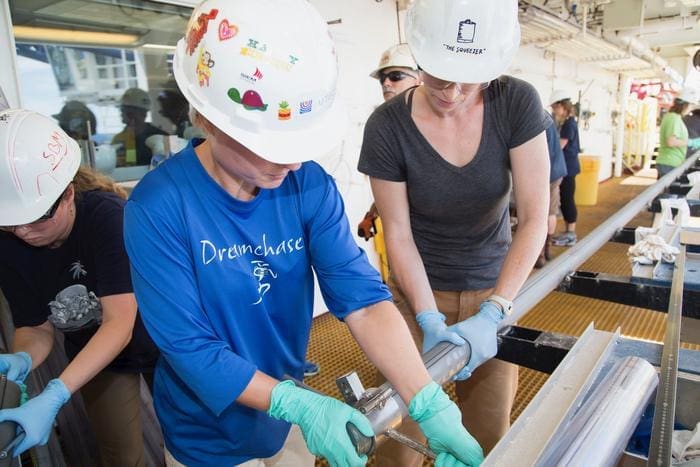
The team used sediment core samples collected from the seafloor near Cape Town, South Africa, during the International Ocean Discovery Program (IODP) Expedition 361. By examining fossilized remains of foraminifera, tiny organisms that inhabit the ocean’s depths, along with carbon and oxygen isotopes and neodymium signatures, they pieced together a detailed record of shifts in deep ocean temperatures, salinity, and circulation patterns. These changes, particularly in the Southern Ocean, provided insights into how shifts in ocean dynamics could influence ice age cycles.
One of the study’s key findings reveals that changes in deep ocean properties do not always align with each other, highlighting a more complex climate interplay than previously thought.
“Crucially, we show that shifts in different deep ocean properties are not always coincident,” said Dr. Sidney Hemming, Arthur D. Storke Memorial Professor of Earth and Environmental Sciences at the Lamont-Doherty Earth Observatory and co-chief scientist on the expedition. “With our more highly resolved multi-proxy record that includes transitional intervals, we find that ice age intensification was influenced primarily by changes around Antarctica.”
As Antarctic ice sheets expanded, the Southern Ocean’s ability to store carbon increased, contributing to lower atmospheric CO₂ levels, colder global climates, and the intensification of ice age cycles. Dr. Hines noted: “Our research sheds light on the intricate interplay between ocean dynamics and climate change, underscoring the significance of the Southern Ocean in understanding our planet’s climate history.”
The study also touches on the contemporary relevance of its findings. Ongoing climate research stresses the impact of human-driven climate change, especially as reductions in the AMOC could further alter global climate dynamics. Warming in the Southern Ocean, a critical regulator of global weather systems, could exacerbate this impact, with far-reaching consequences for ecosystems worldwide.
Journal Reference:
Sophia K. V. Hines et al. ‘Revisiting the mid-Pleistocene transition ocean circulation crisis’, Science 386, 681-686 (2024). DOI: 10.1126/science.adn4154
Article Source:
Press Release/Material by Woods Hole Oceanographic Institution (WHOI)
Featured image: Researchers analyzed sediment core samples collected by D/V JOIDES Resolution near Cape Town, South Africa. Their findings uncovered details about the changes in deep ocean temperature and salinity, as well as the mixing histories of waters originating in both the northern and southern hemispheres. Credit: Sophie Hines | ©Woods Hole Oceanographic Institution | CC BY-SA