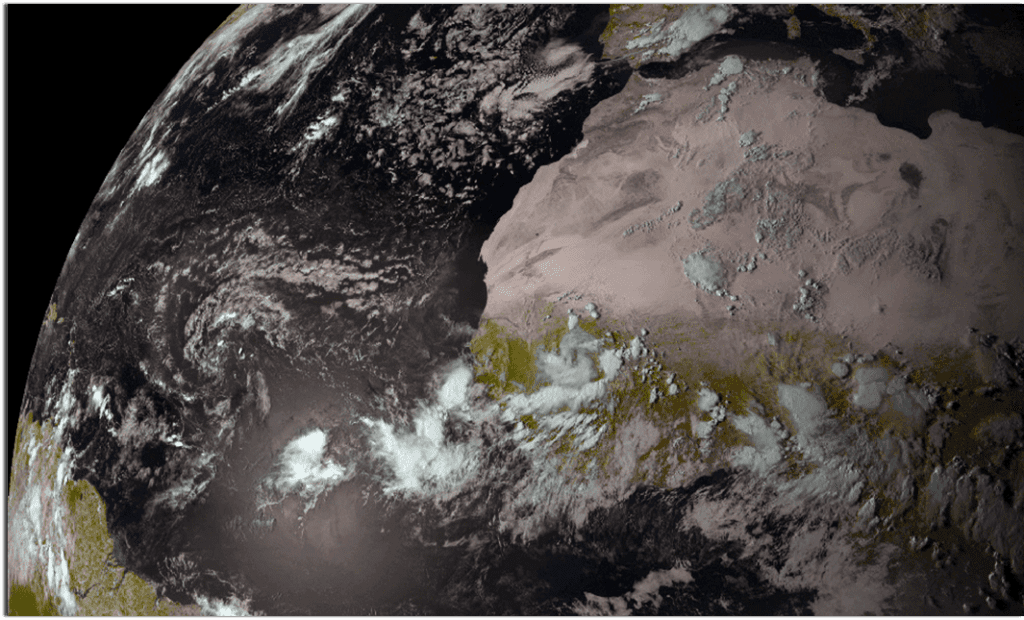
August 2025 was the third-warmest August ever measured worldwide, according to the latest Climate Bulletin from the Copernicus Climate Change Service (C3S). Global surface air temperature averaged 16.6°C, which is 0.49°C above the 1991–2020 average for the month and 1.29°C warmer than the pre-industrial baseline of 1850–1900.
The data show that August 2025 was slightly cooler than the record-breaking Augusts of 2023 and 2024 but still continues the trend of sustained global heat. Across the boreal summer, June to August, this year ranked as the third-warmest on record, trailing only the summers of 2023 and 2024. Over the most recent 12-month period, from September 2024 to August 2025, the global average temperature was 0.64°C above the 1991–2020 average and 1.52°C warmer than pre-industrial levels.

In Europe, conditions varied. The continent as a whole was 0.30°C warmer than the August average, but this was outside the ten warmest Augusts on record. Western Europe faced the most extreme conditions, with a prolonged heatwave that began in late July in Portugal, spread across Spain, and reached France by 8 August. The event lasted until 18 August, with maximum temperatures frequently exceeding 40°C. Highs reached 45°C in Portugal and southern Spain and up to 42°C in southwestern France.
National weather services reported records for heatwave duration and intensity. Spain experienced its most intense August heatwave since at least 1975, lasting 16 days. In Portugal, one station recorded its longest-ever run of heatwave conditions in records going back to 1931. France endured 11 consecutive days of extreme heat, its second-longest August heatwave after 2003.
The new C3S Thermal Trace application, which tracks heat stress, showed that much of the affected region experienced “very strong heat stress,” with parts of Spain and Portugal reaching “extreme heat stress.” Feels-like temperatures peaked at 45°C in France, 47°C in Portugal, and 49°C in Spain.
Beyond Europe, warm anomalies extended to northern Siberia, Antarctica, East Asia, the Middle East, Greenland, and western Canada, while Japan registered its highest-ever temperature of 41.8°C on 5 August. In contrast, northern Europe, eastern North America, and parts of Australia recorded cooler-than-average conditions.
Featured image credit: European Union, Copernicus Climate Change Service Data