
Summary:
As the world marks UN World Cities Day on 31 October, new research published in Communications Earth & Environment warns that the global construction sector’s carbon footprint is set to double by 2050 – a trajectory that could derail efforts to meet the Paris Agreement climate targets.
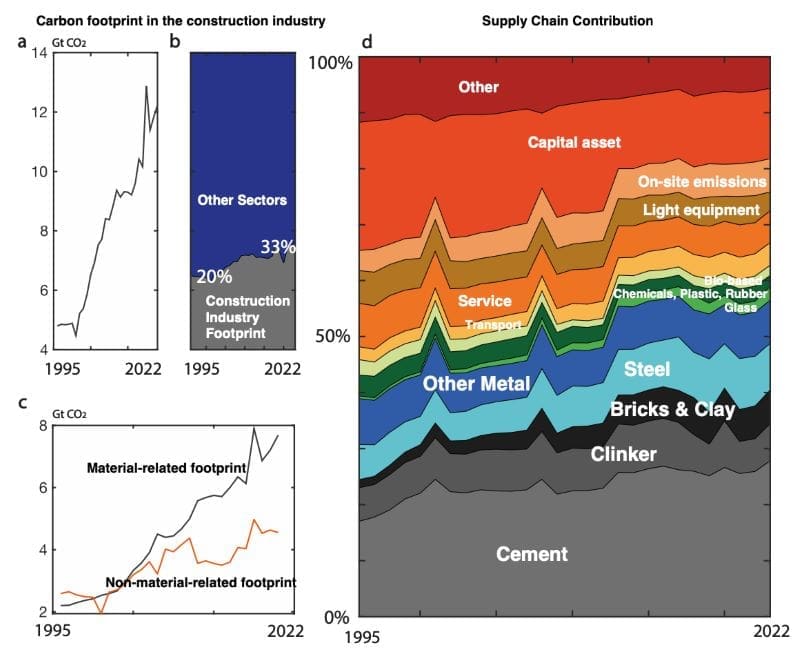
The study, led by Chaohui Li of Peking University, shows that the construction sector now drives about one-third of global CO₂ emissions, up from roughly 20% in 1995. In 2022, over 55% of emissions came from cementitious materials, bricks, and metals, while glass, plastics, and bio-based materials accounted for just 6%. The remaining 37% originated from transport, services, machinery, and on-site activities.
If current trends persist, the construction industry alone will exceed the per-annum carbon budget for the 1.5 °C and 2 °C goals within two decades. Coauthor Prajal Pradhan of the University of Groningen notes that cumulative emissions between 2023 and 2050 could reach 440 gigatons of CO₂ – enough to consume the entire remaining global carbon budget for 1.5 °C.
The authors call for a “material revolution,” replacing carbon-intensive materials like steel and cement with circular, low-carbon, and bio-based alternatives to realign construction with global climate goals.
Global construction carbon footprint set to double by 2050
In 2022, over 55% of the construction industry’s carbon emissions stemmed from cementitious materials, bricks, and metals, while glass, plastics, chemicals, and bio-based materials contributed 6%, and the remaining 37% arose from transport, services, machinery, and on-site activities.
Lead author Chaohui Li from Peking University summarizes: “The study shows that the construction sector now drives one-third of global CO₂ emissions, up from around 20% in 1995. If current trends continue, the sector can exceed the 2°C per annum carbon budget earliest by 2040.”
Projections are alarming
Based on past data, different future emission scenarios were projected. Under the business-as-usual scenario, the construction carbon footprint alone will exceed the per-annum carbon budget for the 1.5 °C and 2 °C goals in the next two decades, not considering other industries.
“Between 2023 and 2050, cumulative construction-related emissions are expected to reach 440 gigatons of CO₂. This is enough to consume the entire remaining global carbon budget for 1.5°C,” explains coauthor Prajal Pradhan, a professor at the University of Groningen in the Netherlands.
The study shows a significant shift in emissions from developed to developing regions. In 1995, high-income countries produced half of construction emissions. By 2022, emissions in these economies had largely stabilized, while growth in developing regions was increasingly driven by reliance on carbon-intensive materials such as steel and cement. At the same time, the use of bio-based materials such as timber has declined, underscoring a missed opportunity for low-carbon alternatives.
Call for a material revolution
The authors call for a global “material revolution” – a fundamental shift away from carbon-intensive building materials toward low-carbon, circular, and bio-based alternatives such as engineered timber, bamboo, and recycled composites. Their analysis shows that cementitious materials, bricks, and metals alone now account for more than half of the sector’s emissions, emphasizing the urgent need to reinvent how the world builds.
“The challenges and solutions for decarbonizing construction are not globally uniform. Tipping full supply-chain-scale changes ultimately requires structural shifts material-wise, reducing reliance on traditional materials like cement, steel, and bricks, while exploring new alternatives,” explains coauthor Jürgen Kropp from the Potsdam Institute for Climate Impact Research (PIK).
The authors further argue that high-income regions should lead through innovation, circular design, and stricter regulation, while developing regions – where most new construction will occur – need targeted financial and technological support to leapfrog directly to sustainable building practices.
Without such a material transformation, the study warns, the construction sector alone could consume the entire remaining carbon budget for the 1.5°C goal in the next two decades. A coordinated global effort to scale up low-carbon materials and redesign construction systems is therefore essential to keep climate commitments within reach.
Global challenge
As the world continues to urbanize rapidly, reducing the construction sector’s environmental impact will be key to achieving sustainable and climate-resilient cities. The study provides the most comprehensive global analysis of construction emissions to date, tracking 49 countries and regions and 163 sectors between 1995 and 2022.
“Humanity has literally built itself into a corner with steel and cement,” says IIASA Director General Hans Joachim (John) Schellnhuber. “To meet the Paris goals, we must reinvent the very materials that shape our cities. A global material revolution rooted in circularity, innovation, and cooperation can turn the construction sector from a climate problem into a cornerstone of a sustainable and resilient future.”
Journal Reference:
Li, C., Pradhan, P., Chen, G. et al., ‘Carbon footprint of the construction sector is projected to double by 2050 globally’, Communications Earth & Environment 6, 831 (2025). DOI: 10.1038/s43247-025-02840-x
Article Source:
Press Release/Material by International Institute for Applied Systems Analysis (IIASA)
Featured image credit: Freepik (AI Gen.)