Summary:
Ammonia pollution from pig farms may contribute indirectly to global warming by increasing emissions of nitrous oxide from nearby soils, according to new research published in the journal Nitrogen Cycling.
The study examined how ammonia released from intensive livestock farming affects nitrogen processes in surrounding soils. Ammonia is the largest nitrogen pollutant emitted by agriculture and is mainly produced when animal waste breaks down in housing facilities and manure storage. After entering the atmosphere, the gas can travel through the air and settle onto nearby land through a process known as atmospheric deposition.
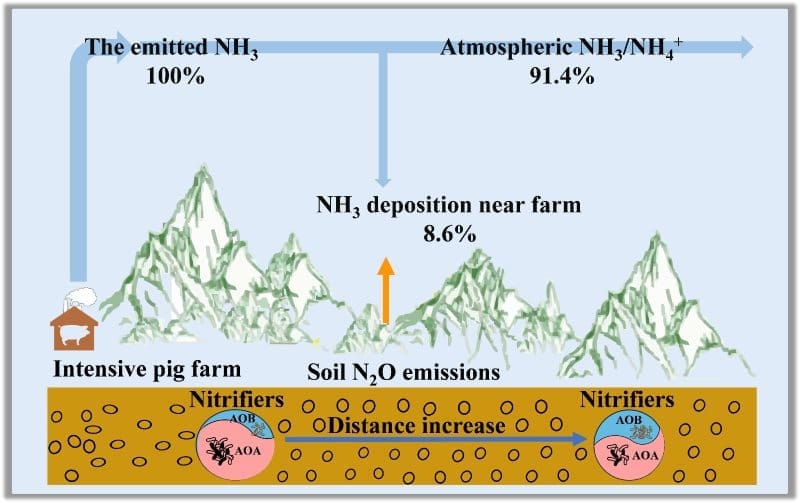
To assess its impact, researchers measured soil nitrous oxide emissions at distances between 50 and 500 metres downwind of a large pig farm in central southern China. The results showed that areas receiving higher ammonia deposition consistently produced more nitrous oxide.
Nitrous oxide is a greenhouse gas with a global warming potential nearly 300 times greater than carbon dioxide over a 100-year period and is also the leading ozone-depleting substance released today.
Further analysis indicated that ammonia deposition increases populations of ammonia-oxidising archaea in the soil – microorganisms that convert ammonium during nitrification and release nitrous oxide as a by-product. The findings suggest livestock ammonia pollution may amplify agricultural greenhouse gas emissions through previously underappreciated soil processes.
— Press Release —
Pig farm ammonia pollution may indirectly accelerate climate warming, new study finds
The research reveals that atmospheric ammonia deposition around livestock facilities can stimulate soil microbial processes that generate nitrous oxide, highlighting an overlooked pathway linking livestock pollution to global warming.
Livestock farming is the largest global source of ammonia emissions. When ammonia escapes from animal housing and manure storage, it can travel through the air and deposit onto surrounding soils and ecosystems. Although ammonia itself is not a greenhouse gas, scientists have long suspected that it may indirectly influence climate by altering nitrogen cycling in soils.
To investigate this possibility, researchers conducted field measurements near a large pig farm in central China. They monitored soil nitrous oxide emissions at multiple locations ranging from 50 to 500 meters downwind of the farm, capturing the natural gradient of ammonia deposition across the landscape.
The results showed a clear pattern. Areas receiving higher ammonia deposition produced significantly more nitrous oxide from the soil.
“Our findings demonstrate that ammonia deposition from livestock farms can stimulate soil microbial activity and lead to increased emissions of nitrous oxide,” said the study’s corresponding author Jianlin Shen. “This process represents an important but often overlooked link between ammonia pollution and climate change.”
Nitrous oxide is one of the most potent greenhouse gases in the atmosphere. Over a 100 year period it has a global warming potential nearly 300 times greater than carbon dioxide. It is also the dominant ozone depleting substance emitted today.
The researchers found that soil nitrous oxide emissions decreased steadily with increasing distance from the pig farm. Within a 500 meter radius of the farm, total nitrous oxide emissions were estimated to reach about 69.7 kilograms of nitrogen per year. This represented roughly 1.3 percent of the ammonia nitrogen deposited in the area, slightly higher than the emission factor commonly used in international climate assessments.
To understand the underlying mechanism, the team also examined microbial genes responsible for nitrogen cycling in the soil. They discovered that ammonia deposition increased the abundance of ammonia oxidizing archaea, microorganisms that convert ammonium into nitrate through a process known as nitrification.
This microbial activity turned out to be a key driver of nitrous oxide production.
“As ammonia accumulates in soil, it provides more substrate for nitrifying microbes,” Shen explained. “These microbes then produce nitrous oxide as a byproduct during the nitrification process.”
Laboratory experiments confirmed this mechanism. When soils were supplied with ammonium based nitrogen sources, nitrous oxide emissions were significantly higher than when nitrate was added. The results suggest that ammonia and ammonium deposition can enhance nitrous oxide production more strongly than oxidized nitrogen inputs.
The findings highlight the broader environmental impact of ammonia emissions from livestock production. While ammonia pollution is often studied for its effects on air quality and ecosystem nitrogen deposition, its potential role in amplifying greenhouse gas emissions has received less attention.
“This study suggests that ammonia deposition near animal farms could act as a secondary source of agricultural nitrous oxide emissions,” Shen said. “Reducing ammonia emissions from livestock systems could therefore help mitigate both air pollution and climate change.”

As livestock production continues to expand worldwide, understanding these hidden links between agricultural emissions and climate processes will be essential for developing more sustainable farming systems.
Journal Reference:
Yi W, Liu G, Kang M, Wang J, Yuan H, et al., ‘Increased soil N₂O emissions under natural gradient of atmospheric NH₃ deposition’, Nitrogen Cycling 2: e011 (2026). DOI: 10.48130/nc-0025-0023
Article Source:
Press Release/Material by Biochar Editorial Office | Shenyang Agricultural University (SYAU)
Featured image credit: Brett Sayles | Pexels