Summary:
A long-term analysis of bowhead whale populations suggests that centuries of commercial hunting are associated with lasting biological changes not seen during earlier climate shifts. In a study published in Cell, researchers combined palaeogenomic data, stable isotopes, and ecological modelling from more than 800 radiocarbon-dated fossils spanning 11,000 years.
The results show that bowhead whales maintained stable genetic diversity and population structure throughout the Holocene, despite major environmental variability. This pattern shifted markedly with the onset of commercial whaling in the 16th century, when genetic diversity declined and populations became more structured.
Modelling indicates that these changes are likely to persist. Even under scenarios of full population recovery, genetic diversity does not return to pre-whaling levels, and overall fitness remains reduced. The study suggests that human exploitation, rather than past climate change, aligns with the observed long-term genetic trends. Reduced diversity may limit the species’ capacity to respond to future environmental pressures, including ongoing Arctic warming.

— Press Release —
Past intensive whaling threatens the future of bowhead whales
A unique collection of prehistoric bowhead whale bones, dating back 11,000 years, reveals a previously untold story of the relative impacts of humans on nature.
The time series of ancient fossils show that commercial hunting of bowhead whales, which spanned 400 years and ceased less than a century ago in 1931, has left irreversible destructive traces in the species’ genetics. This could have serious consequences for the long-term vulnerability of the species.
Researchers from the University of Copenhagen led an international team to study this unique collection of fossils using DNA, stable isotopes, and palaeoclimate data. Their findings show that the bowhead whale has been remarkably resilient to climate changes of the past 11,000 years, but despite this, recent human activity has left lasting impacts that may impact their long-term survival.
“Our study shows the bowhead whale is an extremely robust species. But the visible loss of genetic diversity caused by commercial whaling revealed by our analysis is only the tip of the iceberg. The decline in diversity and fitness is an ongoing process and will continue far into the future,” says lead author Michael V. Westbury, former assistant professor at the University of Copenhagen and now associate professor at DTU.
“Bowhead whales are a species that can withstand almost anything – except humans,” he adds.
Inbred whales are weaker whales
The study, published online in the journal Cell and featured on the cover of the April 2 issue, is based on the analysis of an 11,000-year time series of bowhead whale fossils from the Canadian Arctic Archipelago and from the Svalbard Archipelago (Norway). Hundreds of bones were examined using radiocarbon dating, palaeogenomics, and stable isotopes, and were compared with present-day bowhead whales from the same regions.
In addition, the >850 radiocarbon dated fossils were integrated with palaeoclimate data to model bowhead whale habitat across the past 11,000 years, a period known as the Holocene. This allowed the researchers to explore links between past climatic change, bowhead whale genomics and ecology, and changes in species distribution since the end of the last Ice Age.
The analyses show that bowhead whale populations in the North Atlantic remained stable throughout the Holocene – until 500 years ago. Populations lost genetic diversity and became increasingly structured during commercial whaling.
Based on their 11,000-year time series of bowhead whale genetic diversity, the researchers estimated how the species’ genetic diversity will evolve in future generations. The results show that diversity will continue to decline as a direct result of commercial whaling, even if populations stay stable. This may severely impact the species’ resilience to a changing climate.
“A species’ genetic diversity is like a Swiss Army knife. The bigger the knife, the more tools a species has in their response to stressors,” explains senior author Eline Lorenzen, professor of molecular natural history at the Globe Institute, University of Copenhagen.
“Genetic diversity is what species depend on when facing stress or change, such as disease or environmental change. The more diversity a species has, the better its chances of survival,” she says.

Commercial whaling
Commercial hunting of bowhead whales began around year 1540, driven by a huge demand for whale oil used in lamps. Whalers from England, the U.S., the Netherlands, and Germany headed north to the Arctic Ocean. The pursuit of whales included Danish sailors, particularly from the Wadden Sea islands, who joined Dutch whaling expeditions. Evidence of this can still be seen on the island of Rømø, where a fence built from bowhead whale bones brought back from a 1700s whaling voyage still stands.
Bowhead whale protection was put in place in 1931 with the signing of an international convention banning the harvest of all species in the right whale family (Balaenidae). By then, the global population was so depleted that hunting bowhead whales was no longer economically viable.
‘Gone is gone’
The outlook for bowhead whales is bleak. Even if population sizes increase, the genetic diversity that is gone has been lost forever.
“Our study provides an 11,000-year ecological baseline for the bowhead whale. We provide insight into the species’ long-term resilience to past climatic changes, but also a clear understanding of the relative impact of commercial whaling. In evolutionary terms, that impact has been massive. The biological consequences of whaling will extend many generations into the future,” says Lorenzen.
***
The study was supported by Villum Fonden and the Independent Research Fund Denmark.
Journal Reference:
Westbury M, Brown S, Cabrera A et al., ‘Four centuries of commercial whaling eroded 11,000 years of population stability in bowhead whales’, Cell online ver. (2026). DOI: 10.1016/j.cell.2026.02.022. Also available on ScienceDirect.
Article Source:
Press Release/Material by University of Copenhagen
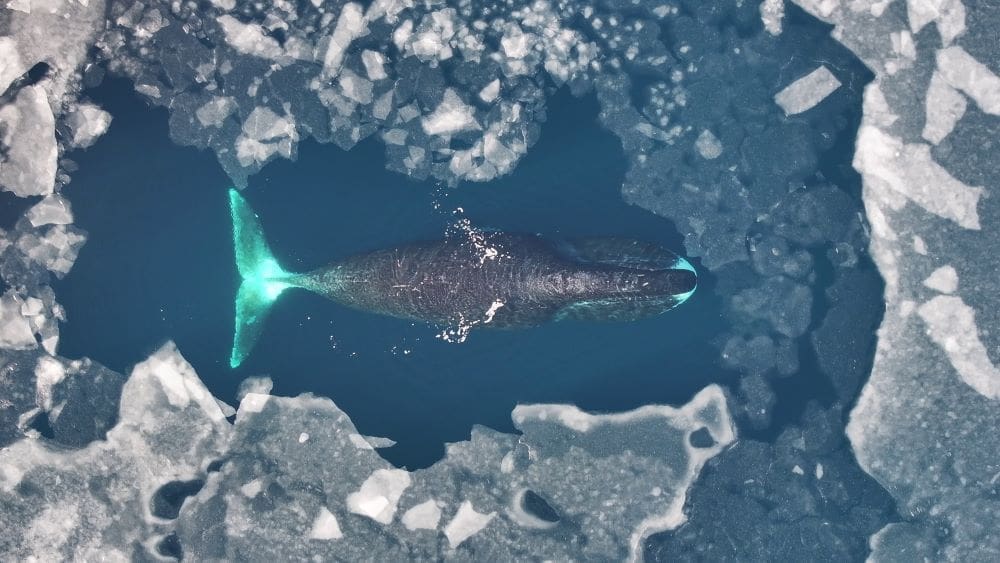
Featured image: Bowhead whales are the only baleen whale species found in Arctic waters year-round. They are among the most biologically distinctive mammals, combining extreme longevity, slow life histories, and exceptional insulation through their thick blubber layer, which constitutes 40-50% of their body. Credit: Fredrik Christiansen