Summary:
Scientists have developed a three-dimensional method that maps atmospheric rivers (ARs) over Antarctica, providing a clearer picture of how these weather systems influence snowfall across the continent. These long, narrow corridors of concentrated water vapor transport moisture from lower latitudes, but their influence has been difficult to measure because conventional detection methods cannot fully capture their vertical structure.
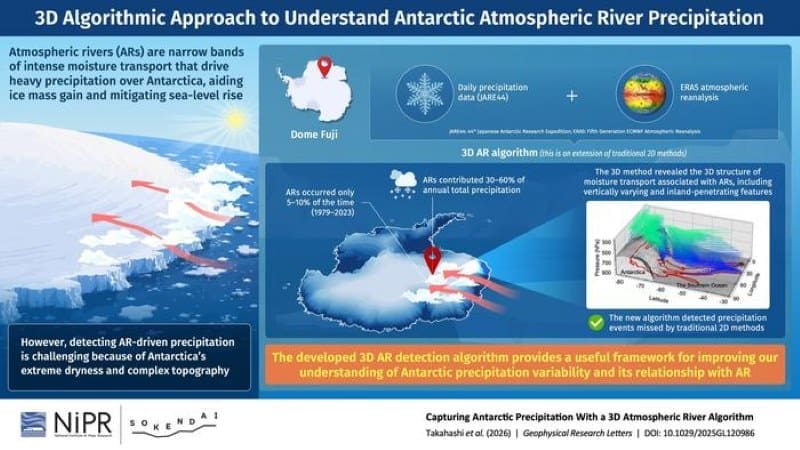
The study, published in Geophysical Research Letters, first evaluated the algorithm using Dome Fuji precipitation observations from the 44th Japanese Antarctic Research Expedition and MODIS satellite data from 2003–2004, before applying it to ERA5 reanalysis data covering 1979–2023 to assess atmospheric rivers across Antarctica. The analysis showed that atmospheric rivers were associated with more than half of the major snowfall events recorded at Dome Fuji, where they accounted for about 40% of total precipitation during the observation period. Across Antarctica, these systems occurred less than 10% of the time but supplied 30%–60% of annual precipitation, with contributions reaching up to 90% in some coastal and West Antarctic regions.
The researchers found that changes in atmospheric river activity closely mirrored long-term changes in Antarctic precipitation, suggesting these weather systems play a central role in snowfall variability across the continent. Better representation of atmospheric rivers in climate models could improve projections of Antarctic ice-sheet mass balance and help refine estimates of future sea-level rise.
— Press Release —
Rivers in the sky over Antarctica, captured in 3D
A rise in the global sea level is closely linked to snowfall in Antarctica, as it directly affects the mass balance of the Antarctic ice sheet. A major source of this snowfall is atmospheric rivers (ARs), which are long, narrow bands of concentrated water vapor in the atmosphere that transport huge amounts of moisture from tropical or subtropical regions toward cooler areas. When these systems reach Antarctica, they can trigger substantial snowfall events over the ice sheet. While this is known, detecting ARs over the Antarctic continent remains a major challenge due to the steep topography and extremely dry environment of Antarctica.
To address this issue, Kazu Takahashi, a doctoral student at the Graduate University for Advanced Studies , SOKENDAI, together with Professor Jun Inoue, Assistant Professor Kazutoshi Sato, Assistant Professor Naohiko Hirasawa, and Project Researcher Kyohei Yamada from the National Institute of Polar Research, developed a new three-dimensional (3D) AR detection algorithm. Their study, made available online on May 5, 2026, and published in Geophysical Research Letters on May 16, 2026, extends conventional 2D AR detection methods into a three-dimensional framework for accurately detecting ARs.
“We found that ARs approaching Antarctica are not vertically aligned as previously assumed but are often tilted structures extending from the Southern Ocean into the upper atmosphere above the continent,” reports Mr. Takahashi.
Conventional 2D methods could not accurately represent this behavior, which led to unclear detection of Antarctic AR activity. The newly developed 3D method overcomes this limitation by identifying moisture transport across multiple atmospheric pressure levels simultaneously.
Read also: Why Antarctic sea ice suddenly declined after decades of growth
To evaluate this new algorithm, the researchers analyzed precipitation observation data collected at Dome Fuji Station in East Antarctica during the 44th Japanese Antarctic Research Expedition (JARE44) and MODIS satellite data for the period from 2003 to 2004, corresponding to the JARE44 observation period. After this evaluation, the statistical analysis over Antarctica was conducted using ERA5 data from 1979 to 2023. The results showed that this new method was able to successfully detect ARs associated with more than half of the significant precipitation events observed during the expedition period.
“AR-related precipitation accounted for approximately 40% of the total precipitation at Dome Fuji,” Mr. Takahashi explains.

The atmospheric climatological analysis from 1979 to 2023 further revealed the dominant role of ARs in climatological Antarctic precipitation variability. Although ARs occurred less than 10% of the time across Antarctica, they accounted for approximately 30%-60% of the annual total precipitation, with contributions reaching up to 90% in some coastal and West Antarctic regions. Interestingly, the spatial pattern of long-term precipitation trends closely matched the distribution of AR-related precipitation trends, indicating that ARs strongly regulate long-term Antarctic snowfall variability.
Apart from the discovery, the study also has important meteorological implications. Although ocean-warming-induced ice loss is the primary driver of sea-level rise, variations in Antarctic snowfall alter ice-sheet mass balance and hence can influence the magnitude of sea-level rise. The findings also suggest that considering changes in AR activity is essential for improving projections of Antarctic climate variability and ice-sheet mass changes under global warming. The researchers further note that large-scale atmospheric phenomena, such as atmospheric warming, may influence Antarctic precipitation through changes in AR activity.
Read also: Warming oceans stir stronger turbulence in polar regions
Explaining the motivation behind the study, the authors noted that earlier approaches were not able to sufficiently characterize ARs over Antarctica and that more advanced detection frameworks were needed to understand variability in Antarctic ice sheet. By incorporating the vertical dimension of moisture transport, the newly developed 3D detection method paves the way for a powerful framework to support future expeditions into Antarctic precipitation processes and climate dynamics.
Journal Reference:
Takahashi, K., Inoue, J., Sato, K., Hirasawa, N., & Yamada, K., ‘Capturing Antarctic precipitation with a 3D atmospheric river algorithm’, Geophysical Research Letters 53, 9: e2025GL120986 (2026). DOI: 10.1029/2025GL120986
Article Source:
Press Release/Material by Tomomi Hayashi | The Graduate University for Advanced Studies, SOKENDAI
Featured image credit: Takahashi et al. (2026) | Geophysical Research Letters | CC BY