The European Space Agency (ESA) launched its Fluorescence Explorer (FLEX) satellite on 15 September, beginning a mission designed to map photosynthetic activity and vegetation stress from orbit. The University of Zurich (UZH) has contributed to the scientific development of the mission, which follows almost two decades of research and preparation involving international teams.
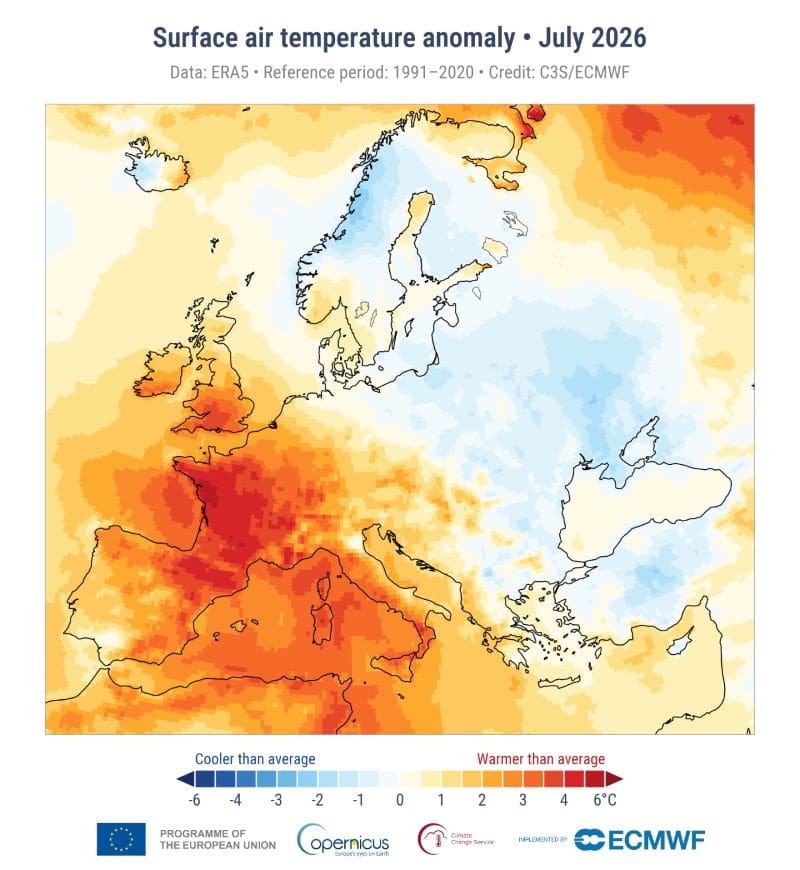
The launch comes after a summer marked by severe heat, low rainfall and widespread drought across parts of Europe. Such conditions can slow plant growth and reduce the amount of carbon dioxide absorbed through photosynthesis, while prolonged water stress can cause vegetation to lose leaves or turn brown.
How FLEX measures plant stress from space
FLEX is intended to reveal changes in plant activity before some of those effects become clearly visible. Rather than relying only on the colour or physical appearance of vegetation, the satellite will measure solar-induced chlorophyll fluorescence, an extremely weak light emitted by plants as part of the photosynthetic process.
“It is methodologically very challenging to measure this weak fluorescence signal emitted by plants. Until now, we simply didn’t have the appropriate sensor technology to do it,” says Alexander Damm-Reiser, Professor of Remote Sensing of Water Systems at UZH.
Plants absorb sunlight for photosynthesis, but not all of that energy is used in the same way. A small fraction is released as fluorescence. The signal is invisible to the human eye and represents only a small proportion of the much stronger sunlight reflected from vegetation, making it difficult to isolate from space.
Its value lies in the connection with photosynthetic activity. Measuring this fluorescence can provide information about how actively plants are photosynthesising and how they are responding to environmental stress, offering researchers information about vegetation function that conventional optical observations cannot provide on their own.

FLEX carries the Fluorescence Imaging Spectrometer (FLORIS), which observes wavelengths between 500 and 780 nanometres. The instrument has particularly fine spectral sampling around oxygen absorption bands, where measurements can help separate the weak fluorescence signal from reflected sunlight.
Damm-Reiser first became involved in preparatory work for FLEX in 2007 while completing his doctorate, joining an international consortium working for ESA. He has been a member of the FLEX Mission Advisory Group since 2016.
“Based on preliminary studies, we showed ESA at each stage of the project that the FLEX mission could be feasible and successful – and what is required for success,” he says.
His research focuses on remote sensing and imaging spectroscopy across terrestrial and aquatic environments. Together with researchers at UZH and the aquatic research institute Eawag, his team develops methods for extracting information about Earth’s surface from remote sensing measurements and validating satellite observations with instruments on the ground.
Before launch, experiments using ground-based equipment and aircraft observations helped researchers assess whether fluorescence could be used to estimate gross primary productivity, a measure of the carbon taken up by plants through photosynthesis, and to detect vegetation stress associated with water shortages.
The work has also extended beyond land. Damm-Reiser and collaborators at Eawag have explored whether FLEX observations could contribute to research on lakes, including measurements of phytoplankton fluorescence and distinguishing between different algae species.
Read also: New method makes satellite data easier to use in biodiversity research
From vegetation fluorescence to global monitoring
FLEX travelled into orbit aboard a Vega-C rocket alongside the Copernicus Sentinel-3C satellite. ESA confirmed that both spacecraft successfully separated from the launcher and established contact with ground control following the 15 September launch.
The mission is expected to operate for three and a half years. FLEX will produce monthly global observations at a spatial resolution of about 300 by 300 metres, allowing scientists to follow changes in vegetation activity across large areas while also examining regional patterns.
For Switzerland, Damm-Reiser expects suitable weather conditions to provide several useful observations each year.
“We will then be able to, for example, estimate the distribution of CO₂ uptake in forests, recognize the development of damage caused by drought at an earlier stage, and study our lakes in even greater detail,” he says.
Researchers expect analysis of the mission’s full dataset to continue for at least three years. The results could eventually inform decisions about whether ESA or another organisation should establish longer-term operational monitoring of global plant photosynthesis.
For scientists studying how ecosystems respond to changing environmental conditions, FLEX adds a new source of information to existing Earth observation data. By measuring vegetation fluorescence from orbit, the mission is designed to reveal changes in photosynthetic activity across forests, croplands and other ecosystems, including signs of plant stress that can emerge before visible damage appears.
Article Source:
Press Release/Material by Melanie Nyfeler | University of Zurich (UZH) & European Space Agency (ESA)
Featured image credit: ESA/ATG medialab | CC BY-SA 3.0 IGO