
Summary:
Rising sea temperatures should, in theory, lead to higher ocean evaporation, yet a recent study published in Geophysical Research Letters has found the opposite: global ocean evaporation has declined over the past decade.
Researchers from the Institute of Geographic Sciences and Natural Resources Research, Chinese Academy of Sciences, analyzed satellite-based ocean heat flux data and discovered that, while evaporation rates increased from 1988 to the late 2000s, this trend has since reversed. The study points to a decline in wind speed — known as “wind stilling” — as a key factor influencing this unexpected shift. Changes in atmospheric circulation patterns, particularly a shift in the Northern Oscillation Index, may be driving this phenomenon.
Lead author Dr. Ning Ma suggests that this decline does not necessarily indicate a weakened hydrological cycle but may instead reflect natural climate variability. The findings challenge conventional assumptions about the relationship between ocean warming and evaporation, underscoring the complexity of Earth’s climate system.
Unexpected decline in global ocean evaporation amid rising sea temperatures
While the physics we learn in the middle school teaches that water evaporates faster when it is heated, a recent study published in Geophysical Research Letters challenges such a conventional expectation about the relationship between global warming and ocean evaporation.
The research team from the Institute of Geographic Sciences and Natural Resources Research, Chinese Academy of Sciences, has uncovered a surprising phenomenon: despite rising sea surface temperatures, global ocean evaporation has actually decreased over the most recent decade.
Ocean evaporation plays a central role in the Earth’s hydrological cycle, accounting for more than 85% of atmospheric water vapor. Historically, higher ocean evaporation rates were expected when sea surface temperature rises. However, recent observations have revealed a puzzling slowdown in the increase of global water vapor since the early 2000s, prompting scientists to re-evaluate how ocean evaporation has changed in response to warming temperatures.
To investigate this phenomenon, the team employed advanced satellite-based ocean heat flux data to examine long-term variations in global ocean evaporation. The findings revealed a shift in recent ocean evaporation trend over the past few decades.
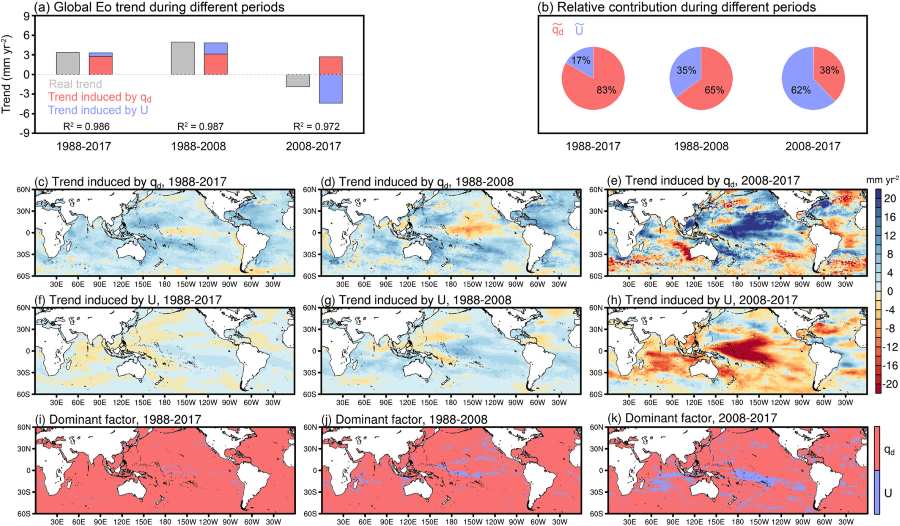
“While global ocean evaporation showed a positive trend from 1988 to 2017, this upward trend reversed in the late 2000s,” said Dr. Ning MA, the lead author of this study. “Since then, two-thirds of the world’s oceans have experienced a reduction in evaporation, leading to a slight decrease in global evaporation rates between 2008 and 2017. This is contrary to what we would typically expect in a warming climate.”
The team identified a key reason behind this unexpected trend: a decline in wind speed, also known as “wind stilling.” Wind stilling, the authors suggest, is likely linked to shifts in atmospheric circulation patterns, particularly the Northern Oscillation Index, which has recently shifted from a positive to a negative phase.
“Wind speed changes may be associated with decadal changes in Earth’s climate variability,” Dr. MA explained. “Recent decreased ocean evaporation may not be interpreted as evidence of a weakened hydrological cycle since it is perhaps a reflection of natural climate oscillations.”
The study emphasizes the need for further research to understand the broader implications of changes in evaporation from saturated surfaces. While the decreasing trend in ocean evaporation may seem counterintuitive in the context of global warming, it highlights the complexity of Earth’s climate system and the intricate feedback mechanisms that shape our planet’s hydrological processes.
Journal Reference:
Ma, N., Zhang, Y., & Yang, Y., ‘Recent decline in global ocean evaporation due to wind stilling’, Geophysical Research Letters 52, e2024GL114256 (2025). DOI: 10.1029/2024GL114256
Article Source:
Press Release/Material by Chinese Academy of Sciences
Featured image credit: wirestock | Freepik