Summary:
A new machine learning method significantly enhances the accuracy of global climate models (GCMs), especially in projecting extreme weather events and their interactions. Published in Scientific Data, the study introduces a technique called Complete Density Correction using Normalizing Flows (CDC-NF), which adjusts multiple variables in climate projections simultaneously. This overcomes limitations in existing bias correction tools, which often struggle to capture complex relationships between temperature, precipitation, and extreme events.
“Global climate models are essential for policy planning, but these models often struggle with ‘compound extreme events,’ which is when extreme events happen in short succession – such as when extreme rainfall is followed immediately by a period of extreme heat,” said Shiqi Fang, first author and research associate at North Carolina State University. “The work we’ve done here addresses all three of those challenges.”
The researchers applied CDC-NF to daily outputs from five widely used CMIP6 models, using NOAA’s nClimGrid-daily data as reference. The method substantially improved error metrics and preserved key cross-variable patterns. “We’re optimistic that this can improve the accuracy of projections used to inform climate adaptation strategies,” said Sankar Arumugam, corresponding author and professor at NC State.
Research improves accuracy of climate models – particularly for extreme events
Researchers have devised a new machine learning method to improve large-scale climate model projections and demonstrated that the new tool makes the models more accurate at both the global and regional level. This advance should provide policymakers with improved climate projections that can be used to inform policy and planning decisions.
“Global climate models are essential for policy planning, but these models often struggle with ‘compound extreme events,’ which is when extreme events happen in short succession – such as when extreme rainfall is followed immediately by a period of extreme heat,” says Shiqi Fang, first author of the paper and a research associate at North Carolina State University.
“Specifically, these models struggle to accurately capture observed patterns regarding compound events in the data used to train the models,” Fang says. “This leads to two additional problems: difficulty in providing accurate projections of compound events on a global scale; and difficulty in providing accurate projections of compound events on a local scale. The work we’ve done here addresses all three of those challenges.”
“All models are imperfect,” says Sankar Arumugam, corresponding author of the paper and a professor of civil, construction and environmental engineering at NC State. “Sometimes a model may underestimate rainfall, and/or overestimate temperature, or whatever. Model developers have a suite of tools that they can use to correct these so-called biases, improving a model’s accuracy.
“However, the existing suite of tools has a key limitation: they are very good at correcting a flaw in a single parameter (like rainfall), but not very good at correcting flaws in multiple parameters (like rainfall and temperature),” Arumugam says. “This is important, because compound events can pose serious threats and – by definition – involve societal impacts from two physical variables, temperature and humidity. This is where our new method comes in.”
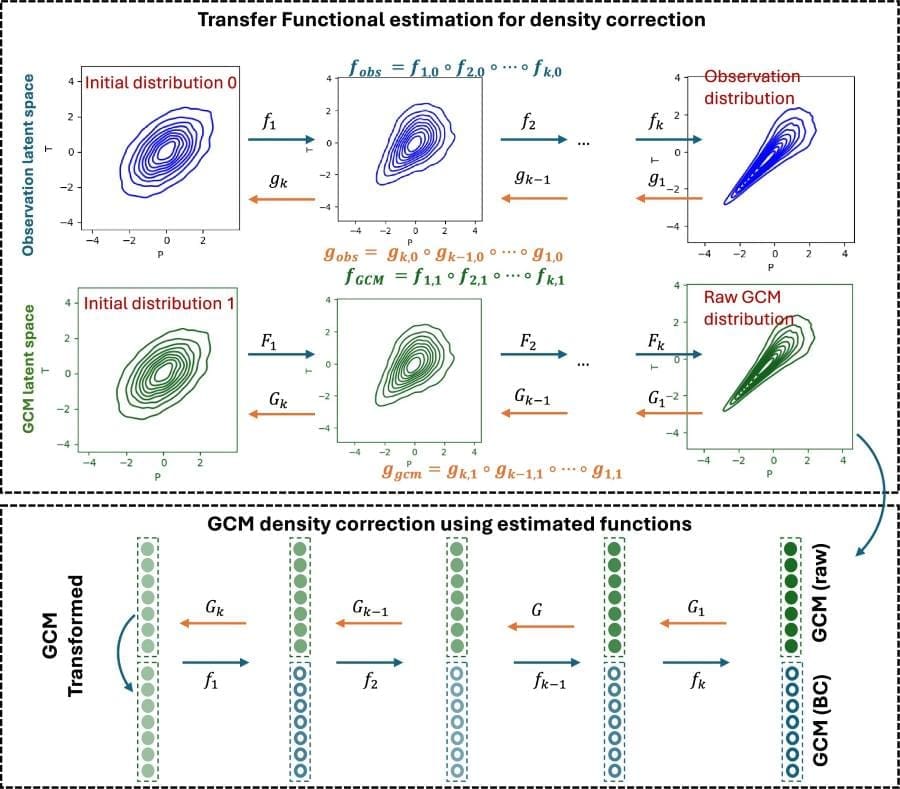
The new method takes a novel approach to the problem and makes use of machine learning techniques to modify a climate model’s outputs in a way that moves the model’s projections closer to the patterns that can be observed in real-world data.
The researchers tested the new method – called Complete Density Correction using Normalizing Flows (CDC-NF) – with the five most widely used global climate models. The testing was done at both the global scale and at the national scale for the continental United States.
“The accuracy of all five models improved when used in conjunction with the CDC-NF method,” says Fang. “And these improvements were especially pronounced with regard to accuracy regarding both isolated extreme events and compound extreme events.”
“We have made the code and data we used publicly available, so that other researchers can use our method in conjunction with their modeling efforts – or further revise the method to meet their needs,” says Arumugam. “We’re optimistic that this can improve the accuracy of projections used to inform climate adaptation strategies.”
The paper was co-authored by Emily Hector, an assistant professor of statistics at NC State; Brian Reich, the Gertrude M. Cox Distinguished Professor of Statistics at NC State; and Reetam Majumder, an assistant professor of statistics at the University of Arkansas.
***
The work was made possible by the National Science Foundation, under grants 2151651 and 2152887.
Journal Reference:
Fang, S., Majumder, R., Hector, E. et al., ‘A Complete Density Correction using Normalizing Flows (CDC-NF) for CMIP6 GCMs’, Scientific Data 12, 1279 (2025). DOI: 10.1038/s41597-025-05478-8
Article Source:
Press Release/Material by Matt Shipman | North Carolina State University (NC State)
Featured image credit: CIRA/NOAA