Flooding along the Aniene River near Tivoli marked one of the most severe impacts of early January weather in the Lazio Region, as intense rainfall caused river levels to rise rapidly and overflow in several locations. The flooding unfolded between 5 and 6 January 2026, prompting escalating warnings from regional and national authorities as saturated ground and swollen waterways increased hydraulic risks across central Italy.
Heavy precipitation affected large parts of Lazio, with the Aniene river basin among the most exposed areas. Localised flooding was reported near Ponte Lucano, within the municipality of Tivoli, as well as further downstream toward eastern districts of Rome. Several roads were closed as a precaution, including sections of Via Tiburtina, while residents in affected zones were advised to limit movement.
In a statement released on 6 January, the Lazio Civil Protection confirmed the seriousness of the situation: “At this time, heavy rainfall is being recorded and, in recent hours, flooding has occurred in several stretches of the Aniene River and its tributaries. In light of this evident hydraulic criticality, the Regional Civil Protection Directorate has declared a red alert for the areas affected by the Aniene river basin.”
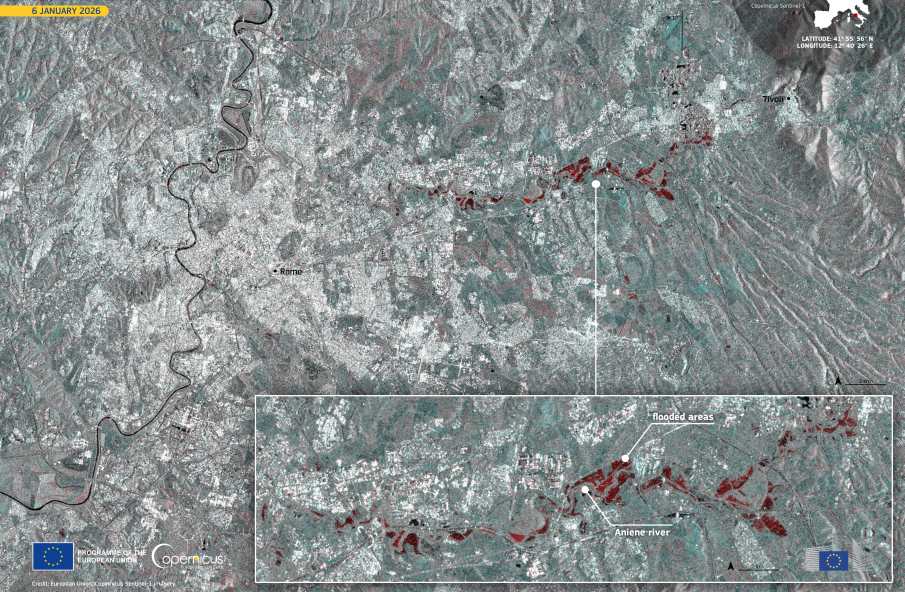
This Copernicus Sentinel-1 image, acquired on 6 January 2026, shows flooded areas along an approximately 15-kilometre stretch of the Aniene River near Tivoli, where the river overflowed in multiple sections following persistent rainfall. The satellite data provides a clear overview of flood extent, supporting authorities in understanding the scale and distribution of the event.
Emergency response measures were coordinated at both regional and national levels. “Together with the Regional Civil Protection Director, Massimo La Pietra, we are in constant coordination with the operations center and the volunteers on site. Therefore, all citizens – especially those in the red zone – are urged to avoid travel in the coming hours and to remain cautious,” said Pasquale Ciacciarelli, Lazio Regional Councilor for Civil Protection.
The Italian Department of Civil Protection activated the Copernicus Emergency Management Service (CEMS) to produce emergency mapping for flood extent and damage assessment. Open data from Copernicus Services and Sentinel satellites continues to support monitoring, response, and recovery efforts in areas affected by flooding.
Featured image credit: European Union, Copernicus Sentinel-1 imagery