Summary:
Large parts of Europe could help strengthen biodiversity, improve climate resilience, and increase carbon storage through carefully planned rewilding efforts, according to a study published in One Earth. Researchers from the German Centre for Integrative Biodiversity Research (iDiv), Martin Luther University Halle-Wittenberg (MLU), and the EU Horizon WildE project developed a climate-smart rewilding framework designed to identify where ecosystem restoration may deliver the strongest combined environmental and societal benefits.
The analysis found that eastern and southern Europe offer the highest overall potential for climate-smart rewilding, while northern regions stand out for their climate adaptation value. Eastern Europe showed particularly strong opportunities for carbon sequestration, whereas western Europe faces greater limitations linked to fragmented landscapes and intensive land use.
Instead of focusing only on carbon capture or species recovery, the framework combines biodiversity restoration with climate adaptation, ecosystem connectivity, tourism opportunities, and possible land-use conflicts such as livestock predation. The researchers also examined trade-offs, including wildfire risks linked to abandoned farmland and expanding vegetation.
The study provides a regional overview of where restoration strategies may align most effectively with Europe’s climate and biodiversity targets while helping policymakers and land managers assess local opportunities and constraints.

— Press Release —
New maps show where European landscapes can advance climate and biodiversity goals together
Across Europe, many landscapes show strong potential to move forward climate mitigation, climate adaptation, and biodiversity benefits, with low socio‑economic risk, according to an analysis using a new climate‑smart rewilding framework published in One Earth.
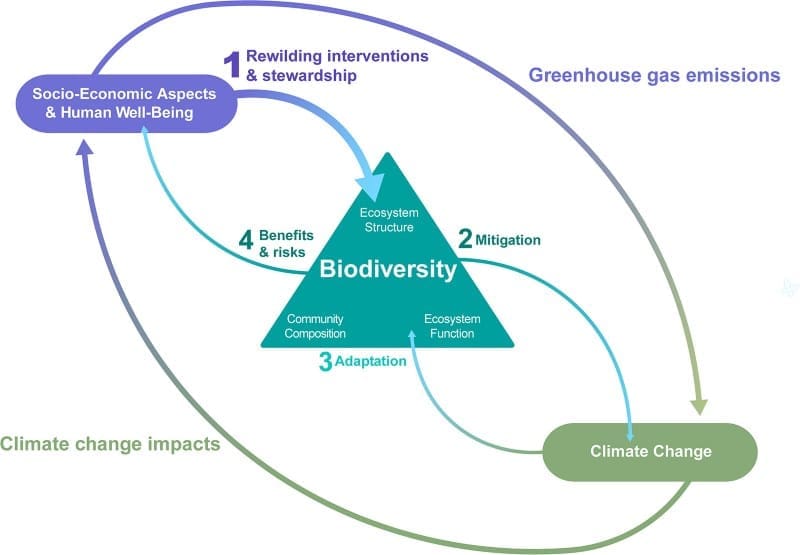
Climate-smart rewilding builds on the core ideas of rewilding – giving nature more space and restoring natural processes – but also includes interventions that consider climate benefits and benefits to communities, so-called ecosystem services.
Rather than identifying a single perfect region, the researchers from the German Centre for Integrative Biodiversity Research (iDiv), the Martin Luther University Halle‑Wittenberg (MLU), and the EU Horizon project WildE noted regional strengths.
Eastern and southern Europe show the highest overall suitability with northern regions standing out for climate adaptation. Parts of eastern Europe offer high climate mitigation potential and western Europe is more constrained due to landscape fragmentation.
“Climate-smart rewilding brings together ecosystem restoration and climate mitigation – two urgent EU priorities that do not always progress at the same pace,” explains lead author Dr Gavin Stark of iDiv and MLU. “We wanted an approach that not only prioritises restoration but also delivers climate mitigation, climate adaptation, and benefits for people.”
For example, in some countries abandoned farmland may boost biodiversity and carbon storage as vegetation recovers – an ecosystem service – but also raises wildfire risk, highlighting how climate benefits can create ecological and management trade‑offs. A possible climate-smart rewilding intervention could be to manage vegetation through natural grazing by reintroduced or free‑ranging herbivores, or through controlled livestock grazing, both of which can reduce the buildup of dry biomass that fuels wildfires.
Bridging people, biodiversity, and the climate
It is no secret that carbon-first strategies can often sideline biodiversity progress and biodiversity interventions may be slower to deliver mitigation. For instance, fast-growing monoculture forests can store carbon more quickly than diverse forests, but they also support far fewer plant and animal species.
The climate-smart rewilding framework helps harmonise multiple objectives – noting where they naturally reinforce each other and where targeted interventions can allow for them to be pursued together, according to the authors.
Another example from the study identifies connectivity hotspots in the Baltic States, Finland, and parts of Sweden where restoring ecological corridors, that would allow animals to move more freely in response to climate change, support both biodiversity recovery and climate adaptation. However, careful planning is needed to balance these measures with agricultural, forestry, or regional development priorities.
“Climate-smart rewilding moves beyond single goal ecological restoration approaches that focus either in climate change or biodiversity change alone, and therefore often have undesirable side effects. Climate-smart rewilding addresses multiple objectives together delivering more benefits for nature and people,” explains senior author Prof Dr Henrique Pereira of MLU and iDiv. “It helps practitioners and decisionmakers see which interventions could have the most impact when implemented in the right regions”.
The authors note that the framework’s performance is always context‑dependent, requiring adjustments to the appropriate spatial scale and local conditions.
The framework and spatial outputs can be accessed through the WildE website, the WildE Knowledge Hub, and soon in the EBV Data Portal. All data and code needed to reproduce the maps will also be available on Zenodo, enabling practitioners, researchers, policymakers, and land managers to explore regional opportunities, adapt the analyses to their own planning contexts, and apply the framework to other conservation and restoration questions.
Journal Reference:
Stark, G., Weissgerber, M., Fernández, N., Quintero-Uribe, L. C., Giergiczny, M., Poulsen, N. R., Villar, N., Mols, B., Bakker, E. S., Smith, A. M., Winkel, G., Alagador, D., Rey-Benayas, J. M., Espelta, J. M., Selwyn, M., Brotons, L., Kluvankova, T., Brnkalakova, S., Kloibhofer, J., Prestele, R., Smith, H. G., Lázaro-González, A., Buitenwerf, R., Pearce, E. A., Svenning, J.-C., Santana, J., Beja, P., Moreira, F., Wunder, S., Svoboda, M., Vancura, V., Arneth, A., Hampe, A., & Pereira, H. M., ‘Toward climate-smart rewilding: An integrated framework for biodiversity, climate change, and society’, One Earth online ver. (2026). DOI: 10.1016/j.oneear.2026.101704. Also available on ScienceDirect.
Article Source:
Press Release/Material by Volker Hahn | German Centre for Integrative Biodiversity Research Halle-Jena-Leipzig (iDiv)
Featured image credit: Andrzej Kułak | Pixabay