Summary:
Global warming is increasing the risk of dangerous heat exposure during the Tour de France, according to a study published in Scientific Reports. Researchers examined meteorological records from 12 locations regularly included in the race between 1974 and 2023 to determine how often conditions reached levels considered hazardous for athletes.
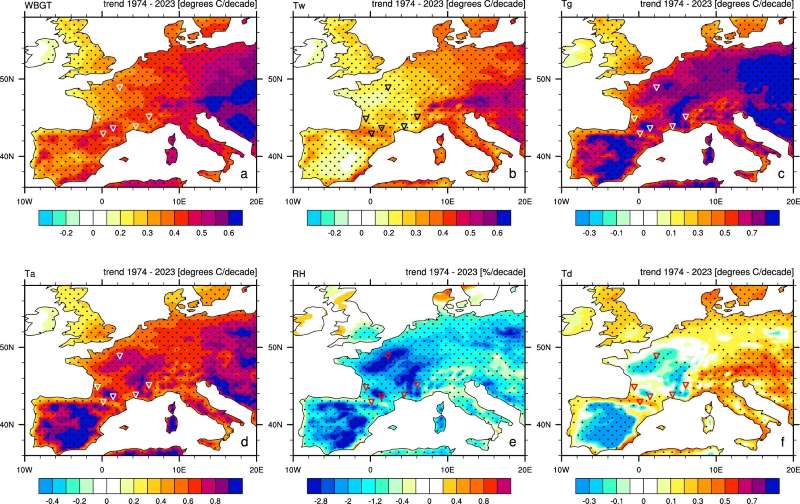
The team used the Wet Bulb Globe Temperature (WBGT), a composite index that combines air temperature, humidity, wind and solar radiation to estimate heat stress. Their analysis shows that July heat stress values have risen steadily across France, with the past decade recording the highest number of extreme heat episodes.
So far, race dates have narrowly avoided the most critical thresholds. In Paris, for example, high-risk levels above 28 °C on this scale were recorded five times in July over the past 50 years, four since 2014, but not on the day of a stage finish. Southwestern cities such as Toulouse, Pau and Bordeaux, along with Nîmes and Perpignan, show the most frequent episodes. The authors conclude that more frequent heatwaves could soon challenge existing safety protocols.
— Press Release —
Global warming and heat stress risk close in on the Tour de France
The progressive rise in temperatures poses a growing threat to the staging of summer sporting events in Europe and, more specifically, to the Tour de France, due to the increasing risk of heat stress for athletes. This is one of the conclusions of a study published in Scientific Reports, which analysed climate data associated with more than 50 editions of the French race.
The research was led by the French National Research Institute for Sustainable Development (IRD) within the European project TipESM, in collaboration with institutions such as the London School of Hygiene & Tropical Medicine (LSHTM) and the Barcelona Institute for Global Health (ISGlobal), a centre supported by the ”la Caixa” Foundation.
The aim of the newly published study was to assess under which heat stress risk levels the Tour de France has taken place at different locations and dates between 1974 and 2023. The results show that, at the times and places where the race is held, heat stress risk has increased steadily over the years, with the most recent decade accumulating the highest number of extreme heat episodes. Despite this trend, the Tour has so far managed to avoid conditions of maximum health risk, in some cases by only a matter of days or tenths of a degree.
An ‘extremely fortunate’ race
“In our analysis, we observe that the city of Paris, for example, has crossed the high-risk threshold for heat on five occasions in July, four of them since 2014. Other cities have experienced many days of extreme heat in July, but thankfully not on the date of a Tour de France stage,” explains Ivana Cvijanovic, researcher at IRD and first author of the study.
“In a way, we can say that it is an extremely fortunate race, but with record-breaking heatwaves becoming more frequent, it is only a matter of time before the Tour encounters extreme heat stress day that will test existing safety protocols,” she adds.
Regions at higher risk
The researchers found that episodes of dangerous heat levels have been most common around Toulouse, Pau and Bordeaux in southwestern France, and around Nîmes and Perpignan in the southeast. They also warn that locations such as Paris and Lyon are increasingly crossing the high-risk heat threshold, becoming new heat stress hotspots. “Extra caution should be exercised when planning stages in these regions,” says Desislava Petrova, researcher at ISGlobal.
By contrast, classic mountain stage locations such as the Col du Tourmalet and Alpe d’Huez have historically remained within low to moderate heat stress risk thresholds, with no recorded episodes of extreme heat risk to date.
Regarding the time of day, the analysis shows that morning hours remain the safest part of the day, while high heat stress levels can persist until late in the afternoon.
These patterns highlight the need to adapt schedules, routes and safety protocols in order to reduce risks for both cyclists and event staff and spectators.
Heat, a growing risk for all sports
In this study, the researchers use the Tour de France to illustrate the broader challenge that rising temperatures driven by climate change pose to the organisation of summer sporting events, particularly in elite sport.
Heat not only affects athletic performance but can also pose a serious risk to athletes’ health. For this reason, the Union Cycliste Internationale (UCI), like FIFA and other international sports federations, has implemented safety protocols that assess heat risk and trigger protective measures, such as hydration or cooling breaks in football. However, each federation defines its own risk thresholds, and no universal standard currently exists across sports.
The need for physiological data to refine risk assessment
“Science still has many unanswered questions about how the human body responds to heat, and even more so in the case of elite athletes, who face sustained physical exertion while also having physical conditioning and training levels well above those of the general population,” says James Begg, researcher at Galson Sciences. “To investigate sport-specific vulnerabilities, we would need access to anonymised physiological data that would allow us to go beyond heat indices alone.”
Methodology
Many heat safety protocols used by international sports federations are based on a heat index known as the Wet Bulb Globe Temperature (WBGT), which combines several meteorological variables – including air temperature, relative humidity, solar radiation and wind – to estimate heat-related health risk.
To conduct the study, the research team retrieved historical meteorological records for 12 locations frequently visited by the Tour de France, as well as for all July dates corresponding to the different editions of the race. Using these data, they calculated WBGT values and analysed the occasions on which the high-risk category in the UCI protocol (above 28 °C WBGT) was reached.
Journal Reference:
Cvijanovic, I., Begg, J.D., Mistry, M.N. et al., ‘The future of European outdoor summer sports through the lens of 50 years of the tour de France’, Scientific Reports 16, 2644 (2026). DOI: 10.1038/s41598-025-30129-8
Article Source:
Press Release/Material by Barcelona Institute for Global Health (ISGlobal)
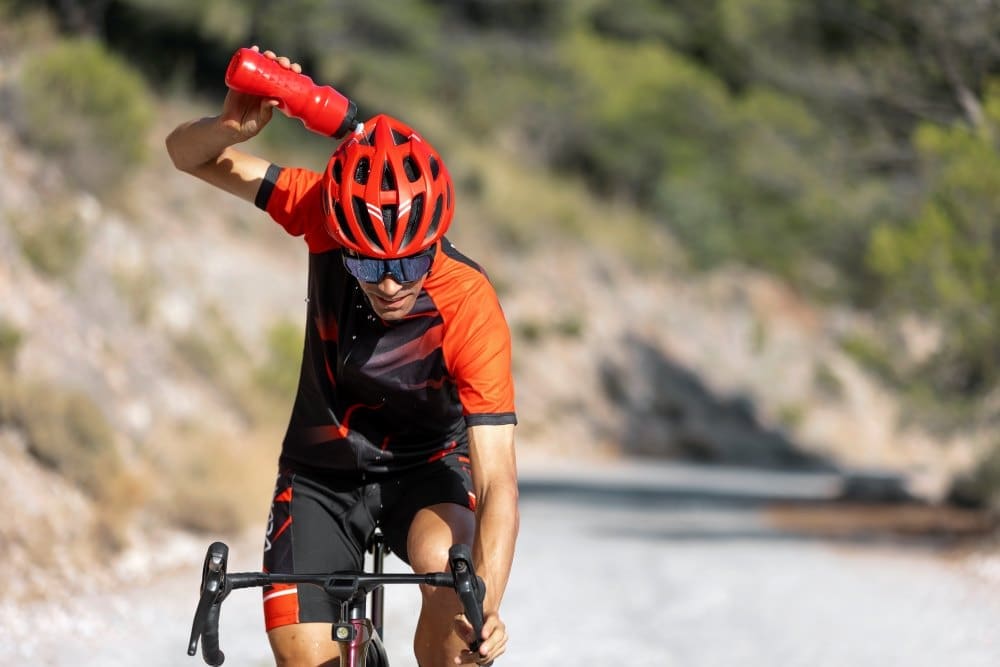
Featured image credit: Freepik