AFP | WWA | Muser NewsDesk
Human-driven climate change intensified torrential downpours that killed dozens and forced thousands of people from their homes across Spain, Portugal and Morocco earlier this year, a network of climate scientists said Thursday.
Precipitation during the region’s wettest days now entail around one-third more rainfall compared with the pre-industrial climate, which was 1.3 °C cooler, according to a report by the World Weather Attribution (WWA), whose scientists study the link between extreme weather events and climate change.
Nine storms unleashed torrential rain and hurricane-force winds across the three countries from 16 January to 17 February, killing more than 50 people and forcing over 200,000 to flee their homes, mostly in Morocco.
Grazalema, one of the hardest-hit municipalities in southern Spain, saw more than a full year’s expected rainfall in just a few days, according to the WWA.
Videos on social media showed residents breaking through the walls of their homes to drain water and prevent further flooding damage.
The volume of rainfall in places like Grazalema is “staggering”, said David Garcia-Garcia, a climate scientist at the University of Alicante and study co-author, calling it a “massive shock” to infrastructure and soil.
The WWA estimates that rainfall intensity is now about 11 percent higher in northern Portugal and northwestern Spain than in pre-industrial times.
The researchers were unable to quantify the exact impact of climate change on rainfall in southern Iberia and northern Morocco, as the available data show regional variations.
“This is exactly what climate change looks like: weather patterns that used to be more manageable are now turning into more dangerous disasters,” said Friederike Otto, a climate scientist at Imperial College London who also worked on the study.
A “blocked” high-pressure system over Scandinavia and Greenland channelled “storm after storm” towards western Europe, resulting in wetter-than-usual conditions, according to the study.
Abnormally warm Atlantic waters west of the Iberian Peninsula “supercharged” the storms with moisture, it added.
The WWA is a pioneer in attribution science, which uses peer-reviewed methods to quickly assess the possible influence of climate change on extreme weather events.
This allows a comparison of a drought or flood today against simulations that consider the climate before the industrial revolution of the 1800s and the smass foss fuel burning that came with it.
The study looked at weather data — in this case the most extreme one-day rainfall events in the three nations — and extrapolated trends back to the pre-industrial era to see how this type of event has changed over time.
ds/mdm/cc
© Agence France-Presse
Key Findings:
- Early warnings were issued across all three countries, enabling authorities to take timely action. Evacuations were carried out, where proactive measures helped limit the impact on communities at risk. As a result, the death toll remained low. While any loss of life is one too many, the combination of advance warning and decisive response significantly reduced the overall human cost of the event.
- Densely populated urban centres, particularly where tourism-driven development has expanded into floodplains, as well as highly exposed, low-lying, sandy and eroding coastal towns, faced particularly high levels of exposure. In Morocco, high exposure was further compounded by social vulnerability, with a number of people living in informal settlements where housing quality, infrastructure and access to services are often limited. These underlying exposure and vulnerability factors significantly increased the potential for impacts when the hazard occurred.
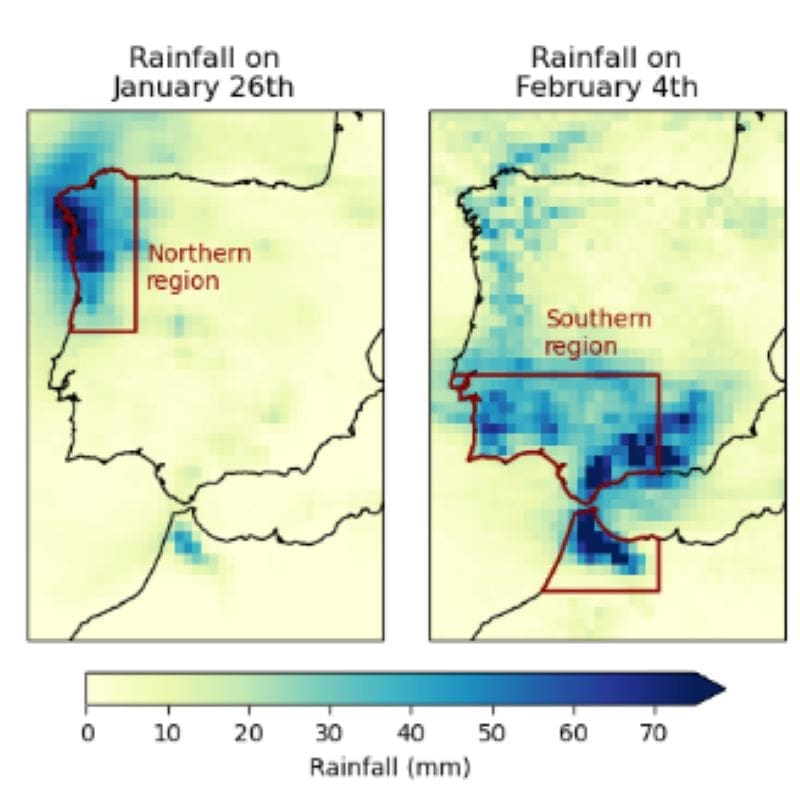
- Nine named storms have occurred since mid-January across the Mediterranean, affecting parts of both study regions. However, the overall return period of the Rx1day event over the two larger regions is not exceptionally high, at around 40 years in the southern region and approximately 5 years in the northern region. In contrast, at local scales the event corresponds to a much rarer occurrence, with return periods well in excess of 100 years.
- To estimate if human induced climate change influenced heavy rainfall over the region we first determine if there is a trend in gridded observations in Rx1day in both regions. Over the observational record since 1950, the intensity of the event shows an increase of about 36% in the southern region and approximately 29% in the northern region. In addition, variability associated with the North Atlantic Oscillation further amplifies extreme daily rainfall in the southern region, contributing an additional 5% to Rx1day intensity. In the northern region this influence is very small, with just about 2% increase in intensity.
- To assess the extent to which the observed changes can be attributed to human-induced climate change, we combine observational evidence with climate model simulations. While observations indicate an increase in intensity, the models in the southern region do not reproduce this trend. In the northern region, while the modelled trend is weaker, the difference between modelled and observed trends is smaller, with a combined increase in intensity of about 11%.
- Analysis of the atmospheric circulation from 4 February 2026 reveals a familiar North Atlantic pressure dipole, with lower sea-level pressure over the North Atlantic and northern Europe, and higher pressure over the subtropics and the Mediterranean. This pattern is associated with high precipitation across northern and northwestern Europe. The spatial structure of the event resembles similar circulation patterns found in the historical data considered, but they are weaker in magnitude compared to the 2026 event, highlighting no apparent trend, but that 2026 had a much less stable atmosphere and high moisture availability, leading to high winds and high rainfall.
- An additional analysis estimating how the number of heavy rainfall events above a threshold has changed shows indications of an increase in the number of the most extreme events, particularly in the northern region. However, the results are highly dependent on the exact region and dataset chosen.
- In summary, while all lines of evidence are highly uncertain, especially in the southern region, and exact numbers strongly depend on the region and dataset chosen, they point towards an increased intensity of especially the most extreme heavy rainfall events.
- Despite all countries having shown progress in strengthening disaster management systems at varying degrees, there is still a need to better align national and municipal level early warning and response systems and capacity building at local level.
- To reduce future flood risks, routinely updated disaster risk information needs to combine vulnerability assessments, exposure mapping and future climate projections. Planning decisions should then embed and enforce risk reduction across land-use planning, building codes, and infrastructure investment decisions.
- Long-term impacts of the current floods can also be reduced if response and early-recovery measures are timely and properly implemented. For example, assessing structural damage to homes, schools, roads and public buildings, safe contaminant clean-up and disposal, water and waste management system rehabilitation, preventive measles vaccination in displacement camps, among others.
Journal Reference:
Barnes, C. et al., ‘Increasingly severe rainstorms put people and structures built on floodplains at risk’, WWA scientific report 83, World Weather Attribution (2026). DOI: 10.25560/128108
Article Source:
Press Release/Material by AFP & World Weather Attribution (WWA)
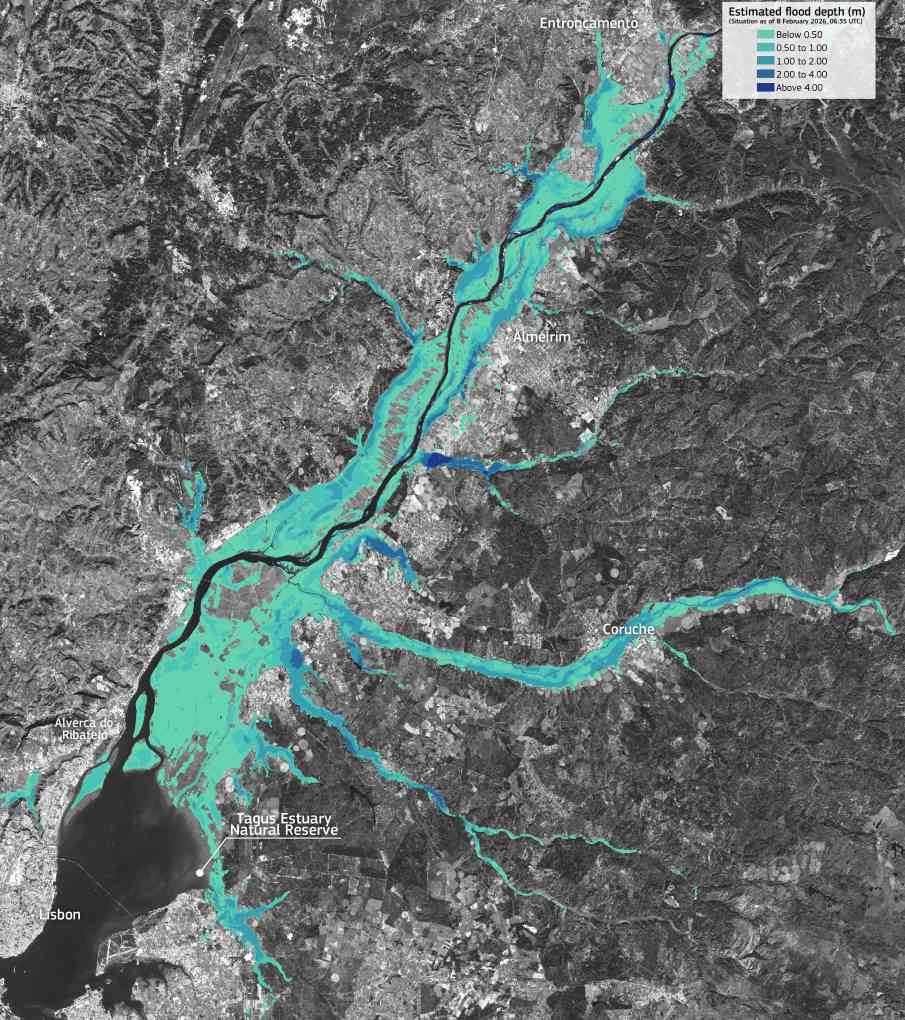
Featured image: Floodwaters along Tagus River, Portugal. credit: European Union, Copernicus Emergency Management Service