

Explore the latest insights from top science journals in the Muser Press roundup (April 10, 2026), featuring impactful research on climate change challenges.
In brief:
— Press Release —
The forest for the trees: Why mass planting doesn’t always lock away soil carbon
Planting trees is widely championed as a straightforward, nature-based fix for global warming. The logic seems foolproof: expanding forests should pull more carbon dioxide from the air and pack it safely into the earth. However, a sweeping five-decade analysis of land transformation in Kerala, India, suggests the reality beneath the surface is full of unexpected trade-offs.
Published in the journal Carbon Research, the study was spearheaded by corresponding author V. K. Dadhwal at the School of Natural Sciences & Engineering, National Institute of Advanced Studies in Bengaluru. His team utilized advanced machine learning to map how half a century of plantation expansion actually impacted the dirt itself. Their findings challenge a popular assumption, proving that massive afforestation campaigns do not automatically equal a massive boost in soil organic carbon (SOC).
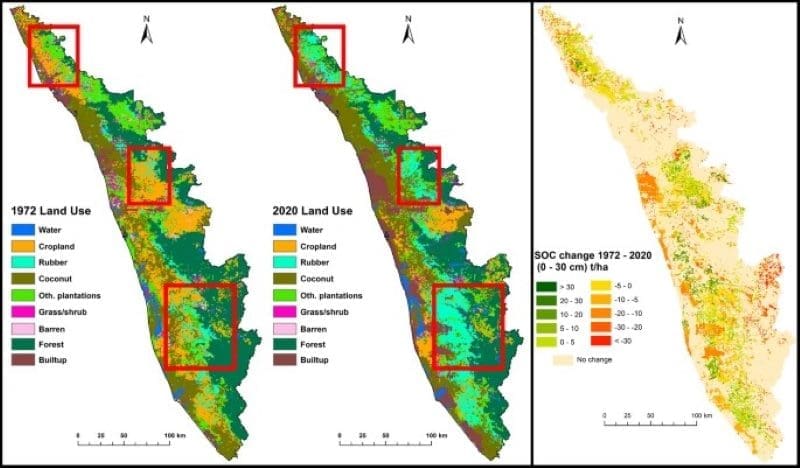
To accurately track the landscape from 1972 to 2020, the research team moved beyond traditional area-based counting. They fed a Random Forest predictive model with detailed historical land use maps, legacy soil measurements, local climate data, and topographic variables. This high-resolution approach allowed them to pinpoint specific geographical hotspots where carbon was either successfully sequestered or silently lost.
The data painted a surprising picture of ecological balancing acts. While tree cover across the region expanded significantly over the fifty years, the overall size of the soil carbon pool barely budged, showing a marginal net change of just around 2%.
Why did the numbers flatline? The analysis showed that the carbon gained in certain newly forested areas was entirely canceled out by carbon leaking from other regions. The net impact on the ground depends heavily on the specific type of commercial plantation being grown and the previous state of the land. For instance, converting a naturally rich ecosystem into a monoculture tree farm might actually deplete the existing underground carbon reserves rather than build them up.
As governments and corporations heavily invest in tree-planting initiatives to meet climate mitigation targets, the spatial modeling out of the National Institute of Advanced Studies serves as a vital cautionary tale. It emphasizes that accurate climate accounting requires looking at the exact type of plantation and the historical soil profile, rather than simply celebrating a greener map.
By demonstrating that land use and original soil type are the ultimate predictors of carbon storage, Dadhwal’s work provides a much-needed, data-driven reality check for designing truly effective regional and national climate inventories.
Journal Reference:
Kandadai, S., Dadhwal, V.K. & Rajasekaran, E., ‘Spatiotemporal dynamics of soil organic carbon stocks due to plantation expansion and other land use changes in Kerala, India (1972–2020)’, Carbon Research 5, 22 (2026). DOI: 10.1007/s44246-026-00263-7
Article Source:
Press Release/Material by Biochar Editorial Office | Shenyang Agricultural University (SYAU)
— Press Release —
Hidden ocean feedback loop could accelerate climate change
The world’s oceans may be quietly amplifying climate change in ways scientists are only beginning to understand.
In a new study published in the journal Proceedings of the National Academy of Sciences, University of Rochester scientists – including Thomas Weber, an associate professor in the Department of Earth and Environmental Sciences, and graduate student Shengyu Wang and postdoctoral research associate Hairong Xu in Weber’s lab – uncovered a key mechanism behind methane production in the open ocean. Their research indicates that this mechanism could intensify as the planet warms, providing an alarming feedback loop for global warming.
Methane is a powerful greenhouse gas, and for decades scientists have puzzled over a paradox: surface ocean waters consistently release methane into the atmosphere, even though surface water is rich in oxygen. Traditionally, methane production has been associated with oxygen-free environments, such as wetlands or deep sediments.
Weber’s team set out to solve this puzzle using a global dataset and computer modeling. Their findings point to a specific microbial process that is responsible for methane production in the ocean environment: certain bacteria generate methane as a byproduct when they break down organic compounds, but they only do this when the nutrient phosphate is scarce.
“This means that phosphate scarcity is the primary control knob for methane production and emissions in the open ocean,” Weber says.
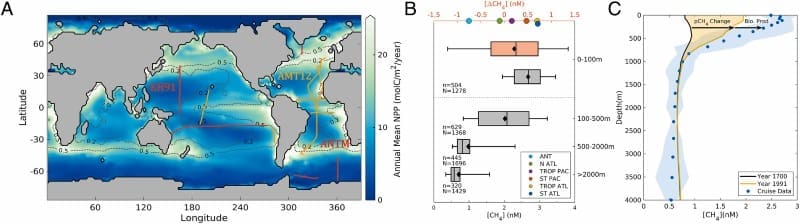
The findings reframe how scientists understand methane production in the ocean. Rather than being a rare or unusual process, methane production in oxygen-rich environments may be widespread in regions where phosphate is limited.
But the study extends further than explaining marine methane production in the present – it also offers a troubling glimpse into the future.
“Climate change is warming the ocean from the top down, increasing the density difference between surface and deep waters,” Weber says. “This is expected to slow the vertical mixing that carries nutrients like phosphate up from depth.”
According to the team’s model, with less vertical mixing, surface waters could become increasingly nutrient-starved, creating ideal conditions for methane-producing microbes to thrive.
The result, Weber warns, would be more methane released from the ocean into the atmosphere. Because methane is such a potent greenhouse gas, this creates the potential for a harmful feedback loop: warming oceans lead to more methane emissions, which in turn drive further warming.
The findings highlight how even processes occurring at the microscopic level in the ocean can have global consequences.
Crucially, this feedback is not currently included in major climate projection models. As researchers continue to refine climate models, incorporating feedbacks such as this may be essential for accurately predicting the pace and scale of future climate change.
“Our work will help fill a key gap in climate predictions, which often overlook interactions between the changing environment and natural greenhouse gas sources to the atmosphere,” Weber says.
Journal Reference:
S. Wang, H. Xu, & T.S. Weber, ‘Phosphate scarcity governs methane production in the global open ocean’, Proceedings of the National Academy of Sciences U.S.A. 123 (12): e2521235123 (2026). DOI: 10.1073/pnas.2521235123
Article Source:
Press Release/Material by Lindsey Valich | University of Rochester
— Press Release —
Tiny plankton have big impact on harmful algal bloom predictions
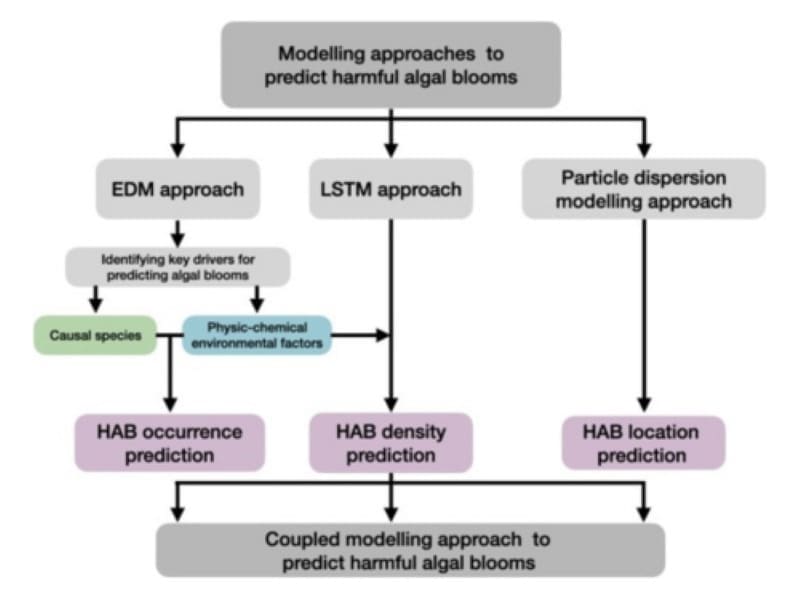
Harmful algal blooms (HABs) – responsible for environmental damage, mass fish die-offs, economic downfalls, and even human deaths – are increasing in frequency and severity as the Earth warms. While some computer models can forecast potential blooms, their accuracy is limited by the number of algae species that can bloom harmfully under different environmental triggers, as well as how different species may overlap with one another. However, an international team has demonstrated that coupling three models and accounting for how different algae species interact can significantly improve predictions.
The researchers, led by Fumito Maruyama, a professor with the Center for Planetary Health and Innovation Science at Hiroshima University’s The IDEC Institute, published their work in the March issue of Ecological Informatics.
“Harmful algal blooms are like ecological conversations, where species interactions and environmental signals continuously shape outcomes, rather than being driven by a single dominant factor,” Maruyama said. “This study shows that integrating physical processes, ecological interactions, and machine learning approaches can improve prediction accuracy. Hybrid, context-specific modeling frameworks offer a more robust way to understand and forecast harmful algal blooms across environments.”
$1B lost to harmful algal blooms in the past decade
Algae, minuscule plants, are a key part of marine ecosystems, serving as food for plankton and other water life. Heat or excessive nutrients from fertilizer runoff can trigger the algae to grow out of control, which depletes oxygen in the water and knocks the fragile ecosystem out of sync. This has led to major economic impact in Chile, the world’s second-largest producer of salmon and one of the largest exporters of mussels. Harmful algal blooms have plagued the country in recent decades, with an estimated loss of $1 billion in the last 10 years alone, the researchers said.
“Fish and shellfish farmers are more likely to benefit from short-term harmful algal bloom forecasts of one or two weeks, as the ability to plan and close fish cages in advance of a bloom can protect their stock and increase profitability,” Maruyama said. “However, there is a trade-off: False positive predictions can lead to premature harvesting and loss of revenue.”
The Science and Technology Research Partnership for Sustainable Development – Monitoring of Algae in Chile (SATREPS-MACH) project evolved from a collaborative effort between Chile and Japan, which relies on Chile for three-quarters of its salmon imports, to improve the understanding and prediction of algal blooms to prevent food waste.
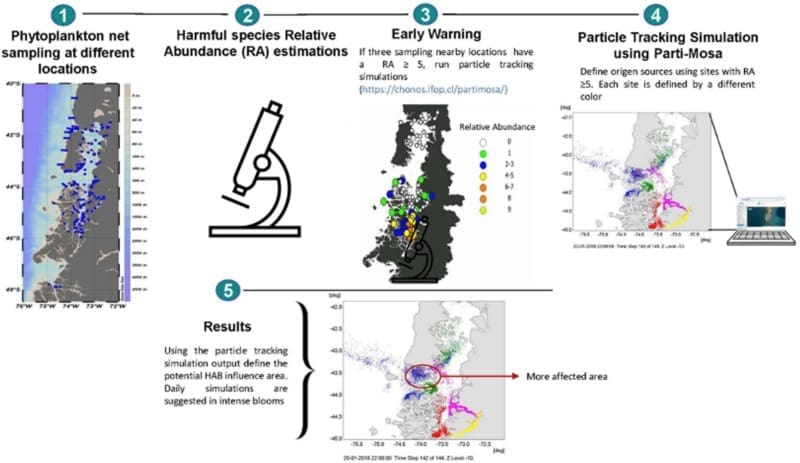
Maruyama explained that, in this study, the team presented and evaluated three models developed under SATREPS-MACH. The first model, Parti-MOSA, simulates the physical movement of algae through specific environments, accounting for weather and other factors. The second is an artificial intelligence model based on long short-term memory, meaning it continues to learn and remember based on accumulated data, so with more data, it can better understand how different factors will influence behaviors. The third is an empirical dynamic model that incorporates long-term community data to predict how things change depending on factors interacting.
Accounting for plankton interactions sharpened forecast accuracy
Using more than 30 years of observational data from three environmentally different sampling sites around Chile, with a focus on two specific plankton species groups, the researchers evaluated how closely the models predicted the harmful algal bloom species dynamics. Model performance varied across the locations and algae species, but when the researchers included interaction among plankton species in their model data, prediction accuracy significantly improved.
“Individual models can capture important aspects of harmful algal bloom dynamics, but each has limitations,” Maruyama said, explaining that the individual models cannot account for how environmental conditions and plankton species interactions influence harmful algal bloom dynamics. “Together, these models address critical gaps in forecasting harmful algal bloom dynamics in the highly complex and understudied Chilean Patagonian environment. This study shows that integrating physical processes, ecological interactions, and machine learning approaches can improve prediction accuracy.”
Next, the researchers said they plan to refine the approach by incorporating additional environmental variables and extending the frameworks to broader regional contexts, including coastal systems in Japan.
“Ultimately, our goal is to develop reliable, operational harmful algal bloom forecasting tools for effective early warning and risk reduction,” Maruyama said.
Maruyama is also affiliated with Hiroshima University’s Center for HOlobiome and Built Environment. In addition to Maruyama, other authors affiliated with Hiroshima University are: Ishara Uhanie Perera, So Fujiyoshi, Kyoko Yarimizu, and Milko A. Jorquera.
Other authors are Daiki Kumakura and Shinji Nakaoka, Graduate School of Life Science at Hokkaido University in Japan; Carolina Medel and Pablo Reche, Instituto de Fomento Pesquero, CTPA Putemún, Chile; Osvaldo Artal and Jacquelinne J. Acuña, Universidad de La Frontera, Chile; Oscar Espinoza-González and Leonardo Guzman, Instituto de Fomento Pesquero, Centro de Estudios de Algas Nocivas, Chile; Felipe Tucca and Alexander Jaramillo-Torres, Instituto Tecnológico del Salmón, Chile; Satoshi Nagai, Coastal and Inland Fisheries Ecosystems Division, Fisheries Technology Institute, Japan Fisheries Research and Education Agency.
Perera is also affiliated with Yamaguchi University, Japan; Fujiyoshi with Toyama Prefectural University, Japan; Kumakura with RIKEN, Japan; Artal with University de Concepción, Chile; Jorquera with Universidad de la Frontera; and Nakaoka with Hokkaido University.
***
The Japan Society for the Promotion of Science, and the Science and Technology Research Partnership for Sustainable Development supported this work.
Journal Reference:
Ishara Uhanie Perera, So Fujiyoshi, Daiki Kumakura, Carolina Medel, Kyoko Yarimizu, Osvaldo Artal, Pablo Reche, Oscar Espinoza-González, Leonardo Guzman, Felipe Tucca, Alexander Jaramillo-Torres, Jacquelinne J. Acuña, Milko A. Jorquera, Shinji Nakaoka, Satoshi Nagai, Fumito Maruyama, ‘A prototype coupled modeling approach for predicting harmful algal blooms: A case study in Chile’, Ecological Informatics 94, 103615 (2026). DOI: 10.1016/j.ecoinf.2026.103615
Article Source:
Press Release/Material by Hiroshima University
Featured image credit: Freepik (AI Gen.)